日本語で読む | This is the English version of a bilingual article.
Today’s Pairing
- Craft beer: Shonan Beer Pilsner — 100% pilsner malt, Czech Saaz and New Zealand hops, 5.0% ABV, 24 IBU, unfiltered and unpasteurized / Kumazawa Brewing Co. (Kagawa, Chigasaki City, Kanagawa)
Official site: https://kumazawa.jp/sake-beer/shonan-beer/ - Music: “Kibo no Wadachi” by Southern All Stars (1990)
YouTube: https://www.youtube.com/watch?v=9tLG5gP4Vz4
▶ If the player above doesn’t play, open it on YouTube
The Story of the Brewery
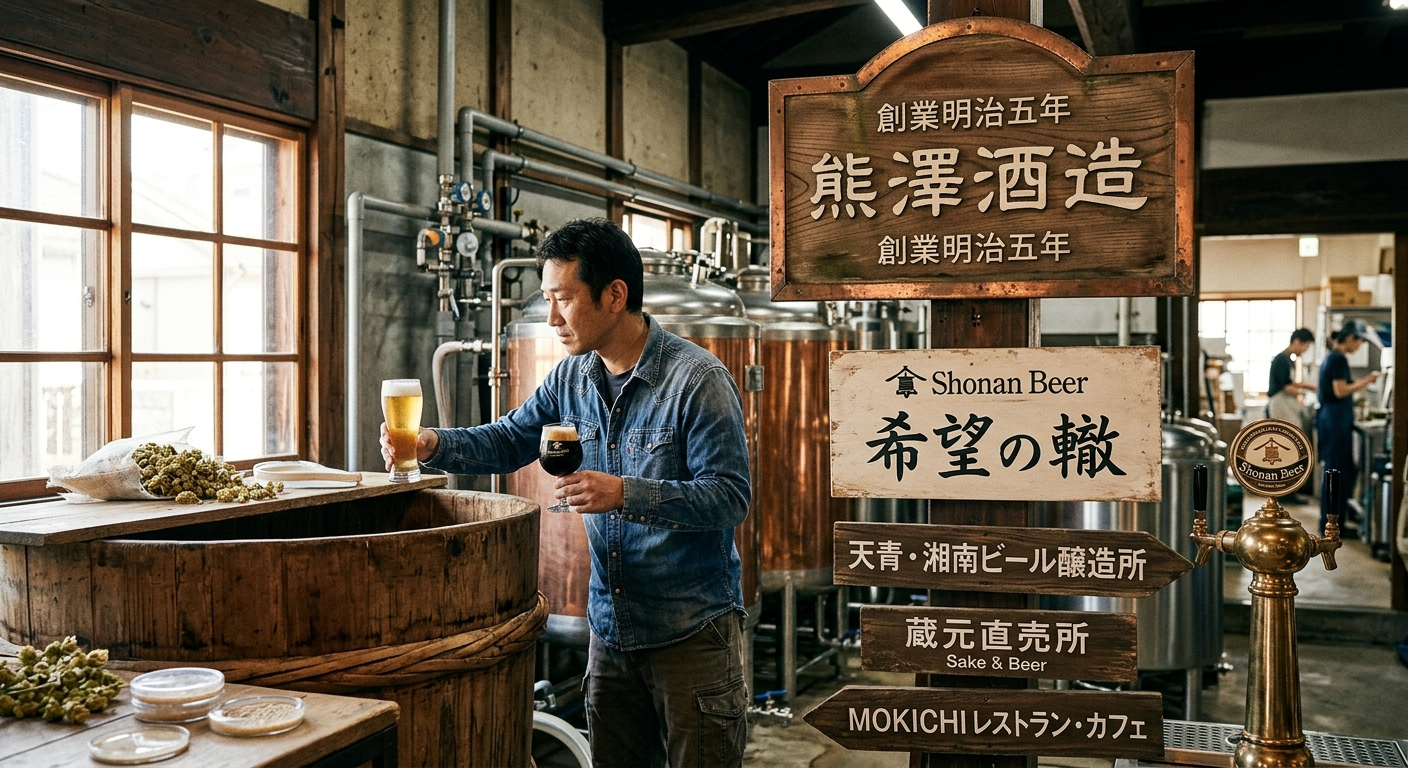
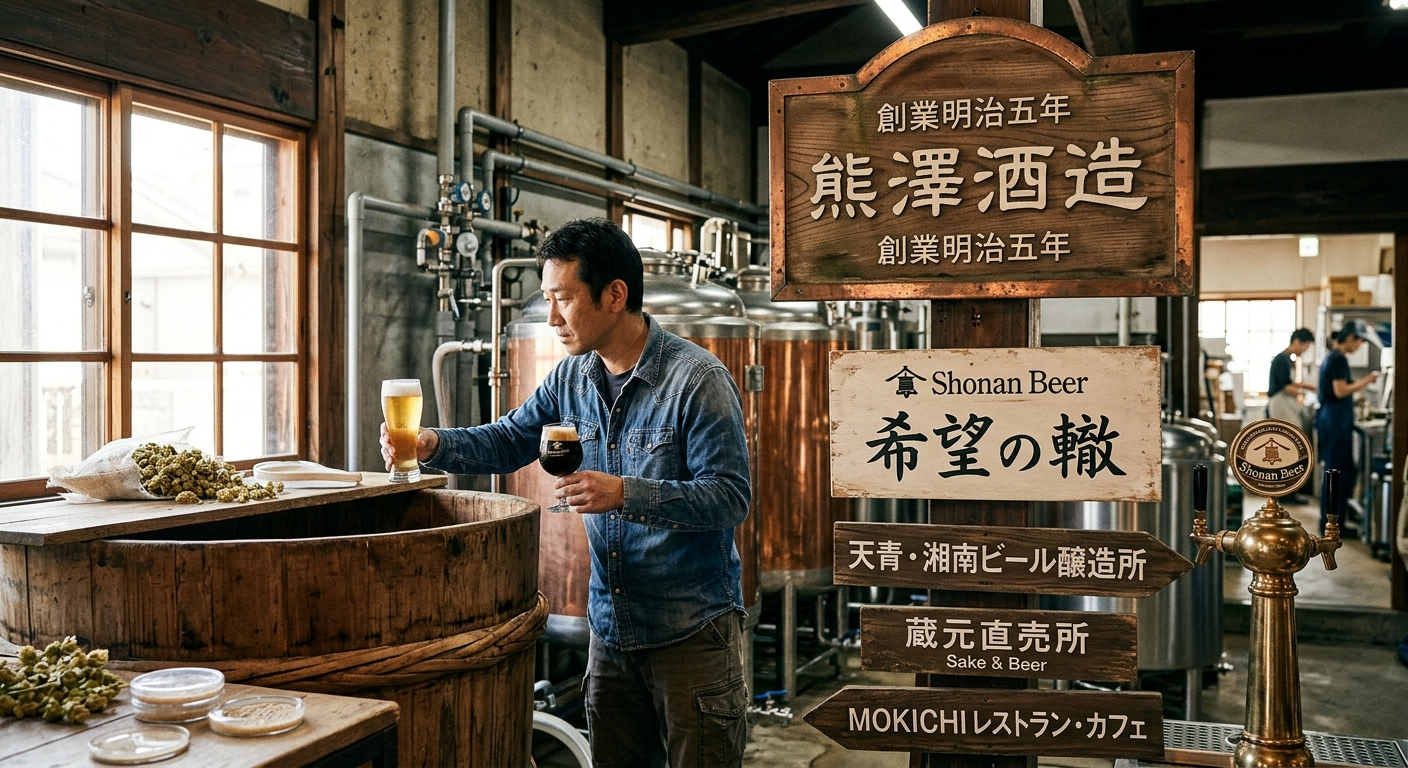
Kumazawa Brewing was founded in 1872 as a sake brewery, and still calls itself “the last brewery left in Shonan.” By the early 1990s it was close to shutting down. Shigekichi Kumazawa returned as the sixth-generation owner in 1993, at the age of twenty-four. At that point the brewery’s main output was cheap, mass-produced sake, and it carried a reputation as the local budget label.
Rebuilding the sake would take years. The question was how the brewery would survive in the meantime — and what it would do during the summer, since sake brewing is winter work. The answer was a phrase that was still unfamiliar in Japan at the time: craft beer. Kumazawa brought in a German brewer, and after a good deal of trial and error, Shonan Beer launched in 1996, among the very first craft beers in Kanagawa Prefecture.
The Pilsner featured here is Shonan Beer’s best seller. It is built on 100% pilsner malt, with Czech Saaz hops balanced against New Zealand varieties, at 5.0% ABV and 24 IBU. Those numbers read as gentle, but the hop aroma is clearly there. And because Shonan Beer is unfiltered and unpasteurized, live yeast goes into the bottle — which is why it keeps for only 120 days refrigerated. Shelf life was traded away for freshness.
The Story of the Land
Say “Chigasaki” and most people picture the beach. But Kumazawa Brewing sits inland, in a district called Kagawa, served by a small station on the Sagami Line, surrounded by a loose mix of fields and houses. You cannot hear the waves here. This is the place just short of the glamour that the word “Shonan” carries.
That “just short of” may be the truer face of this area. To reach the sea, you have to pass through somewhere like this first — south along the highway, the rows of houses thinning out, and then the view suddenly opening onto the horizon. Living in Shonan means driving that road, back and forth, every day.
On the brewery grounds, restaurants, a café and a shop occupy the old brewing halls and farmhouses. The place where the beer is made and the place where people gather to drink it share the same ground. A brewery that came within sight of closing chose to open itself up in exactly that way.
The Story of the Song
“Kibo no Wadachi” — roughly, “the rut of hope” — was released on September 1, 1990, as a track on the album Inamura Jane. Kuwata Keisuke wrote both words and music; the arrangement is credited to Kobayashi Takeshi and Kuwata. It was an insert song for the film of the same name, which Kuwata himself directed, and it was never released as a single. Even so, it has been sung as one of Southern All Stars’ signature songs ever since.
The piano intro comes down, the rhythm takes off, and the car is already moving before the vocal starts. Kuwata Keisuke grew up in Chigasaki, and what the song captures is the air of the town he came from.
On October 1, 2014, the song became the departure melody on the Tokaido Line platform at JR Chigasaki Station. When locals were surveyed on which song belonged there, roughly ten thousand people answered, and this one came first. That intro still plays every time a train pulls out — an everyday signal for the people of the town.
Why This Pairing
Both are about the stretch before you reach the sea. “Kibo no Wadachi” is not a song about arriving; it is a song about still driving. And Kumazawa Brewing stands not where the ocean is visible, but partway along the road toward it. Both take on the time it takes to get somewhere, rather than the shining point at the end.
The flavors agree, too. A restrained 24 IBU of bitterness, and the plain sweetness of all-pilsner malt. Because it never insists on itself, the glass keeps emptying. “Kibo no Wadachi” is not a song that overwhelms you either. A rhythm that keeps running, a melody that keeps opening. Both make you want to stay where you are a while longer.
And one more thing. This beer exists because a sake brewery needed a way to survive — something to keep the brewhouse moving through the summer months when sake sleeps. There was something worth protecting, so the way of moving forward changed. That, most likely, is the kind of forward motion the song’s title points at.
Where to Find This Beer
The Rakuten Ichiba links below are affiliate links.
|
|
![[商品価格に関しましては、リンクが作成された時点と現時点で情報が変更されている場合がございます。]](https://hbb.afl.rakuten.co.jp/hgb/56f951e2.939e122c.56f951e3.5d4519ff/?me_id=1340633&item_id=10000129&pc=https%3A%2F%2Fthumbnail.image.rakuten.co.jp%2F%400_mall%2Fsake-akiyama%2Fcabinet%2Fshohin%2Fbeer%2Fimgrc0076208071.jpg%3F_ex%3D240x240&s=240x240&t=picttext "[商品価格に関しましては、リンクが作成された時点と現時点で情報が変更されている場合がございます。]")

|
|
![[商品価格に関しましては、リンクが作成された時点と現時点で情報が変更されている場合がございます。]](https://hbb.afl.rakuten.co.jp/hgb/56f9532e.8d0c19c0.56f9532f.ef33771e/?me_id=1194827&item_id=10000057&pc=https%3A%2F%2Fthumbnail.image.rakuten.co.jp%2F%400_mall%2Falar%2Fcabinet%2Fikou_20100331%2Fimg1046114347.jpg%3F_ex%3D240x240&s=240x240&t=picttext "[商品価格に関しましては、リンクが作成された時点と現時点で情報が変更されている場合がございます。]")
- Brewery official site:https://kumazawa.jp/sake-beer/shonan-beer/
- Buy on Rakuten Ichiba: View the product page (300ml, ¥594)
These are Japanese storefronts. If you are visiting the brewery, drinking it fresh at their own taproom is by far the best option.
Pairing Dishes Worth Trying
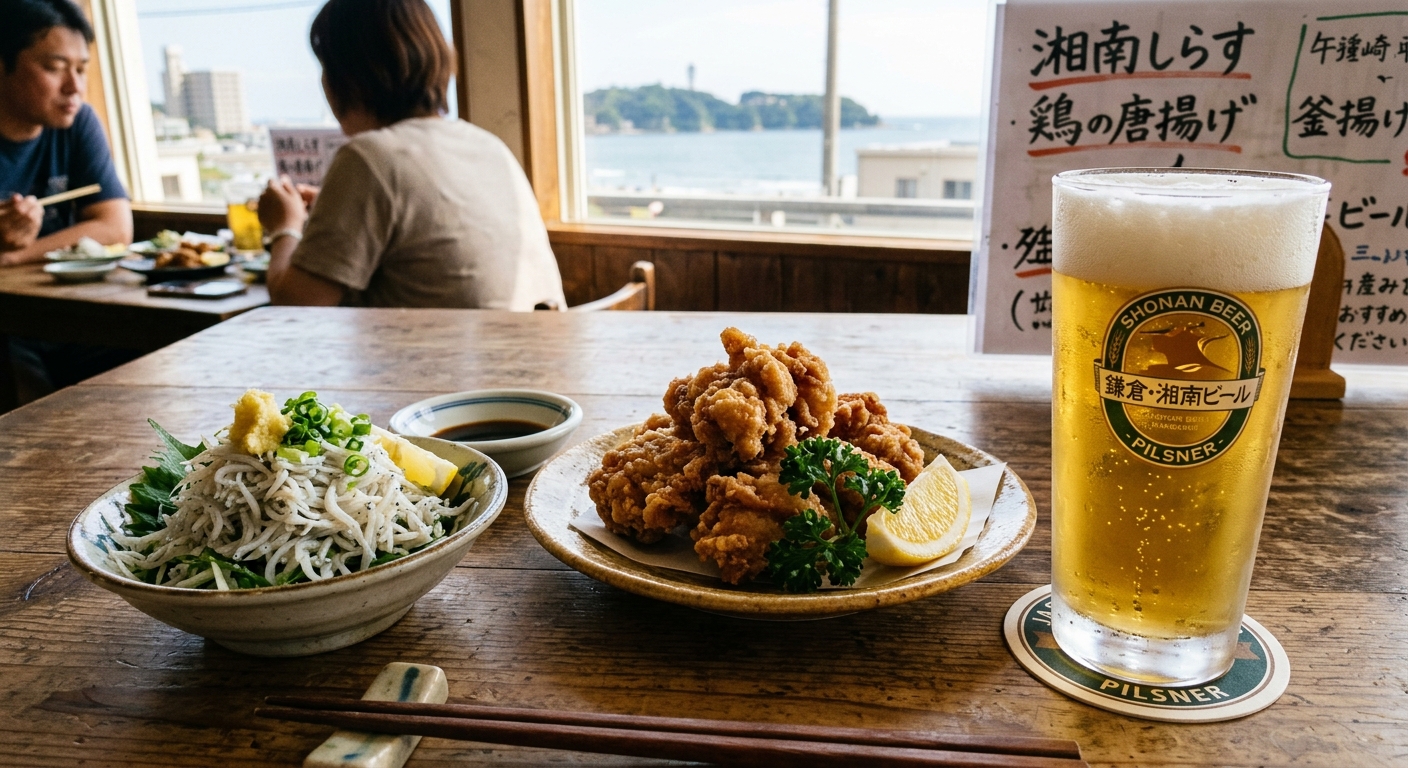
- Kamaage shirasu (steamed whitebait) from Shonan
A specialty of the coast from Chigasaki to Koshigoe. The salt and faint bitterness of the whitebait never collide with the pilsner’s gentle bitterness; instead they push the malt sweetness forward. A little ginger and lemon links up with the citrus edge of the hops. - Karaage (Japanese fried chicken)
The brewery’s own recommended pairing. Hop bitterness and carbonation wash the frying oil away together, so every bite starts in the same condition as the first.
A note on the science: the iso-alpha acids that carry hop bitterness, together with the pressure of carbonation, strip away the film of oil that fried food leaves in the mouth, resetting the palate. Sodium is also known to suppress the perception of bitterness, so the salt in the whitebait softens the pilsner’s bitter edge and lets the hidden malt sweetness surface.
Visiting the Brewery
Kumazawa Sake Brewery (Shonan Beer)
7-10-7 Kagawa, Chigasaki City, Kanagawa. About a 7-min walk from Kagawa Station (JR Sagami Line).
The grounds hold restaurants (MOKICHI TRATTORIA, Tensei) and a shop (MOKICHI CAFE, closed Tuesdays) where you can drink Shonan Beer with the food.
Sights Nearby
- Southern Beach Chigasaki / Chigasaki City | ~15 min, ~6 km by car from the brewery
The Chigasaki shore, looking out to Eboshi-iwa rock. It is the seaside of the town the paired song runs through, busy with swimmers in summer. - Samukawa Shrine / Samukawa Town | ~10 min, ~4 km by car from the brewery
The first-ranked shrine of the old Sagami Province, known as the only shrine of “happo-yoke” (protection from misfortune in all directions), with a broad sacred wood and a garden.
Hot Springs Nearby
- Ryusenji no Yu, Shonan-Chigasaki branch / Chigasaki City | ~12 min, ~4 km by car from the brewery
A day-use bathhouse with open-air natural hot-spring baths, saunas and a stone sauna. 6:00-2:00, ¥600 for adults.
Opening hours, closing days and day-use bathing availability can change. Please check each facility’s official information before visiting.
A Quick Glossary of Beer Terms
- Craft beer: Beer made by small breweries that put the character of the maker front and centre, as opposed to the uniformity of mass production.
- Pilsner: A pale lager born in Pilsen, Czechia, known for its clear golden colour and refined hop bitterness. The most widely drunk style in the world.
- Malt: Germinated barley. It forms the foundation of a beer’s sweetness, colour and body; how deeply it is roasted determines colour and toastiness.
- Hops: The cones of a climbing plant, which give beer its bitterness and aroma. Depending on the variety, that aroma can read as citrus, tropical fruit or open grassland.
- IBU: An international measure of bitterness. Around 10 you barely notice it; above 60 you are in clearly bitter IPA territory.
Sources
- Shonan Beer, Kumazawa Brewing official site
- Kumazawa online store — Pilsner
- “Kibo no Wadachi” — Wikipedia (Japanese)
- Kanaloco: Chigasaki Station adopts “Kibo no Wadachi” as its departure melody
If you notice any errors in this article, please don’t hesitate to reach out at info@soundrecords.jp.
Read this article in Japanese: 海へ向かう道の途中で