日本語で読む | This is the English version of a bilingual article.
Today’s Pairing
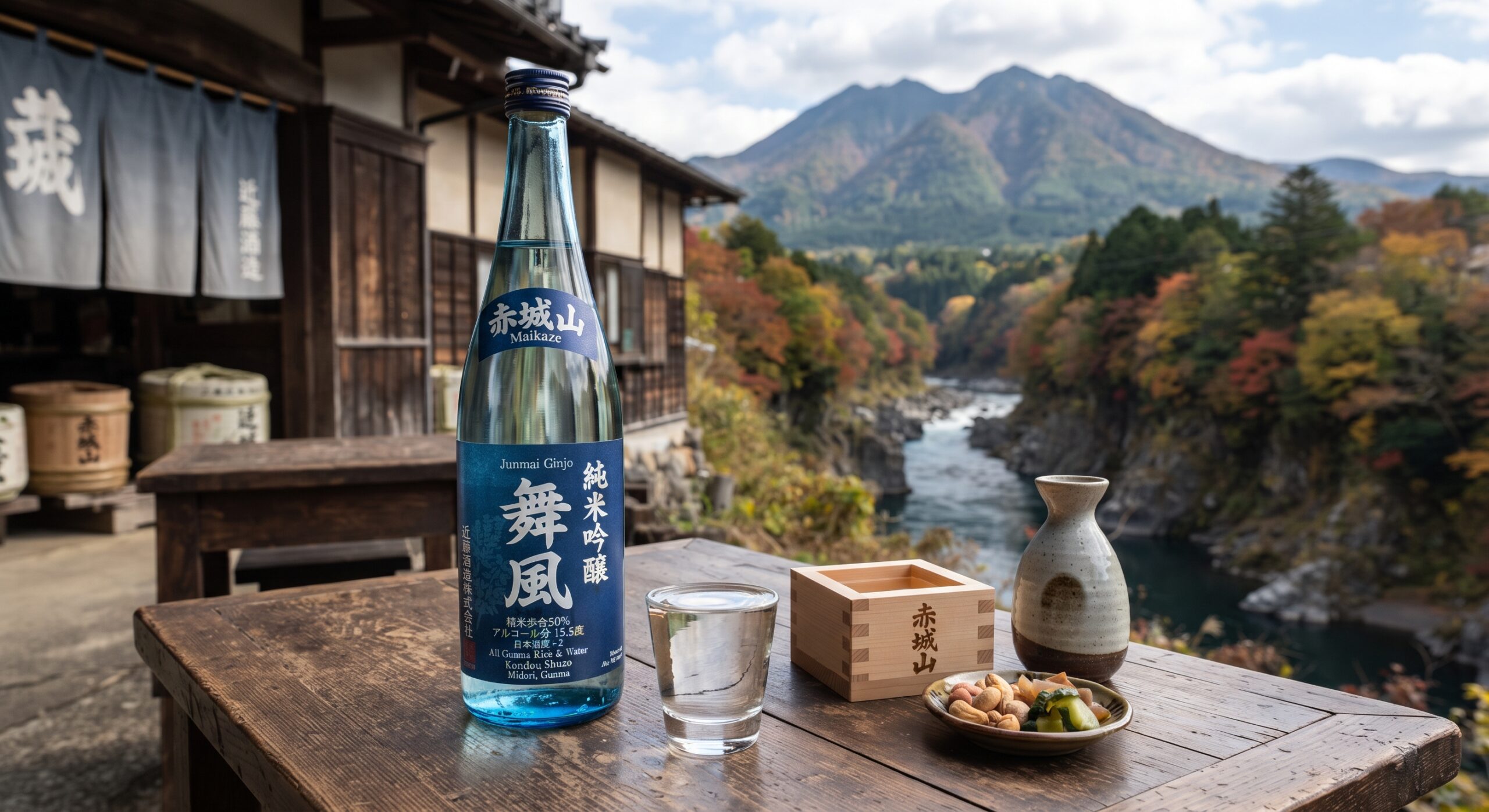
- Sake: Akagisan “Maikaze” Junmai Ginjo — brewed 100% with Gunma’s own sake rice variety Maikaze, rice-polishing ratio (seimai buai) 50%, 15.5% alcohol / Kondo Shuzo Co., Ltd. (1002 Omama, Omama-cho, Midori City, Gunma Prefecture)
Official site: https://akagisan.com/ - Kayoukyoku (classic Japanese popular song): “Akagi no Komoriuta” (“Akagi’s Lullaby”) by Tokairin Taro, 1934
YouTube: https://www.youtube.com/watch?v=dy1lXecEG70
▶ If the player above doesn’t play, open it on YouTube
The Story of the Brewery
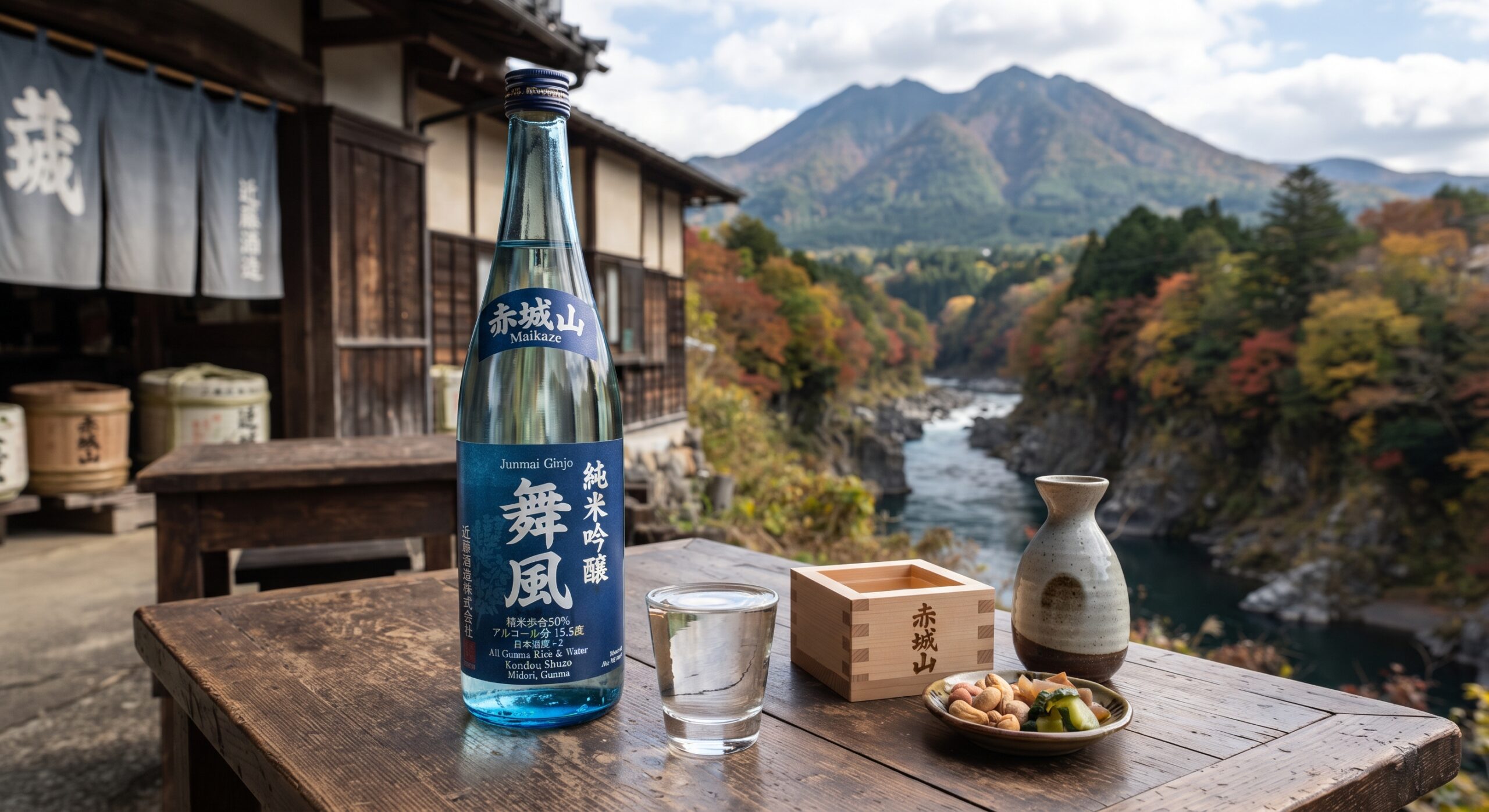
Kondo Shuzo Co., Ltd. was founded in 1875 by Kondo Kamekichi in what is now Omama-cho, Midori City, Gunma Prefecture, under the shop name “Tanakaya.” Because the brewery stood at the foot of Mt. Akagi, its sake was first sold under the name “Akagi,” later changed to “Akagi Masamune.” Under the third-generation owner, the name changed again — to its present form, “Akagisan” (“Mt. Akagi”) — because that owner loved the moon, and the new name echoed “Meigetsu Akagiyama” (“The Bright Moon over Mt. Akagi”), a title tied to the legend of the outlaw Kunisada Chuji. Since its founding, the brewery has drawn its brewing water from a spring fed by Mt. Akagi, welling up from beneath its own grounds, and has stayed true to dry-style sake throughout. Its brewers work under the motto “brewing sake means building people, as a team” — and in 2006, their sake was ranked best among 241 breweries at the Kanto-Shin’etsu Regional Taxation Bureau’s sake competition.
The bottle in this pairing, “Akagisan Maikaze Junmai Ginjo,” is brewed 100% with Maikaze, a sake rice variety developed by the Gunma Prefectural Agricultural Technology Center at the request of the Gunma Sake Brewers’ Association. Maikaze was registered with the Ministry of Agriculture, Forestry and Fisheries in 2011 and went on sale the following year — a rice born and bred in Gunma. To carry the Maikaze name, a sake must use 100% Gunma-grown Maikaze rice and Gunma’s own water, and must be a junmai-style sake (made only from rice, rice koji, and water). This bottle goes further still, using a Gunma-developed yeast called “Gunma KAZE Yeast No. 2,” polished to a seimai buai of 50%, at 15.5% alcohol, with a sake meter value (nihonshu-do) of +2 — an “all-Gunma” junmai ginjo where the rice, water, and yeast all come from the prefecture. It’s described as rich in umami yet clean on the finish, equally enjoyable served chilled or warmed.
The Story of the Land
Omama-cho, where the brewery stands, spreads along the Watarase River at the southern foot of Mt. Akagi. During the Edo period, this area was one of the post towns along the “Akagane Kaido” (Copper Road), which carried copper mined at the Ashio Copper Mine to Edo. After a silk market opened here in 1658, Omama also grew into the leading commercial town of the eastern Gunma region, and many storehouses and Western-style buildings from the prewar era still line its streets today. A short walk from the brewery is Kozudo Gorge, carved by the Watarase River and sometimes called “the Yabakei of the Kanto region.” On the bluff overlooking that gorge sits Nagame Park, known for its seasonal flowers and autumn foliage.
The Story of the Song
“Akagi no Komoriuta” was released in February 1934 by Nippon Polydor. The lyrics are by Sato Sonosuke, the music by Takeoka Nobuyuki, and it was sung by Tokairin Taro. It was originally written as the theme song for a Shochiku period film, “Asataro Akagi no Uta,” starring Takada Hiroyoshi, about Itawari Asataro, a follower of the late-Edo-period outlaw Kunisada Chuji. The song became an overnight sensation as soon as it was released — so popular that the film itself was later retitled “Akagi no Komoriuta” to match. At a time when phonographs numbered about a million nationwide, the record is said to have sold 500,000 copies.
The singer, Tokairin Taro, was born in Akita City in 1898. He debuted as a professional singer in 1933 and became known for his distinctive style — round glasses, a tailcoat, and standing bolt upright as he sang. “Akagi no Komoriuta” became his breakthrough hit, and he appeared four times on NHK’s Kohaku Uta Gassen (Red and White Song Festival), starting with the very first one in 1951 — singing this song there in 1956 and 1965. In 1963, he became the first president of the Japan Singers Association.
Why This Pairing
The sake’s name, “Akagisan,” and the song’s title, “Akagi no Komoriuta,” both trace back to the very same legend. The Edo-period outlaw Kunisada Chuji is remembered above all for his flight through the mountains of Akagi, and the line he delivers in the stage versions of his story — “Tonight is my last night on Mt. Akagi” — is counted among the most famous lines in Japanese popular theater, on a par with kabuki’s own classic phrases. Kondo Shuzo renamed its sake “Akagisan” because its moon-loving third-generation owner wanted the name to echo “Meigetsu Akagiyama,” a title tied to Chuji’s legend. “Akagi no Komoriuta,” for its part, was written for a film about Chuji’s own follower, Asataro.
A sake’s name and a song’s title — chosen by different people, in different eras, yet both drawn from the same mountain’s legend. Keep that in mind as you listen with a cup in hand, and the song may sound a little different.
Where to Find This Bottle
The Rakuten Ichiba link below is an affiliate link.
- Brewery’s official site: https://akagisan.com/
- Buy on Rakuten Ichiba: View the product page (720ml, ¥1,815)
Note: the links above lead to Japan-based retailers. They’re most convenient for readers in Japan, or for those elsewhere who are able to arrange international shipping. Stock and availability change over time, so if you’re near a specialty sake shop, it’s well worth asking for this label by name.
Pairing Dishes Worth Trying
- Okkirikomi
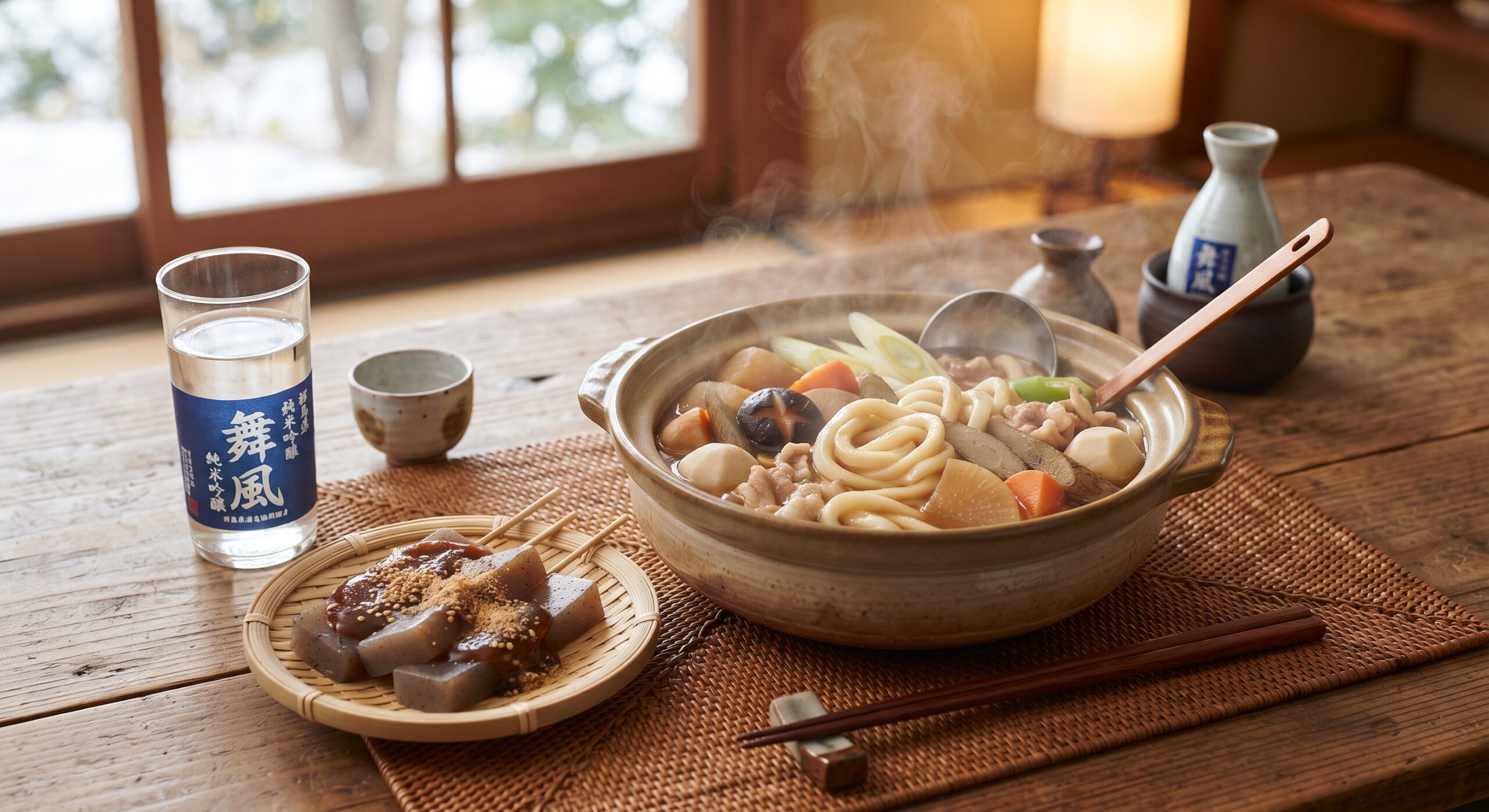
A local dish from Gunma and northern Saitama: wide, flat, hand-cut noodles simmered slowly with root vegetables in a soy-based broth. It’s a dish long loved through the cold winters carried in on the “Akagi-oroshi,” the dry wind that blows down off Mt. Akagi — and the sweetness of its root vegetables and the umami of its soy broth pair naturally with the clean finish of this junmai ginjo.
Recipe (in Japanese): Kurashiru, “Warm Soy-Flavored Okkirikomi” - Konnyaku dengaku (miso-glazed konjac)
Gunma produces more konjac (konnyaku) potato than any other prefecture in Japan. This simple dish coats boiled konjac in a sweet-savory miso glaze. The aroma of fermented miso echoes the gentle ginjo aroma of a junmai ginjo sake.
Recipe (in Japanese): Kurashiru, “Miso Konnyaku (Dengaku)”
A note on the science: both miso and soy-based dashi are rich in umami compounds, such as glutamic acid, produced through koji fermentation. These resonate with the amino-acid umami found in sake, creating a synergistic boost of savoriness on the palate. At the same time, aromatic compounds born of fermentation in both the dish and the sake echo one another, giving the pairing a sense of unity.
Visiting the Brewery
Kondo Shuzo Co., Ltd.
1002 Omama, Omama-cho, Midori City, Gunma Prefecture. About a 5-minute walk from Omama Station on the Watarase Keikoku Railway.
The brewery sits in a town along the Watarase River, at the southern foot of Mt. Akagi, and draws its brewing water from a spring fed by the mountain, right beneath the brewery grounds.
Sights Nearby
- Kozudo Gorge / Omama-cho, Midori City | about an 8-min walk from Kondo Shuzo (8 min from Omama Station)
A gorge carved by the Watarase River, sometimes called “the Yabakei of the Kanto region.” A roughly 500m walking path runs between Hanetaki Bridge and Kozudo Bridge, with fresh greenery in spring and autumn colors in fall. Free admission; parking for 70 cars. - Nagame Park / Omama-cho, Midori City | about a 10-min walk from Kondo Shuzo
A hilltop park overlooking Kozudo Gorge, known for seasonal flowers. Every autumn it hosts the Kanto Chrysanthemum Exhibition (admission charged only during that event; free the rest of the year). The adjoining Nagame Yokyojo is a playhouse built in the Taisho era.
Hot Springs Nearby
- Yu-Topia Midomospa / 2562 Shika, Kasakake-cho, Midori City | about 15 min, ~6 km by car from Kondo Shuzo (an approximate map-based estimate)
A day-use hot spring facility run by Midori City, opened May 24, 2026. Its sodium-sulfate spring water is drawn from 1,600m underground and feeds an open-air bath, a carbonated bath, and more; non-resident adult admission starts at ¥650 for 3 hours. Since the distance here is an approximate estimate, please confirm the route and hours before visiting.
Opening hours, closing days and day-use bathing availability can change. Please check each facility’s official information before visiting.
A Quick Glossary of Sake Terms
- Junmai Ginjo: Junmai (sake made only from rice, rice koji, and water, with no added brewing alcohol) that has been polished to a seimai buai of 60% or less and fermented slowly at low temperatures, giving it a fragrant aroma.
- Seimai buai (rice-polishing ratio): The percentage of the original grain remaining after milling. The lower the number, the more the rice has been polished down.
Sources
- Kondo Shuzo Co., Ltd. – Official Site
- Kondo Shuzo Co., Ltd. – Gunma SAKE TSUGU
- Akagisan “Maikaze” Junmai Ginjo Nama-zake – Gunma SAKE TSUGU
- “Maikaze,” Gunma’s Local Sake Rice – Gunma Prefecture Official Site
- Kondo Shuzo – Gunma Prefecture Official Tourism Site
- Akagi no Komoriuta – Wikipedia (Japanese)
- Tokairin Taro – Wikipedia (Japanese)
- Kunisada Chuji – Wikipedia (Japanese)
- Kozudo Gorge – Midori City Official Tourism Site
- Nagame Park – Midori City Official Tourism Site
- Access & Hours – Yu-Topia Midomospa
If you notice any errors in this article, please don’t hesitate to reach out at info@soundrecords.jp.
Read this article in Japanese: 同じ山から、名前をもらった