日本語で読む | This is the English version of a bilingual article.
Today’s Pairing
- Craft beer: Kawaba Beer “Kawaba Ale” — amber ale, ABV 5%, unfiltered, malt-driven caramel aroma with a faint sweetness / Denen Plaza Kawaba Co., Ltd. (Michi-no-Eki Kawaba Denen Plaza, Kawaba Village, Gunma)
Official site: https://denenplaza.co.jp/shopping/kawaba_beer/ - Music: “Furusato -C.BECHSTEIN ver.-” by EXILE ATSUSHI (2019)
YouTube: https://www.youtube.com/watch?v=tPrcfYAU_oA
▶ If the player above doesn’t play, open it on YouTube
The Story of the Brewery
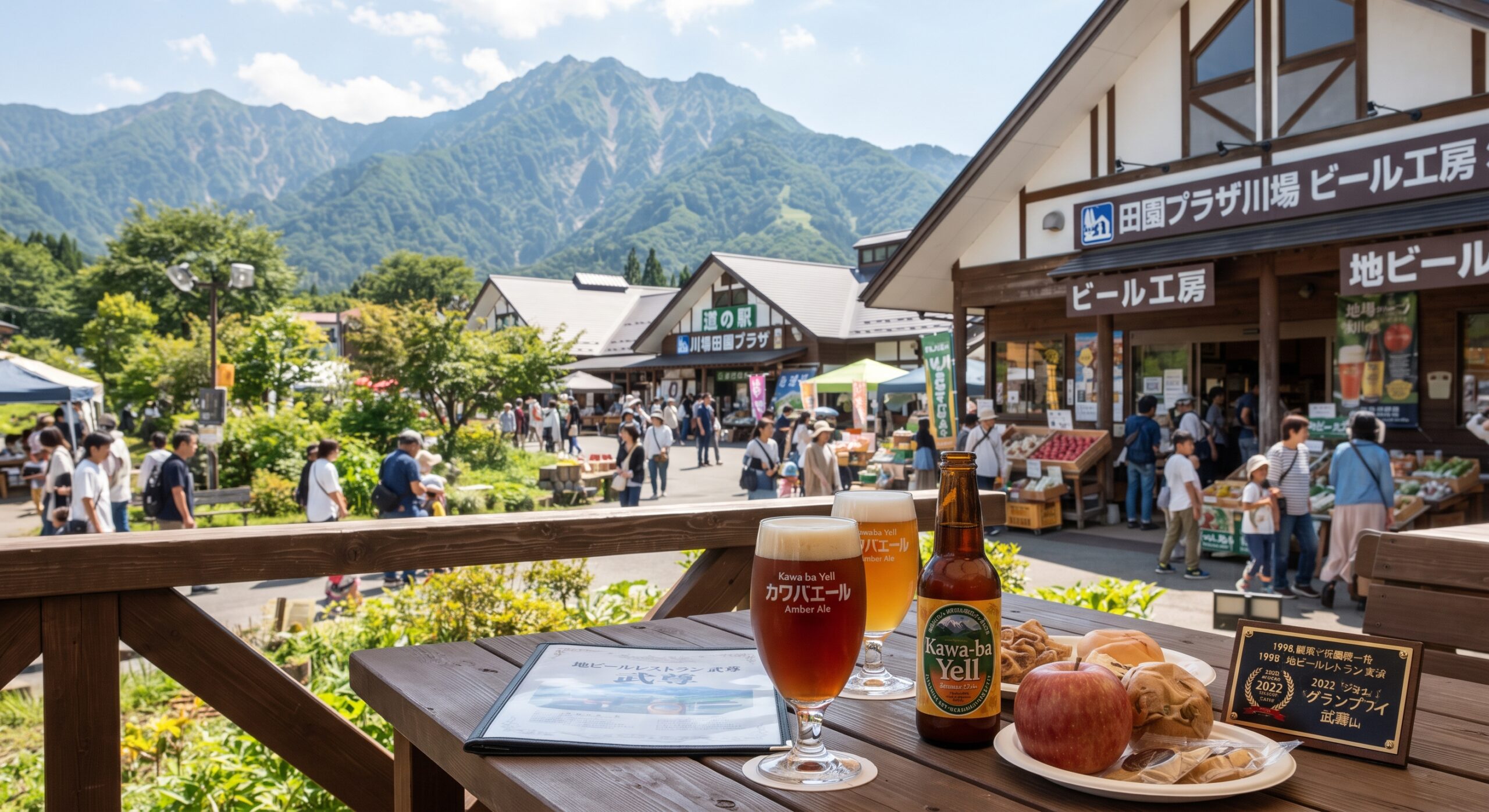
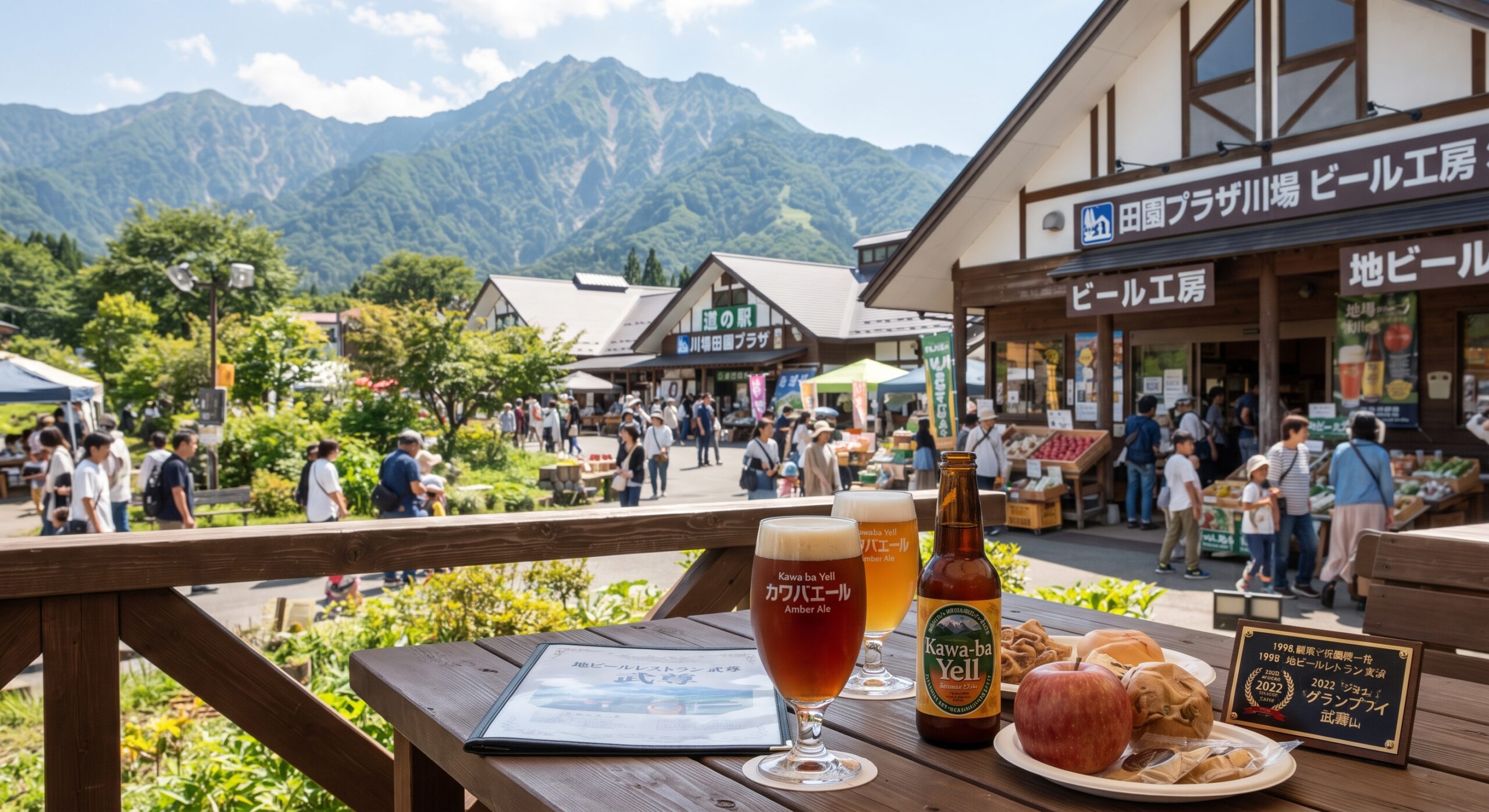
Michi-no-Eki Kawaba Denen Plaza sits in Kawaba Village, at the foot of Mt. Hotaka. Its operator, Denen Plaza Kawaba Co., Ltd., set up a brewhouse and began brewing local beer here in 1998, using water that flows down from the Hotaka mountains. Four beers anchor the lineup: a Weizen, an amber ale (Kawaba Ale), an IPA, and a Pilsner brewed with Yuki Hotaka rice grown in the village. In 2008 and 2009, the brewery placed at the Japan Asia Beer Cup, run by the Japan Beer Culture Association, two years running.
The beer featured here, Kawaba Ale, is an amber ale with a striking deep red color. At 5% ABV, a moderate hop bitterness sits alongside the aroma and faint sweetness of caramel malt. It is unfiltered, so a light haze remains in the bottle — the yeast’s work left visibly in the glass.
The roadside station itself took first place for the first time in the 2022 “National Michi-no-Eki Grand Prix,” run by the travel magazine Jalan, in a survey covering roughly 1,000 roadside stations nationwide — recognized in part for the range of experiences on offer, including the brewhouse.
The Story of the Land
Kawaba Village is a small mountain village of just over 3,000 people, covering about 85 square kilometers. In 1980, Tokyo’s Setagaya Ward, pursuing a plan to build a “health village for its residents,” chose this village out of 52 candidates. The reason given was that it had “no tourist sites, no downtown” — in other words, the nature and farmland scenery that had vanished from the city remained here untouched. The following year, 1981, the two signed a “Mutual Cooperation Agreement for a Residents’ Health Village” — not a simple sister-city tie, but what is called an *engumi* (adoptive-kinship) agreement, under which a city and a rural village jointly build up the place together.
For more than forty years since, fifth-graders from Setagaya schools have visited Kawaba, and the village’s children have visited Setagaya in turn. The village has come to be called Setagaya’s “second hometown.” Beer Restaurant Hotaka, which serves food alongside Kawaba Beer inside the roadside station, is itself run by a company bearing both their names: Setagaya-Kawaba Furusato Corporation. The village’s apples, too, have welcomed visitors arriving each autumn to a place they have come to call their own hometown.
The Story of the Song
“Furusato,” the song behind this cover, began life as “Kokyo,” a Ministry of Education song published in 1914 for sixth-year elementary students, with words by Takano Tatsuyuki and music by Okano Teiichi. The ministry did not disclose the writers’ names at the time, and it was not until 1992 that their names appeared in music textbooks. Its opening line — “I chased rabbits on that mountain, fished for crucian carp in that river” — is a song of remembering the hills and rivers of childhood from somewhere far away.
EXILE ATSUSHI first covered the song in 2012, then re-recorded it as “Furusato -C.BECHSTEIN ver.-” for his best album TRADITIONAL BEST, released April 30, 2019. The album’s theme was “the heart of Japan.” He has said he made the project wanting to carry the nursery songs loved since the Meiji and Taisho eras, and the classics of Showa and Heisei, forward into the coming new era. This particular track was re-recorded and rearranged on a C. Bechstein, a piano of world renown, and it was ATSUSHI himself who suggested naming the version after it — “out of respect for this piano,” as he put it.
Why This Pairing
“Furusato” sings of a mountain and river remembered precisely because they have been left behind. But the relationship between Kawaba Village and Setagaya Ward does not end at remembering. For more than forty years, a new class of fifth-graders has walked that mountain and that river every year, in person. This is a place that has kept its “furusato” not just as a memory, but as real ground people keep returning to.
The water that goes into Kawaba Ale flows down from that same Hotaka mountain. Just as ATSUSHI re-recorded a century-old song to carry it into a new era, this village keeps handing its mountain life to children who grew up in the city, year after year. A glass of beer, a song — both this pairing suggests become a “furusato” only once they are passed on.
Where to Find This Beer
The Rakuten Ichiba link below is an affiliate link.
- Brewery official site:https://denenplaza.co.jp/shopping/kawaba_beer/
- Buy on Rakuten Ichiba: View the product page (330ml, ¥3,980)
These are Japanese storefronts. If you are visiting the brewery, drinking it fresh at their own taproom is by far the best option.
Pairing Dishes Worth Trying
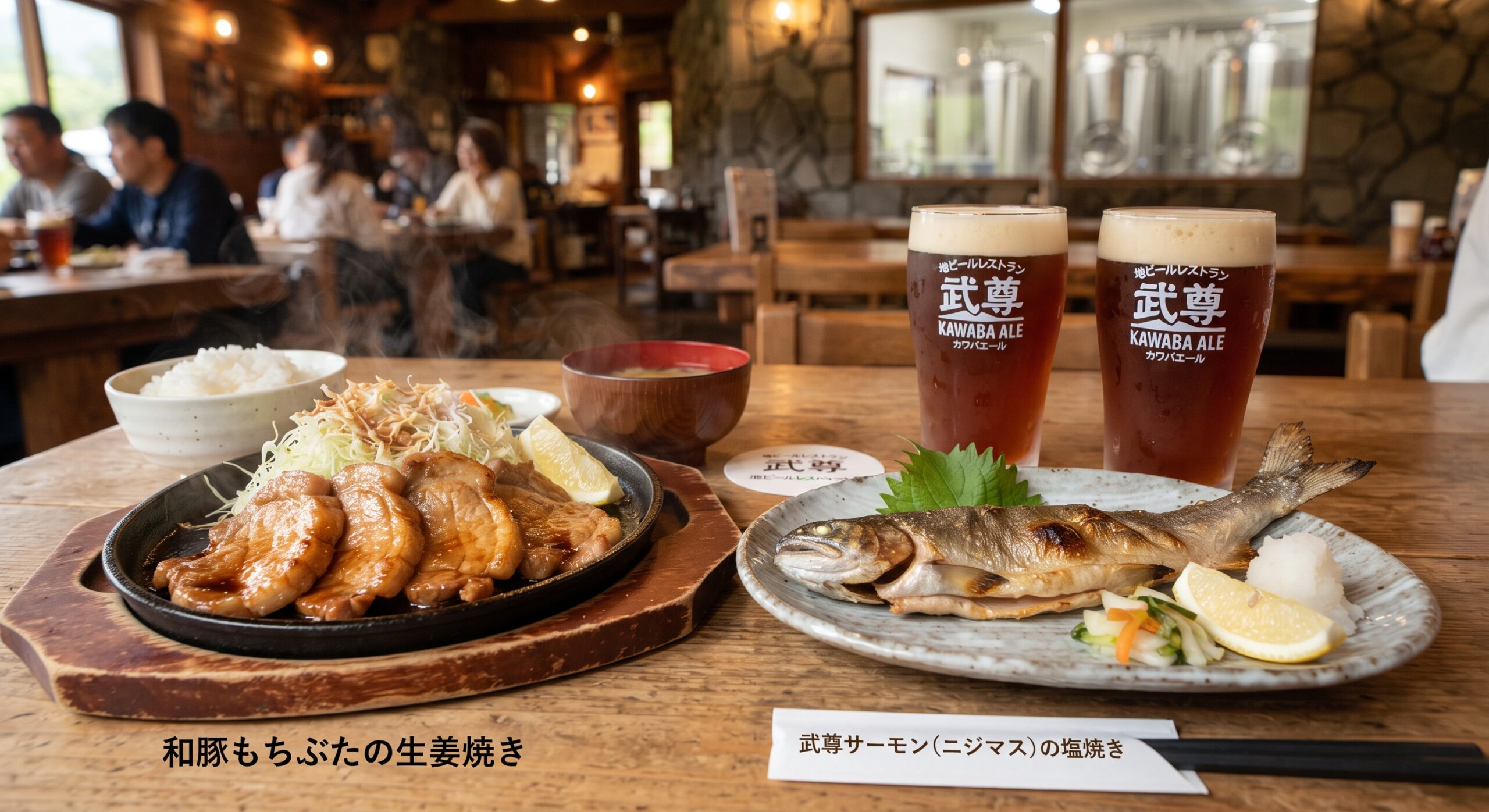
- Wabuta Mochibuta pork, pan-seared with ginger
A signature dish at Beer Restaurant Hotaka inside the roadside station. The savory char of the soy-ginger glaze echoes the caramel malt aroma of Kawaba Ale.
Recipe (in Japanese): Kurashiru, “Basic Pork Ginger Saute” - Grilled Hotaka salmon (rainbow trout)
Rainbow trout raised at a fish farm in Kawaba Village. Hop bitterness and carbonation cut cleanly through the richness the fish leaves behind.
Recipe (in Japanese): Cookpad, “Salt-Grilled Rainbow Trout”
A note on the science: the Maillard reaction that browns the surface of seared meat or fish, and the reaction that happens when malt is roasted, work the same way — sugars and amino acids bonding under heat to produce savory aromatic compounds. That is why the caramel malt aroma in Kawaba Ale and the char on these grilled dishes read as part of the same flavor.
Visiting the Brewery
Michi-no-Eki Kawaba Denen Plaza (Kawaba Beer)
385 Oaza Hagimuro, Kawaba Village, Tone District, Gunma. About a 10-minute drive from the Numata IC on the Kan-etsu Expressway.
The brewhouse and shop sit on the same grounds as Beer Restaurant Hotaka, where you can drink it fresh.
Sights Nearby
- Seiryuzan Kichijoji Temple / Kawaba Village | ~5 min, ~1.5 km by car from the brewery
A Zen temple founded in 1339, during the Nanboku-cho period. Known as a “flower temple” for the blossoms that fill its grounds through the seasons, with a notable display of autumn foliage over its Japanese garden. - Seki Apple Orchard / Kawaba Village | ~5 min by car from the brewery
Kawaba Village is a lesser-known apple-growing area, cultivating several varieties including Akagi, Yoko and Fuji, with apple-picking and a farm stand open in autumn.
Hot Springs Nearby
- Kawaba Denen Onsen Rakuraku no Yu / Kawaba Village | ~2 min by car, ~10 min on foot from the brewery
A day-use natural hot spring right by the roadside station, with an open-air bath set among sky, mountains and farmland.
Opening hours, closing days and day-use bathing availability can change. Please check each facility’s official information before visiting.
A Quick Glossary of Beer Terms
- Craft beer: Beer made by small breweries that put the character of the maker front and centre, as opposed to the uniformity of mass production.
- Ale: Beer made by top fermentation, with the yeast working near the surface at close to room temperature. It tends toward fruity aromas and a fuller body.
- Malt: Germinated barley. It forms the foundation of a beer’s sweetness, colour and body; how deeply it is roasted determines colour and toastiness.
- Hops: The cones of a climbing plant, which give beer its bitterness and aroma. Depending on the variety, that aroma can read as citrus, tropical fruit or open grassland.
- ABV: Alcohol By Volume. Beer typically runs around 5%; above 8% is considered a strong, heavier-drinking beer.
- Ji-biru: The name given to the beers that appeared across Japan after the 1994 liquor tax reform opened small-scale brewing. Today most of them are simply called craft beer.
Sources
- Michi-no-Eki Kawaba Denen Plaza official site: “KAWABA BEER”
- Tanoshii Osake.jp: Gunma’s Kawaba Beer
- C. Bechstein Japan official site: “EXILE ATSUSHI”
- “Kokyo” (shoka) — Wikipedia (Japanese)
If you notice any errors in this article, please don’t hesitate to reach out at info@soundrecords.jp.
Read this article in Japanese: かの山は、いまも