日本語で読む | This is the English version of a bilingual article.
Today’s Pairing
- Sake: Sentoku Junmai — brewed with Yamada Nishiki rice, rice-polishing ratio (seimai buai) 60%, 15% alcohol / Sentoku Shuzo Co., Ltd. (2-1-8 Oose-machi, Nobeoka City, Miyazaki Prefecture)
Official site: http://www.sentoku.com/ - Kayoukyoku (classic Japanese popular song): “Hyuga-misaki” (“Hyuga Cape”) by Mizumori Kaori, 2023
YouTube: https://www.youtube.com/watch?v=F_gAIzPDsE4
▶ If the player above doesn’t play, open it on YouTube
The Story of the Brewery
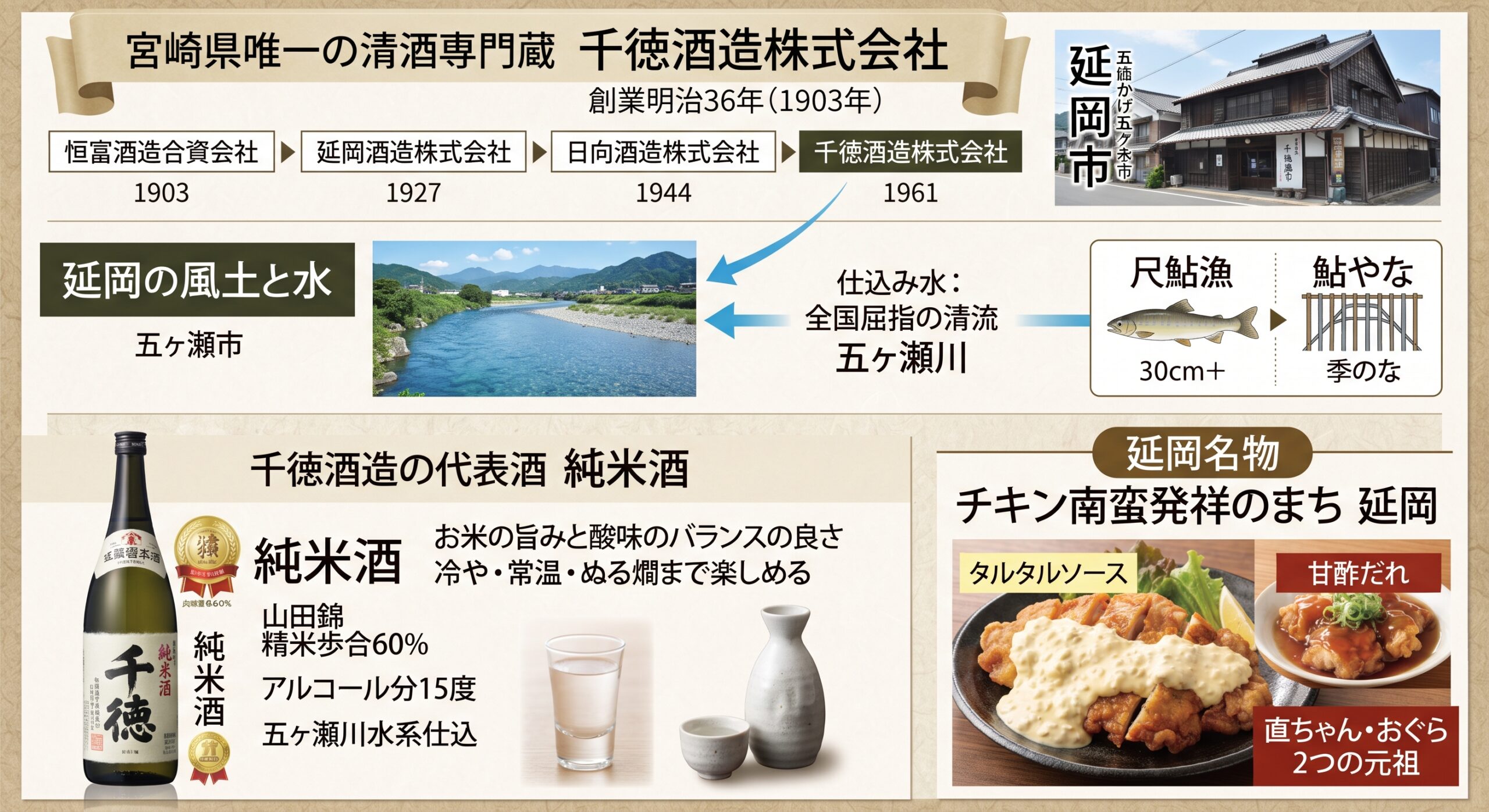
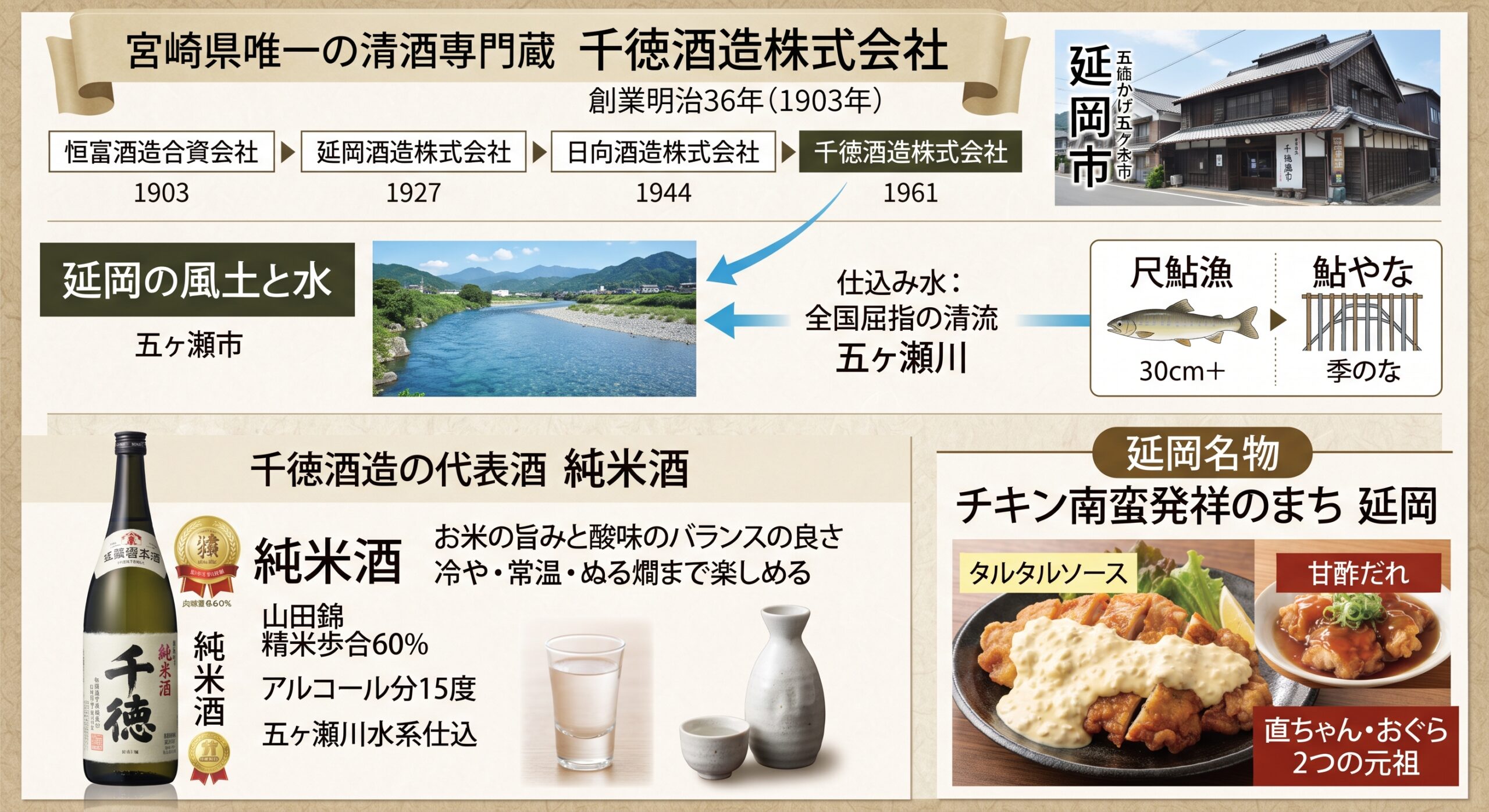
Sentoku Shuzo Co., Ltd., based in the Oose neighborhood of Nobeoka City, is Miyazaki Prefecture’s only brewery dedicated solely to sake. It was founded in 1903 as “Tsunetomi Shuzo,” a partnership started in what was then Tsunetomi Village (the site of today’s brewery). In 1927 it was reorganized as “Nobeoka Shuzo Co., Ltd.” Then, in 1944, under wartime industry consolidation, three companies — Hihira Shoten, Korogi Kunji Shuzo, and Nobeoka Shuzo — merged into “Hyuga Shuzo Co., Ltd.” Finally, in 1961, when the brewery rebuilt its facilities, it took its present name, Sentoku Shuzo. The brewery has passed through four names to become what it is today. Its current president, Kadota Kenji, also serves as the brewery’s toji (master brewer).
The brewing water comes from the Gokase River, which flows right past the brewery. In the Ministry of Land, Infrastructure, Transport and Tourism’s annual water-quality survey of Japan’s major rivers, the Gokase has ranked among the cleanest in the country year after year. The bottle in this pairing, simply called Junmai (pure rice sake), is brewed with contract-grown Yamada Nishiki rice polished to a seimai buai of 60%, at 15% alcohol. The brewery describes it as a sake with a good balance of rice umami and acidity, one that can be enjoyed at room temperature, chilled, or gently warmed (nurukan). It’s the brewery’s most fundamental bottle, backed by a steady record of quality since the 2000s: six gold medals and five honorable mentions at the National New Sake Awards, thirteen honor awards at the Kumamoto Regional Taxation Bureau’s tasting, and a gold medal at the 2019 U.S. National Sake Appraisal.
The Story of the Land
Nobeoka City sits in northern Miyazaki Prefecture, spread along the mouth of the Gokase River. The river runs so clear, and its mossy stones feed the fish so well, that it raises “shaku-ayu” — sweetfish over 30 centimeters long — and Nobeoka has long been called a treasure house of ayu. From late October through early December, a traditional fishing method called “ayu-yana,” a weir-trap technique over 300 years old, is set up along the river running through the city, and salt-grilled roe-bearing ayu and ayu rice become the season’s signature treat.
Nobeoka is also known as the birthplace of chicken nanban, a dish of fried chicken glazed in sweet vinegar. According to Japan’s Ministry of Agriculture, Forestry and Fisheries, it was invented in the 1950s as a staff meal at a Western-style restaurant in Nobeoka, and on July 8, 2009, the city officially declared itself “the birthplace of chicken nanban.” Two restaurants, each claiming to be the original, are still open in the city today: “Naochan,” which serves it with sweet vinegar alone, and “Oguro,” which tops it with tartar sauce.
The Story of the Song
Mizumori Kaori was born on August 31, 1973, in Kita Ward, Tokyo. She debuted as a singer in 1995 with “Oshiroi Bana.” After her 2003 single “Tottori Sakyu” (“Tottori Sand Dunes”) became a major hit, she went on to release new songs centered on a different place in Japan nearly every year, earning her the title “Queen of Local-Themed Songs” (go-tochi songs). Over the years, she has sung about dozens of places, including Toujinbo, Kushiro Shitsugen (Kushiro Marsh), the Gono Line, and the Kumano Kodo pilgrimage route.
“Hyuga-misaki” is her 33rd single, released on January 24, 2023, with lyrics by Kazu Tsubasa, music by Gen Tetsuya, and arrangement by Ito Norio. Its coupling track, “Rishu… Takachiho,” is also set in Miyazaki Prefecture. “Hyuga-misaki” was performed that same year on NHK’s Kohaku Uta Gassen (Year-End Song Festival) as part of a special “Hyuga-misaki: Kohaku Domino Challenge” segment. Hyuga Cape itself lies just south of Nobeoka, where Sentoku Shuzo is based, on the Hyuga-nada coast in neighboring Hyuga City.
Why This Pairing
Sentoku Shuzo has passed through four names since its founding in 1903: Tsunetomi Shuzo, Nobeoka Shuzo, Hyuga Shuzo, and finally Sentoku. Through all those changes of name, forced by the circumstances of each era, the brewery never once changed its location — it has stood on the same bank of the Gokase River the whole time, as Miyazaki’s only dedicated sake brewery.
Mizumori Kaori, meanwhile, has made a career of doing the opposite: as the “Queen of Local-Themed Songs,” she travels to a new place nearly every year and turns its very name into a song title. In 2023, the place she chose was Hyuga Cape, just next door to the city where Sentoku Shuzo has stood all along.
A brewery that kept its roots in one place while its name kept changing, and a voice that has traveled the country turning one place after another into song. The two happen to meet along the same stretch of the Gokase River and the Hyuga-nada Sea — one story of staying, and one story of traveling.
Where to Find This Bottle
The Rakuten Ichiba link below is an affiliate link.
- Brewery’s official site: http://www.sentoku.com/
- Buy on Rakuten Ichiba: View the product page (720ml, ¥1,800)
Note: the links above lead to Japan-based retailers. They’re most convenient for readers in Japan, or for those elsewhere who are able to arrange international shipping. Stock and availability change over time, so if you’re near a specialty sake shop, it’s well worth asking for this label by name.
Pairing Dishes Worth Trying
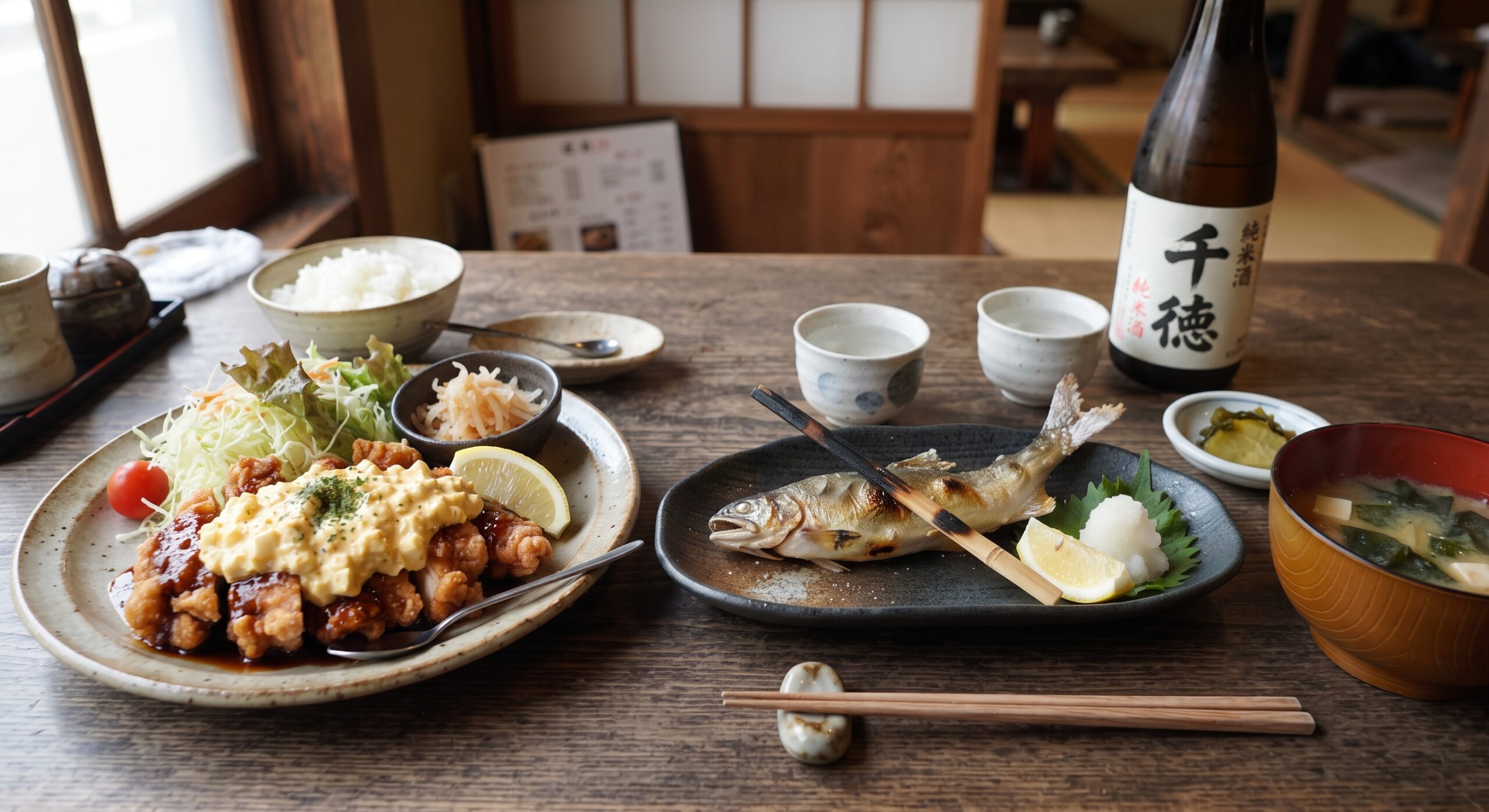
- Chicken nanban
Fried chicken glazed in sweet vinegar, said to have originated right here in Nobeoka. The contrast between the vinegar’s acidity and the chicken’s richness pairs naturally with this junmai’s full umami and gentle acidity.
Recipe (in Japanese): Kurashiru, “Classic Chicken Nanban” - Salt-grilled ayu (sweetfish)
A autumn delicacy from the same Gokase River that supplies the brewery’s water. The fish’s faintly bitter aroma and refined umami sit naturally alongside a junmai sake that lets the rice’s own umami come through directly.
Recipe (in Japanese): Cookpad, “Salt-Grilled Ayu”
A note on the science: the acidity in the sweet-vinegar glaze cuts through the richness of the fried chicken’s fat on the palate. Junmai sake carries its own gentle acidity that works the same way, so instead of competing, the two acidities layer together and leave the mouth feeling lighter. The faint bitterness in ayu’s inner organs (wata) resonates with the quiet umami that comes from rice, each bringing out the other without canceling it out.
Visiting the Brewery
Sentoku Shuzo Co., Ltd.
2-1-8 Oose-machi, Nobeoka City, Miyazaki Prefecture. About a 15-minute walk from JR Nobeoka Station; about 10 minutes by car from the Nobeoka IC on the Higashi-Kyushu Expressway.
Miyazaki Prefecture’s only sake-specialty brewery, located right in central Nobeoka.
Sights Nearby
- Nobeoka Castle Ruins & Shiroyama Park / Higashihon-koji, Nobeoka | ~5 min, ~1 km by car from Sentoku
A hilltop park built on the ruins of Nobeoka Castle, with surviving stone walls and the old keep’s foundation. Also known for its cherry blossoms. The hilltop bell, “Shiroyama no Kane,” is free to visit. - Atagoyama Observatory / central Nobeoka | ~15–20 min by car from Sentoku
An observation deck atop a 251-meter hill with sweeping views of Nobeoka city and the Hyuga-nada Sea. Named one of Japan’s “Night View Heritage” sites, with a road all the way to the summit (the city’s official site lists it as about 20 minutes by car from JR Nobeoka Station).
Hot Springs Nearby
- Healthtopia Nobeoka / Nagahama-machi, Nobeoka | ~10 min, ~3 km by car from Sentoku
A day-use bathing facility heated by waste-incineration plant heat, offering a “semi-natural Komeiseki” mineral bath, sauna, and open-air bath. Open 10:00–21:00, closed Mondays (bathing fee ¥520 for high-school age and up). Please check opening days before visiting.
Opening hours, closing days and day-use bathing availability can change. Please check each facility’s official information before visiting.
A Quick Glossary of Sake Terms
- Junmai-shu: Sake made only from rice, rice koji, and water, with no added brewing alcohol. It lets the rice’s own umami come through directly.
- Seimai buai (rice-polishing ratio): The percentage of the original grain remaining after milling. The lower the number, the more the rice has been polished down.
Sources
- Company Profile – Sentoku Shuzo Co., Ltd. Official Site
- Product Guide – Sentoku Shuzo Co., Ltd. Official Site
- Mizumori Kaori – Wikipedia (Japanese)
- Atagoyama – Nobeoka City Official Site (Japanese)
- Chicken Nanban, Miyazaki Prefecture – “Our Local Cuisine,” Japan’s Ministry of Agriculture, Forestry and Fisheries (Japanese)
If you notice any errors in this article, please don’t hesitate to reach out at info@soundrecords.jp.
Read this article in Japanese: 名前は変わっても、流れは変わらない