日本語で読む | This is the English version of a bilingual article.
Today’s Pairing
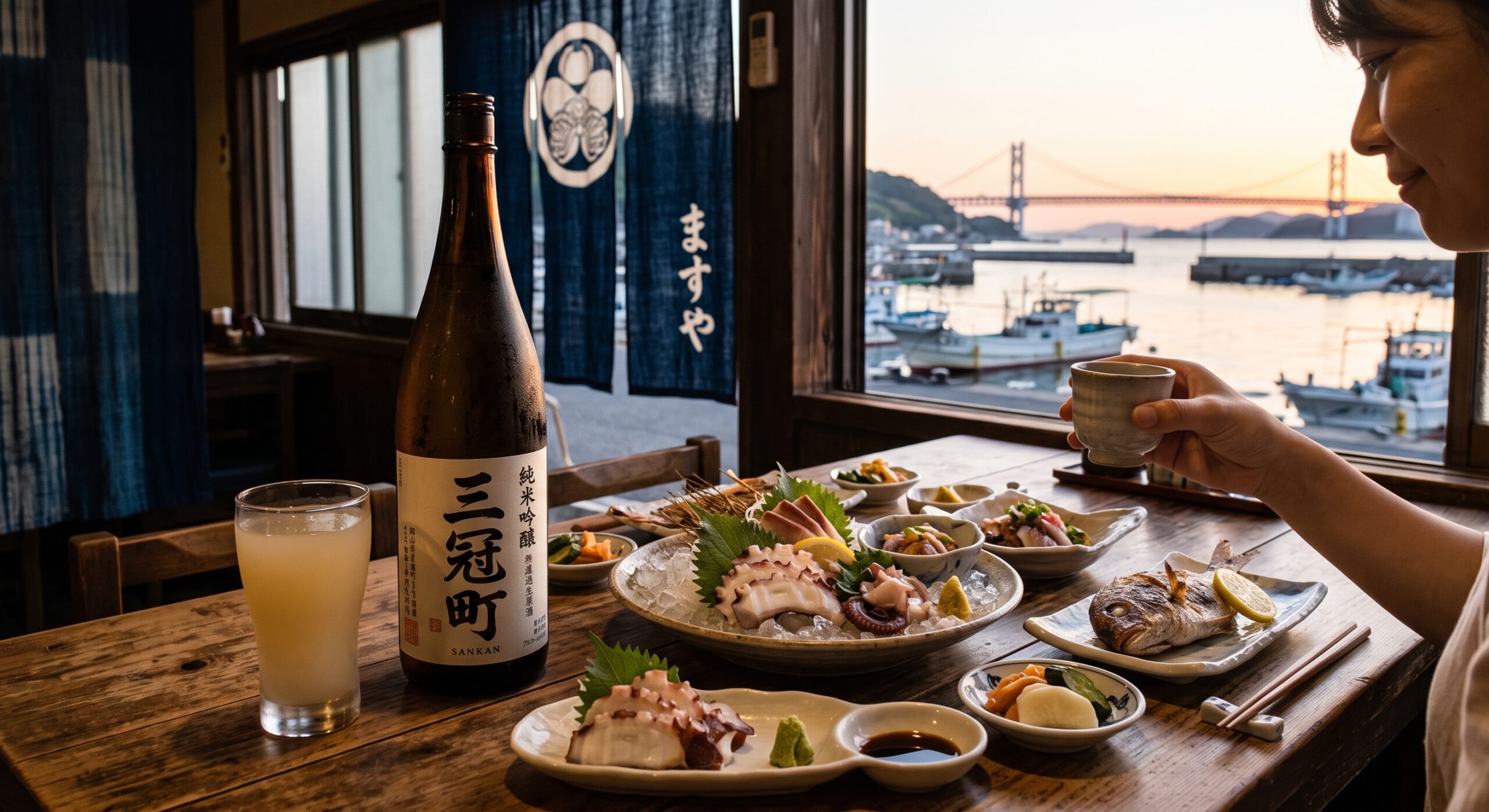
- Sake: Sankan “Omachi” Junmai Ginjo Muroka Nama-genshu (unfiltered, undiluted, unpasteurized) — brewed 100% with Okayama-grown Omachi sake rice, rice-polishing ratio (seimai buai) 55%, 18% alcohol / Sankan Shuzo Ltd. (2-9-22 Shimono-cho, Kojima, Kurashiki City, Okayama Prefecture)
Official site: http://www.sankan.co.jp/ - Kayoukyoku (classic Japanese popular song): “Shimotsui-bushi” by Mihashi Michiya
YouTube: https://www.youtube.com/watch?v=ZW6EIqSVDRA
▶ If the player above doesn’t play, open it on YouTube
The Story of the Brewery

Sankan Shuzo Ltd. traces back to 1806, when its first-generation founder, Suwaki Kichizo, began brewing sake under the name “Masuya” in the hills of Kojima, Kurashiki City. Around the Ansei era (1854–1860), third-generation Yasutaro studied at the University of Michigan in the United States before taking over the family trade; he changed his surname from Maebata to Maebatake, the name of the local area, and ran the business as “Maebatake Sake Brewery.” In 1903, under fourth-generation Maebatake Heizaburo, the brand “Fuji Masamune” received a letter of commendation from the Emperor at the National Industrial Exposition, prompting a name change to “Gion.” When “Gion” received the same honor again in 1911, the brewery renamed itself once more — to “Sankan” (“Triple Crown”), in hopes of winning a third such honor. After a wartime suspension of brewing under fifth-generation Raizo, the company was incorporated as a limited company. In 1976, sixth-generation Maebatake Toshishige, who had studied at Tokyo University of Agriculture, returned to the brewery and took up the techniques of the Bicchu toji (master brewer) tradition, said to be the second-oldest such tradition in Japan after the Noto toji. In 2011, Toshishige was awarded the Medal with Blue Ribbon. Today, seventh-generation Maebatake Masumi carries on the brewing under Toshishige’s guidance.
The brewery’s guiding philosophy is “sake that plays a supporting role and makes the meal the star.” Its official website explains that even when a sake is polished finely enough to qualify as daiginjo-grade, the brewery deliberately calls it “junmai ginjo” rather than “junmai daiginjo” — because it chooses yeasts that bring out the flavor of the rice itself, rather than the showier yeasts that produce a fruity, fragrant aroma. Rather than stand out with a flashy label, it aims to be the supporting actor that lets the food take the lead — a curious twist for a brewery whose very name, Sankan (“Triple Crown”), sounds like the name of a champion. The bottle in this pairing, “Omachi” Junmai Ginjo Muroka Nama-genshu, is brewed 100% with Omachi, a sake rice variety that originated in Okayama, polished to a seimai buai of 55%, with no water added and no heat treatment (hi-ire) — straight from the press, at 18% alcohol. It’s brewed with the brewery’s local hard water, filtered through granite bedrock and known as “mikoe-no-mizu,” said to have once quenched the thirst of salt-field workers on the nearby coast.
The Story of the Land
Kojima, in Kurashiki City, where Sankan Shuzo is located, is described on the brewery’s own website as “the city of textiles.” Once a major producer of school and work uniforms, it’s known today as the birthplace of Japan’s domestic denim industry, and in 2017 Kurashiki’s textile industry was recognized as a Japan Heritage site. And as the brewery’s website states plainly, Sankan Shuzo is “the brewery nearest to Shimotsui Port.”
Shimotsui is a port town at the southern tip of the Kojima Peninsula, facing the Seto Inland Sea. It served as the landing point for pilgrims crossing to Marugame, Shikoku, on the Konpira pilgrimage route, and from the Edo through the Meiji periods it thrived as a port of call for kitamae-bune trading ships sailing the Sea of Japan route between Osaka, Shimonoseki, and Hokkaido. Sankan Shuzo states on its official site that it brews with the pairing of Shimotsui Port’s seafood foremost in mind. Even now, long after the opening of the Great Seto Bridge in 1988 brought an end to the era of the ferries, Shimotsui remains known for its fishing — above all for its octopus, “Shimotsui-dako.”
The Story of the Song
“Shimotsui-bushi” is a folk song born in this same port of Shimotsui. It began as a drinking song called “Tokohai-bushi,” sung back and forth in Shimotsui’s pleasure quarters by Konpira pilgrims and kitamae-bune sailors passing through. In the early Showa era, its plain and sometimes risque lyrics were reworked into their present form, and once the song was broadcast nationwide via NHK’s Okayama station, it became one of Okayama Prefecture’s representative folk songs. In the postwar years it carried on into the world of enka and kayoukyoku as well, and Mihashi Michiya — known for a repertoire spanning everything from folk songs to popular hits — recorded it among his own releases. Born in Hokkaido, Mihashi debuted in 1954 and is said to be the only Japanese singer ever to reach 100 million records sold in a lifetime — a headliner among headliners. And yet this superstar took the time to carefully carry forward a modest drinking song that had grown out of one small provincial port.
Why This Pairing
“Sankan” is a name chosen in hopes of a third championship — something like a trophy for a champion. And yet what this brewery actually pursues isn’t a sake that announces itself with aroma, but one that quietly stands beside the food as a “supporting role.” A champion’s name, paired with a stagehand’s manner: that contradiction is part of what makes this brewery interesting.
“Shimotsui-bushi,” too, was never written for a grand stage. It was a song meant to quietly liven up a drinking party of travelers and sailors passing through. And it was Mihashi Michiya — a man who had carried the lead role on countless hit records — who carefully carried this modest song forward as part of his own repertoire. Something that never shouts to be noticed, yet keeps the room going all the same. A song born at the port closest to this brewery, and a sake brewed to stand beside that port’s own seafood — both devoted to staying a supporting role, and both loved all the longer for it.
Where to Find This Bottle
The Rakuten Ichiba link below is an affiliate link.
- Brewery’s official site: http://www.sankan.co.jp/
- Buy on Rakuten Ichiba: View the product page (720ml, ¥1,980)
Note: the links above lead to Japan-based retailers. They’re most convenient for readers in Japan, or for those elsewhere who are able to arrange international shipping. Stock and availability change over time, so if you’re near a specialty sake shop, it’s well worth asking for this label by name.
Pairing Dishes Worth Trying

- Mamakari-zuke (vinegared sappa fish)
Officially called sappa, this small fish is so delicious in Okayama that, according to local lore, people would “borrow rice from the neighbors” (mama-kari) just to keep eating it — giving the dish its name. The vinegar-cured fish’s richness and tang stand up well to this dry junmai ginjo, which in turn stands up to the fish’s own oils.
Recipe (in Japanese): Cookpad, “Vinegared Sardine/Mamakari” - Tako no karaage (fried octopus)
Shimotsui is known for its octopus catch, “Shimotsui-dako.” Sankan Shuzo states on its own website that it brews specifically to stand up to the oils of the seafood landed at Shimotsui Port. The crisp, savory char of fried octopus meets that dry sake head-on.
Recipe (in Japanese): Kurashiru, “Easy Fried Octopus for a Drink”
A note on the science: the acidity in vinegar lightens the perceived richness of oily fish on the palate and leaves a clean finish. A dry nama-genshu that retains plenty of the rice’s own umami (amino acids) has enough structural backbone to match that acidity, so the sake holds its own even against rich, oily dishes.
Visiting the Brewery
Sankan Shuzo (Shimono-cho, Kojima, Kurashiki)
2-9-22 Shimono-cho, Kojima, Kurashiki City, Okayama. About a 7-min drive from JR Kojima Station (Seto-Ohashi Line); about 12 min by car from Kojima IC on the Seto-Chuo Expressway.
The brewery’s own direct-sale shop (a small sake gallery) is open 10:30–16:30, with free tastings and self-guided browsing.
Sights Nearby
- Kojima Jeans Street / Ajino, Kojima, Kurashiki | about a 15-min walk (5 min by car) from Sankan
A roughly 400m stretch of the old Ajino shopping street, known as the birthplace of Japan’s domestic denim industry. This area right by the brewery once produced school and work uniforms, and in 2017 Kurashiki’s textile industry was recognized as a Japan Heritage site. - Mukashi Shimotsui Kaisen Donya (old shipping-merchant house) / Shimotsui, Kurashiki | about 20 min, ~8 km by car from Sankan
A restored merchant house from the days when Shimotsui thrived on kitamae-bune trading ships. Free admission (9:00–17:00, closed Tuesdays and New Year holidays). This is the port town where “Shimotsui-bushi” itself was born. - Washuzan Observatory / Tanoura, Shimotsui, Kurashiki | about 15 min, ~7 km by car from Sankan
A landmark viewpoint of Seto Inland Sea National Park, with sweeping views of the Great Seto Bridge. Free parking for about 366 cars.
Hot Springs Nearby
- Kurashiki Yuga Onsen Hotel Santouka / Yuga, Kojima, Kurashiki | about 20 min by car from Sankan
A hot spring at the gate of Yuga-jinja Honmiya shrine. Day-use bathing is available 11:00–15:00 for ¥1,870 (adults); please confirm current hours and prices before visiting.
Opening hours, closing days and day-use bathing availability can change. Please check each facility’s official information before visiting.
A Quick Glossary of Sake Terms
- Junmai Ginjo: Junmai (sake made only from rice, rice koji, and water, with no added brewing alcohol) that has been polished to a seimai buai of 60% or less and fermented slowly at low temperatures, giving it a fragrant aroma.
- Muroka nama-genshu: Sake bottled straight from the press — unfiltered, with no water added to adjust alcohol content, and without heat treatment (pasteurization). It’s prized for its fresh, vivid flavor.
Sources
- Sankan Shuzo Ltd. – Official Site
- About Sankan Shuzo – Official Site
- Sankan Shuzo Online – Official Online Store
- Sankan “Omachi” Junmai Ginjo Muroka Nama-genshu 720ml – Sake Mirai Hyakkaten (Rakuten Ichiba)
- Mihashi Michiya – Wikipedia (Japanese)
- Shimotsui-bushi – Regional Music of Okayama, Kyogei Co.
- Mukashi Shimotsui Kaisen Donya – Okayama Kanko WEB (official tourism site)
- Washuzan – Okayama Kanko WEB (official tourism site)
If you notice any errors in this article, please don’t hesitate to reach out at info@soundrecords.jp.
Read this article in Japanese: 名脇役に徹する酒は、下津井の唄を静かに支える