日本語で読む | This is the English version of a bilingual article.
Today’s Pairing
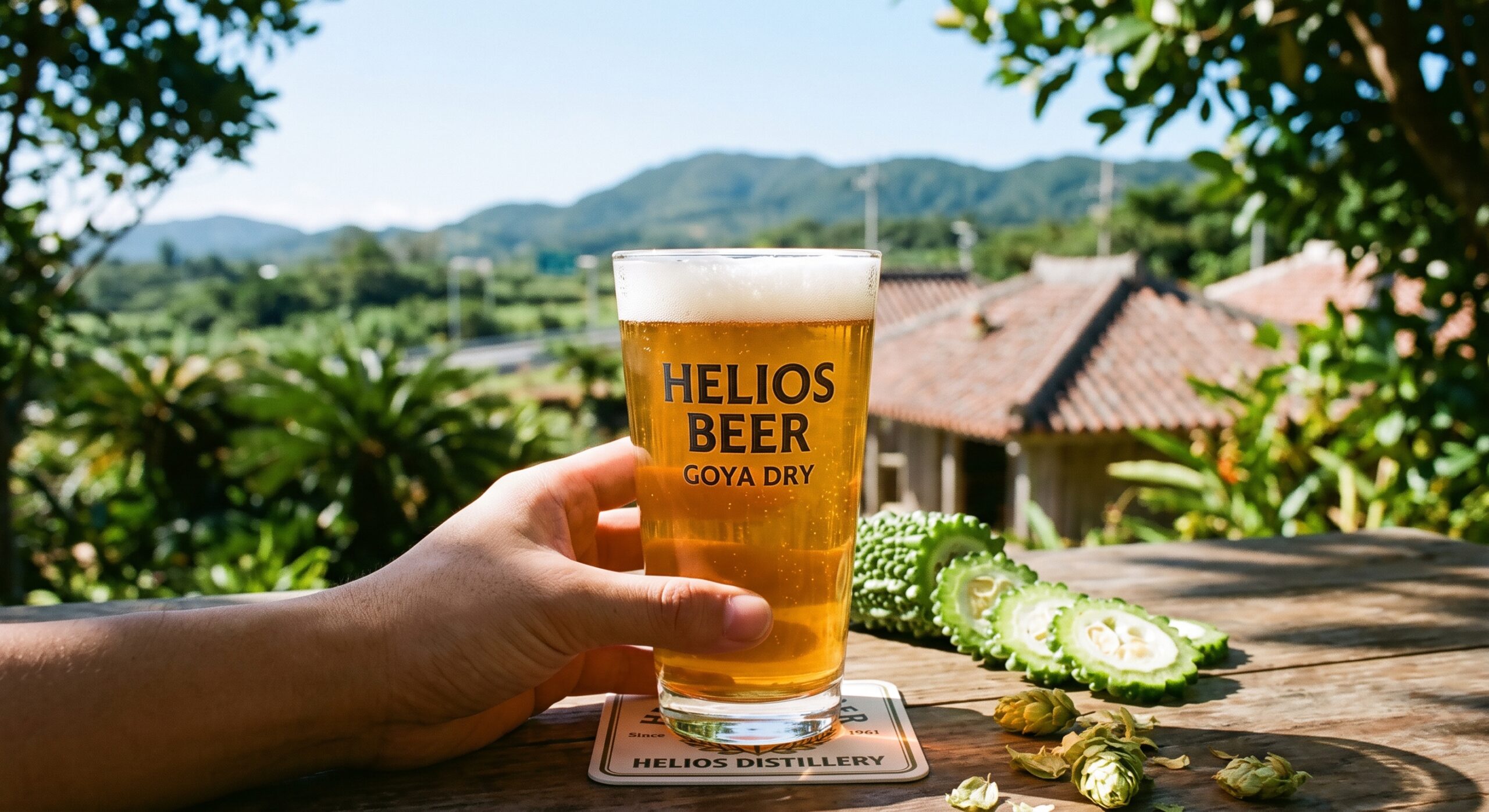
- Craft beer: Goya Dry — brewed with 100% Okinawan-grown goya (bitter melon) juice, 5% ABV, classified as “happoshu” (low-malt beer) under Japan’s liquor tax law / Helios Distillery Co., Ltd. (Kyoda, Nago City, Okinawa)
Official site: https://www.helios-syuzo.co.jp/product/goyadry - Music: “Shimanchu nu Takara” (“The Island People’s Treasure”) by BEGIN (2002)
YouTube: https://www.youtube.com/watch?v=p-vH03uhKCI
▶ If the player above doesn’t play, open it on YouTube
The Story of the Brewery
Helios Distillery was founded in 1961 in Kyoda, Nago City, Okinawa. It began as a maker of rum from Okinawan sugarcane and awamori — its “Kura” aged awamori is one of its best-known labels — and today holds six separate manufacturing licenses covering awamori, spirits, whisky, liqueurs, beer and happoshu.
It moved into craft beer after a 1994 revision to Japan’s liquor tax law opened the door to small-scale brewing. The very first batch of Helios Beer was born on June 20, 1996. Goya Dry, the beer featured here, puts goya (bitter melon) — a vegetable essential to the Okinawan summer table — front and center. Brewed from malt and hops with 100% Okinawan-grown goya juice, it is classified as “happoshu” under the liquor tax law, and was commercialized in 2003.
What makes this beer interesting is a kind of time lag in its bitterness. Hop bitterness hits hard on the first sip and then fades quickly — and then the refreshing bitterness of the goya follows behind it. In August 2011, on its first-ever entry, it won gold in the “Free Light Lager Style” category at the International Beer Competition 2011, hosted by the Japan Craft Beer Association. That same year, at the Japan Beer Festival Yokohama 2011, it also took the Kanagawa Governor’s Award and the Yokohama Mayor’s Award in the attendee popularity vote — a triple crown.
The Story of the Land
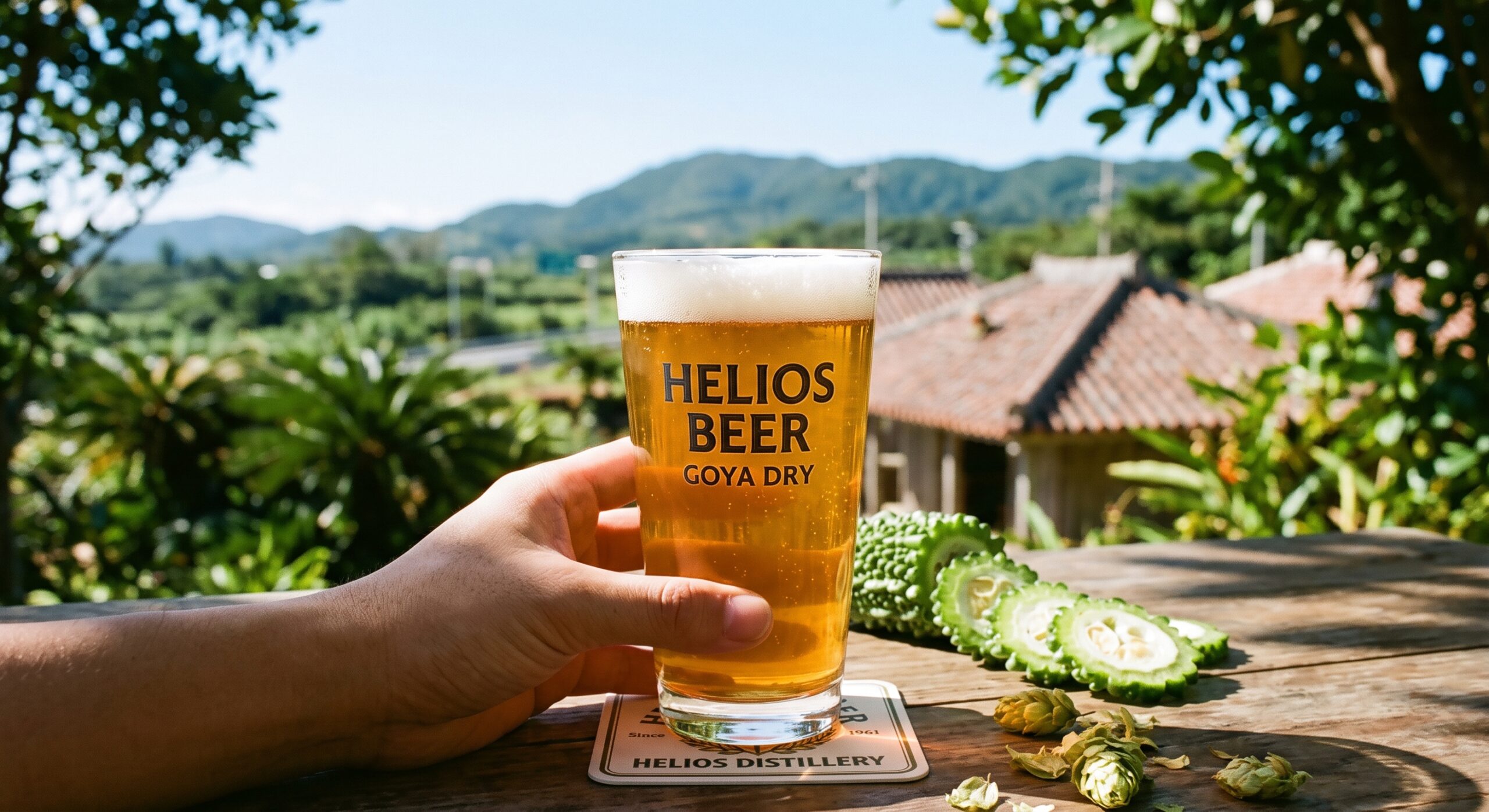
Kyoda, where Helios Distillery stands, sits at the entrance to Yanbaru, the northern region of Okinawa’s main island. Step off the Okinawa Expressway at the Kyoda Interchange nearby, and the subtropical green only grows thicker. Goya is the vegetable of the Okinawan summer, grown under that same strong sun — its bitterness puts some people off, but there is an old Okinawan saying that you get through the summer on goya.
It is a flavor that puts you on guard at first. But the more you eat it, the more you miss it when it’s gone. Rather than smoothing that bitterness away, Helios’s brewers chose to bring goya’s particular character straight into the beer.
The Story of the Song
“Shimanchu nu Takara” was released on May 22, 2002, as BEGIN’s 23rd single. BEGIN wrote, composed and arranged it themselves, and it appears on the album Begin no Shimauta ~Omoto Takeo 2~. 2002 also marked the 30th anniversary of Okinawa’s reversion to mainland Japan, and the song was used as the image song for NHK Okinawa’s coverage of that anniversary. In 2003 it won the lyrics category of the 3rd Yamamoto Kenkichi Literary Award.
BEGIN is made up of Eisho Higa, Yu Shimabukuro and Hitoshi Uechi — three childhood friends, all from Ishigaki Island in Okinawa Prefecture. They formed the band in Tokyo in 1988, appeared on a televised battle-of-the-bands show in 1989, and made their major-label debut on March 21, 1990.
The “treasure” in “Shimanchu nu Takara” is not the obvious kind — no gold, no silver. It is looking up at the sky, diving into the sea, humming songs handed down on the island like Tubaraama and Densaa-bushi — a song that asks how much you really know about the island where you grew up. It looks at nature not as a tourist resource but as something bound up with memory, passed from grandparents to parents to children.
Why This Pairing
Both are stories about not having to search far away. The treasure “Shimanchu nu Takara” sings about is not somewhere beyond the tourist map — it’s the island’s own sky and sea, songs you already know how to hum, all close at hand. Goya Dry’s bitterness works the same way. It may put you off at first, but for Okinawans who grew up on it, it’s a flavor you find yourself missing every summer. In both cases, the thing you were looking for turns out to have been inside the very bitterness you were keeping at arm’s length.
The flavor plays out the same way, in time lag. Hop bitterness arrives first, fades, and then the brighter bitterness of goya comes in behind it — a second wave rather than a single hit. That’s not unlike a song you keep returning to, where a different line catches you each time you listen.
Where to Find This Beer
The Rakuten Ichiba link below is an affiliate link.
- Brewery official site:https://www.helios-syuzo.co.jp/product/goyadry
- Search on Rakuten Ichiba:see results for “ヘリオス ゴーヤードライ”
These are Japanese storefronts. If you are visiting the brewery, drinking it fresh at their own taproom is by far the best option.
Pairing Dishes Worth Trying
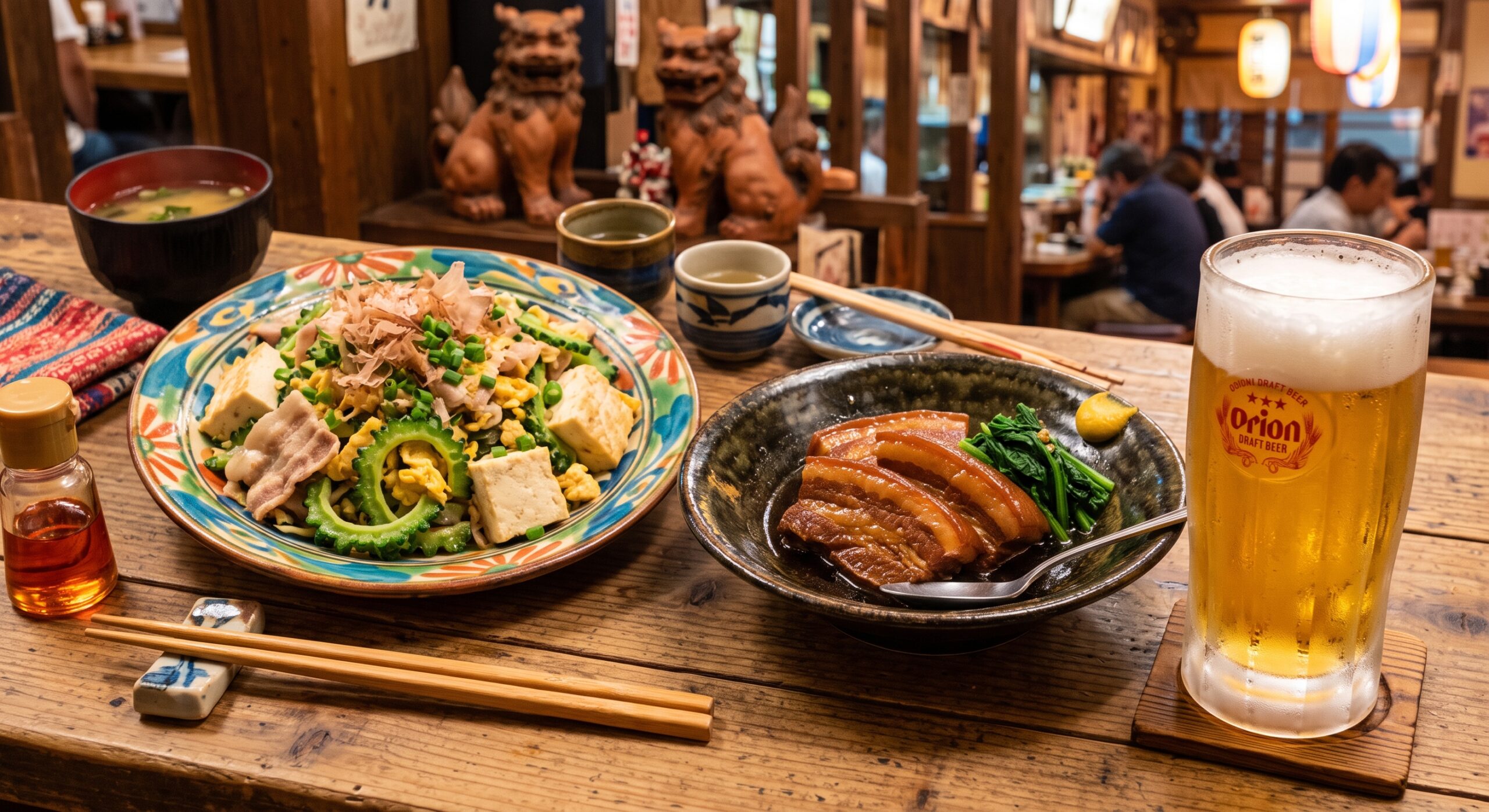
- Goya champuru
Okinawa’s staple home-cooked dish, stir-frying the same goya used in the beer with pork, tofu and egg. Cooking it this way softens the bitterness compared to eating goya on its own, and it echoes the goya notes already in the glass. - Rafute (braised pork belly)
A signature Okinawan pork dish. The hop bitterness and carbonation wash away the richness of the melting fat, so the next bite never feels heavy.
A note on the science: fat and umami are known to soften how bitterness registers on the palate. The fat in rafute and the umami from the pork and egg in goya champuru round off Goya Dry’s bitterness, while the iso-alpha acids from the hops and the beer’s carbonation cut through the oily film left behind, keeping each next bite tasting fresh.
Visiting the Brewery
Helios Distillery Co., Ltd.
405 Kyoda, Nago City, Okinawa. Right by the Kyoda Interchange on the Okinawa Expressway.
Brewery tours are offered, where visitors can see the distilling and brewing process.
Sights Nearby
- Michi-no-Eki Kyoda (Yanbaru Products Center) / Nago City | ~5 min, ~2 km by car from the brewery
Okinawa Prefecture’s very first roadside station, opened in 1994, known as the “gateway to Yanbaru” (the twelve municipalities of northern Okinawa) and selling their local specialty goods. Its road information terminal was renewed in 2021, adding a seaside parking area with an observation deck. - Nago Castle Park / Nago City | ~20 min, ~9 km by car from the brewery
A 690,000-square-meter park said to have the earliest-blooming cherry blossoms in Japan, thanks to its Kanhizakura trees. The city holds its Nago Cherry Blossom Festival here every January. - Orion Happy Park (Orion Beer’s Nago Brewery) / Nago City | ~15 min, ~8 km by car from the brewery
A brewery tour facility run by Orion Beer, one of Japan’s major brewers. The roughly 60-minute course, made up of a 35-minute tour and a 20-minute tasting, walks visitors from brewing through to bottling.
Opening hours and closing days can change. Please check each facility’s official information before visiting.
A Quick Glossary of Beer Terms
- Craft beer: Beer made by small breweries that put the character of the maker front and centre, as opposed to the uniformity of mass production.
- Local beer (ji-beer): The name given to beers that sprang up around Japan after a 1994 revision to the liquor tax law allowed small-scale brewing. These days most are called “craft beer” instead.
- Hops: The cones of a climbing plant, which give beer its bitterness and aroma. Depending on the variety, that aroma can read as citrus, tropical fruit or open grassland.
- Malt: Germinated barley. It forms the foundation of a beer’s sweetness, colour and body; how deeply it is roasted determines colour and toastiness.
Sources
- Goya Dry, Helios Distillery official site
- Helios Distillery official online shop — Goya Dry product page
- “Shimanchu nu Takara” — Wikipedia (Japanese)
- BEGIN — Wikipedia (Japanese)
- “Goya Dry” — Tabiyomi (Yomiuri Travel)
- Michi-no-Eki Kyoda — Okinawa Story (official tourism site)
If you notice any errors in this article, please don’t hesitate to reach out at info@soundrecords.jp.
Read this article in Japanese: 近くにあった宝物