日本語で読む | This is the English version of a bilingual article.
Today’s Pairing
- Sake: Kouro Junmai Ginjo — 16% alcohol (720ml) / Kumamoto Prefectural Sake Research Institute Co., Ltd. (1-7-20 Shimasaki, Chuo-ku, Kumamoto City, Kumamoto Prefecture)
Official site: https://www.kumamotoken-shuzoukenkyusho.com/ - Kayoukyoku (classic Japanese popular song): “Sanbyaku Rokujugo-ho no March” (“The March of 365 Steps”) by Kiyoko Suizenji, 1968
YouTube: https://www.youtube.com/watch?v=hEXAdhFPp7M
▶ If the player above doesn’t play, open it on YouTube
The Story of the Brewery

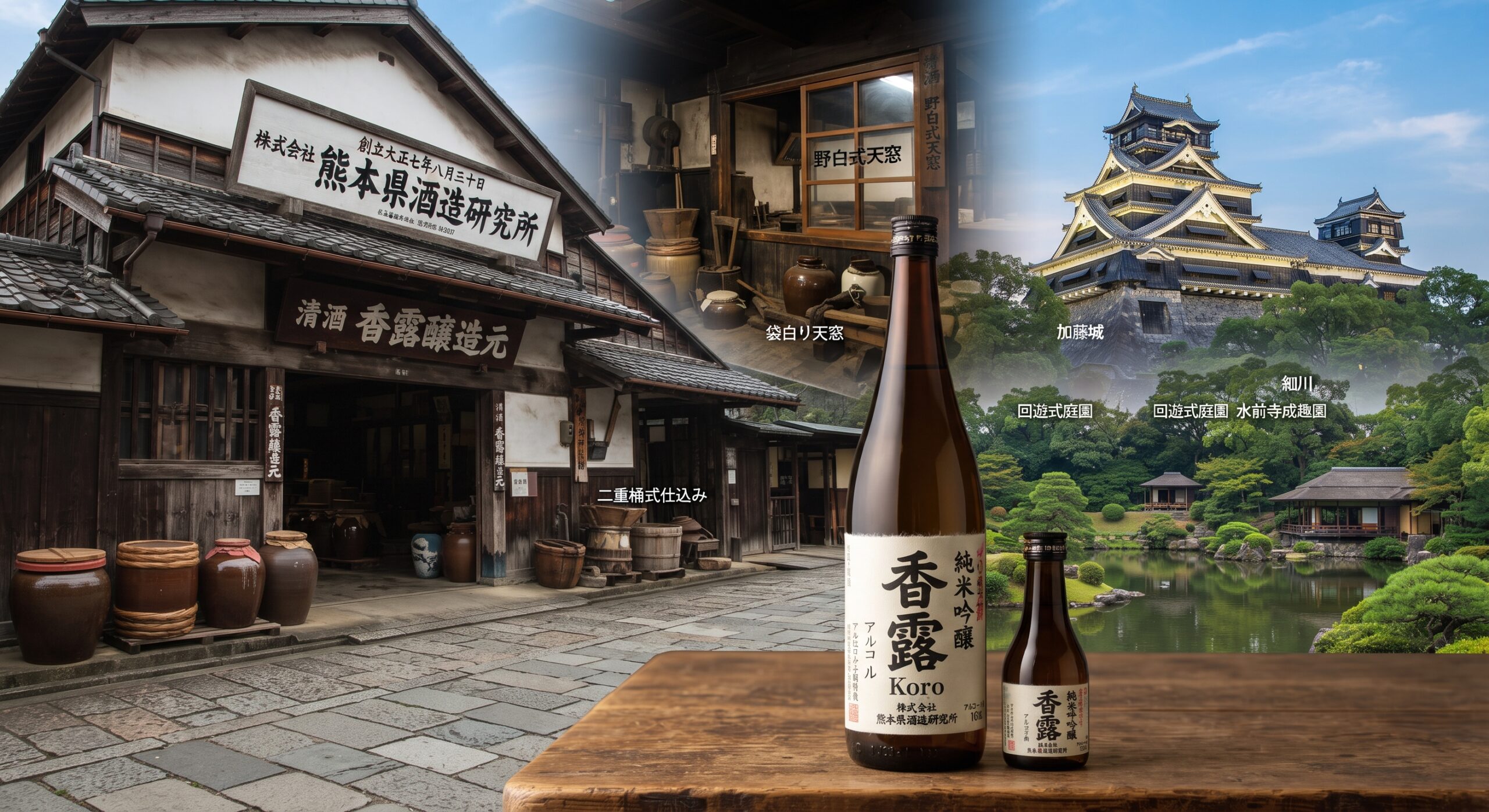
Not many sake breweries have the word “research institute” in their name. According to the Kumamoto Sake Brewers Association, the Kumamoto Prefectural Sake Research Institute was established in 1909 at the call of the prefecture’s own brewery owners, with the aim of improving the quality of sake made in Kumamoto. It was not a brewery handed down through one family, but a shared research body that the region’s brewers funded and staffed together, to make the prefecture’s sake better. Its official site gives August 30, 1918 as the date of its incorporation as a company. It still stands in Shimasaki, Chuo-ku, Kumamoto City, about 3 km west of Kumamoto Castle.
The following year, in 1919, the institute brought in Kinichi Noshiro as its first chief engineer and president. Its official site records that this man — later called “the god of sake” — devised techniques including double-vat mashing, bag pressing (fukuro-shibori), and the Noshiro-style skylight. He was someone who rebuilt even a skylight, even a pressing method, from brewing first principles.
Then, around 1952, the institute succeeded in isolating and cultivating the yeast living in its own brewery. This became “Kumamoto yeast.” According to the official site, that strain became the parent of what is now Kyokai yeast No. 9, which the Brewing Society of Japan began distributing nationwide in 1968. A yeast that gives a lifted, fragrant aroma with restrained acidity, well suited to brewing ginjo sake — the No. 9 yeast that breweries all over Japan still use today left from this brewery in Shimasaki, Kumamoto City. The Kumamoto Sake Brewers Association describes the yeast as, for the institute, “a tool for drawing out the flavor the toji wants to express,” and introduces the resulting daiginjo, Kouro, as a “phantom sake” with devotees across the country.
The bottle in this pairing is that brewery’s own Kouro Junmai Ginjo: 16% alcohol, 720ml. Brewing sake under your own name, with yeast you raised yourself — the slightly unusual position of being a research institute and a brewery at the same time is the background to this bottle.
The Story of the Land
Kumamoto City is a place where the work of two houses — Kato Kiyomasa’s and the Hosokawa clan’s — still survives as the shape of the city itself. According to the official Kumamoto Castle site, in 1607 Kato Kiyomasa completed the castle on the plateau then called Chausuyama, pouring in the most advanced engineering and labor of his day. Kiyomasa rests at Honmyo-ji, about a ten-minute drive from the brewery.
The Hosokawa family entered Higo Province after Kiyomasa. According to the official site of Suizenji Jojuen Garden, Hosokawa Tadatoshi became lord of the Kumamoto domain in 1632 and, struck by the clear spring water here while out hawking, built a teahouse called Suizenji Ochaya — the origin of the garden. Major garden construction followed under the second and third lords, Mitsunao and Tsunatoshi, and in 1671 the graceful Momoyama-style strolling garden was completed. The garden’s name, Jojuen, comes from a poem by the Chinese poet Tao Yuanming.
A singer from Kumamoto City put those two names — Kiyomasa, and Suizenji — side by side and made them her stage name. That singer is Kiyoko Suizenji.
The Story of the Song
According to her official profile at Crown Record, Kiyoko Suizenji was born Tamiko Hayashida on October 9, 1945, in Kumamoto City, Kumamoto Prefecture. She debuted in 1964 with “Namida o Daita Wataridori,” and appeared on NHK’s Kohaku Uta Gassen for the first time the following year, in 1965. Her 1966 release “Ippon Dokko no Uta” sold over a million copies, and she was chosen to host Kohaku for the first time. Her nickname “Chita” is said to come from the lyricist Tetsuro Hoshino, who called the petite singer “chiisana Tami-chan” — “little Tami.”
Her stage name comes straight from her hometown. “Suizenji” is taken from Kumamoto City’s Suizenji Jojuen Garden, and “Kiyoko” from Kato Kiyomasa, the warlord tied to Kumamoto. Surname and given name alike: the place name of the town she was born in, and the name of the man who built it. When she became a singer, she made a calling card out of two layers of home.
“Sanbyaku Rokujugo-ho no March” was released on November 10, 1968, with lyrics by Tetsuro Hoshino, music by Masao Yoneyama, and arrangement by Jinzo Kosugi. Her official Crown Record profile notes that the song passed a million copies sold, was chosen as the entrance march for the 41st National High School Baseball Invitational Tournament, and won the Popular Award at the Japan Record Awards. It maps the 365 days of a year onto 365 steps walked without rest — an encouragement song that sets a particular idea to a marching rhythm: you may slip back as far as you advance, and still, each day, you are one step further on.
Why This Pairing
These two share a year: 1968. It is the year Kumamoto yeast began to be distributed nationwide by the Brewing Society of Japan as Kyokai yeast No. 9, and the year “Sanbyaku Rokujugo-ho no March” was released. A yeast raised in a brewery in Shimasaki, Kumamoto City, and an encouragement song sung by a singer born in Kumamoto City, both left Kumamoto for the rest of Japan in the same year.
And both are stories about moving one step at a time. The yeast was isolated and cultivated around 1952; it took well over a decade from there to nationwide distribution. Count from 1919, when Kinichi Noshiro was brought in as chief engineer, and it is nearly half a century. True to the word “research institute,” that span holds the accumulated failures and small adjustments of people looking for how to make good sake. Few brewery histories map so plainly onto the song’s premise: you slip back as far as you advance, and still you take a step each day.
Even the naming echoes. Kiyoko Suizenji took her hometown’s place name and the name of the man who built it, and made them her own. The research institute isolated the yeast living in its own brewery, named it “Kumamoto yeast,” put the prefecture’s name on its back, and sent it out across the country. Neither went out into the world under one person’s name, but under the name of a place.
The restrained acidity of No. 9 yeast, and an aroma that rises cleanly. Put this march on with a glass in hand, and it starts to sound like the story of a yeast that walked all the way across Japan, three steps forward and two steps back.
Where to Find This Bottle
The Rakuten Ichiba link below is an affiliate link.
- Brewery’s official site: https://www.kumamotoken-shuzoukenkyusho.com/
- Buy on Rakuten Ichiba: View the product page (720ml, ¥3,520)
Note: the links above lead to Japan-based retailers. They’re most convenient for readers in Japan, or for those elsewhere who are able to arrange international shipping. Stock and availability change over time, so if you’re near a specialty sake shop, it’s well worth asking for this label by name.
Pairing Dishes Worth Trying

- Karashi renkon (mustard-stuffed lotus root)
According to the Ministry of Agriculture, Forestry and Fisheries’ “Local Cuisines of Japan,” the dish began in 1632, when the monk Gentaku of Rakan-ji, concerned for the frail health of Tadatoshi, first Hosokawa lord of Higo, mixed miso with Japanese mustard, packed it into the holes of a lotus root, coated it in wheat flour, broad-bean flour and egg yolk, and fried it. That a cross-section of the root resembled the Hosokawa family crest, the kuyo mon, mattered too — and the recipe is said to have been kept a closely guarded secret until the Meiji Restoration. The mustard heat that shoots up the nose is caught and carried by the gentle in-mouth aroma of a junmai ginjo.
Recipe (in Japanese): Kurashiru, “Let’s Make Karashi Renkon at Home” - Hitomoji no guruguru (rolled scallions)
The same Ministry of Agriculture source says this dish is thought to have begun under the sixth lord, Hosokawa Shigekata, when the Higo domain’s finances were strained and austerity orders were issued: it was devised as a cheap but delicious snack to drink with. Blanched hitomoji (a type of scallion) is folded, and the green leaves are wound round and round the white root as a core. The appeal is the crisp bite, the distinctive aroma and the sweetness, eaten with vinegared miso. A snack born of an austerity order — there is no better companion for a song about one step at a time.
Recipe (in Japanese): DELISH KITCHEN, “Hitomoji Guruguru with Refreshing Vinegared Miso”
A note on the science: the pungent compound in Japanese mustard (allyl isothiocyanate) is volatile and shoots up through the nose, but the alcohol and water in sake dilute it in the mouth and soften how sharply it arrives. With the scallions, meanwhile, the acidity of vinegared miso tightens the miso’s saltiness and pushes the sweetness of the allium forward — and the amino-acid umami of a junmai ginjo overlaps with the umami in that miso for a synergistic lift.
Visiting the Brewery
Kumamoto Prefectural Sake Research Institute Co., Ltd.
1-7-20 Shimasaki, Chuo-ku, Kumamoto City, Kumamoto Prefecture. About 10 min by car from JR Kumamoto Station.
Founded on August 30, 1918. This is the brewery where Kyokai yeast No. 9 — the “Kumamoto yeast” — was born. (The official site lists no tour or on-site sales information, so please inquire in advance if you hope to visit.)
Sights Nearby
- Honmyo-ji Temple / Hanazono, Nishi-ku, Kumamoto | ~7 min, ~2 km by car from the brewery
The family temple of the warlord Kato Kiyomasa. A stone-paved approach lined with sub-temples leads to a long stairway, and at the top stand the Jochibyo mausoleum where Kiyomasa rests and a bronze statue of him. The “Kiyo” in Kiyoko Suizenji’s stage name comes from this same Kiyomasa. The grounds are open to visitors; please check ahead regarding the treasure hall’s opening status. - Suizenji Jojuen Garden (Suizenji Park) / Suizenji-koen, Chuo-ku, Kumamoto | ~20 min, ~7 km by car from the brewery
The garden began in 1632, when Hosokawa Tadatoshi became lord of the Kumamoto domain and, struck by the clear spring water here while out hawking, built a teahouse called Suizenji Ochaya. Major garden construction followed under the second and third lords, Mitsunao and Tsunatoshi, and the Momoyama-style strolling garden was completed in 1671. Its name comes from a poem by the Chinese poet Tao Yuanming. On October 7, 1878, Izumi Shrine was founded within the grounds to enshrine Hosokawa Fujitaka, Tadaoki and the successive lords of the domain. The “Suizenji” in Kiyoko Suizenji’s stage name is taken from this garden. Open 8:30–17:00 (last entry 16:30), open year-round; admission ¥500 for adults, ¥200 for children. - Kumamoto Castle / Honmaru, Chuo-ku, Kumamoto | ~10 min, ~3 km by car from the brewery
Completed in 1607 by Kato Kiyomasa, who poured the most advanced engineering of his day into the plateau then known as Chausuyama. From September through June, open 9:00–17:00 (last entry 16:00; last entry to the castle tower 16:30); admission ¥800 for high school students and above, ¥300 for elementary and junior high students. Hours are extended in July and August — check the official site before visiting.
Hot Springs Nearby
- Yulax / Honjo-machi, Chuo-ku, Kumamoto | ~12 min, ~4 km by car from the brewery
A natural hot spring inside Kumamoto City. Day-use bathing is ¥900 on weekdays and ¥1,000 on weekends and holidays (tax included). The baths and sauna are open 10:00 to 8:00 the following morning; bathing is closed 8:00–10:00 for cleaning. Please confirm prices and hours before visiting.
Opening hours, closing days and day-use bathing availability can change. Please check each facility’s official information before visiting.
A Quick Glossary of Sake Terms
- Junmai Ginjo: Sake made only from rice, rice koji and water (junmai), brewed by the ginjo method with rice polished to 60% or less of its original weight, giving a more fragrant, finer-grained style.
- Ginjo: Sake brewed with highly polished rice at low temperatures over a long fermentation, producing the fruity, floral aroma known as ginjo-ka.
- Seimai buai (rice-polishing ratio): The percentage of the original grain remaining after milling. The lower the number, the more the rice has been polished down.
Sources
- Kumamoto Prefectural Sake Research Institute Co., Ltd. – Official Site
- Kumamoto Prefectural Sake Research Institute – Kumamoto Sake Brewers Association
- Kiyoko Suizenji – Profile, Nippon Crown / Crown Record (Official)
- Kiyoko Suizenji – Wikipedia (Japanese)
- Sanbyaku Rokujugo-ho no March – Wikipedia (Japanese)
- Suizenji Jojuen Garden / Izumi Shrine – Official Site (History)
- Suizenji Jojuen Garden / Izumi Shrine – Official Site (Visitor Information)
- Kumamoto Castle – Official Site (Visitor Information)
- Honmyo-ji Temple – Kumamoto Prefecture Official Tourism Site
- Karashi Renkon, Kumamoto – MAFF, “Local Cuisines of Japan”
- Hitomoji no Guruguru, Kumamoto – MAFF, “Local Cuisines of Japan”
- Yulax – Official Site
If you notice any errors in this article, please don’t hesitate to reach out at info@soundrecords.jp.
Read this article in Japanese: 同じ年に、熊本から出ていった