日本語で読む | This is the English version of a bilingual article.
Today’s Pairing
- Sake: Kid (紀土) Junmai Daiginjo, 720ml / Heiwa Shuzou Co., Ltd. (119 Mizonokuchi, Kainan, Wakayama; founded 1928)
Official site: https://www.heiwashuzou.co.jp/ - Music: “Iwai-zake” by Sakamoto Fuyumi (1988; lyrics by Takata Kashi, music by Inomata Koshou, arrangement by Kosugi Jinzou)
YouTube: https://www.youtube.com/watch?v=unmpzqkyNV8
▶ If the player above doesn’t play, open it on YouTube
The Story of the Brewery
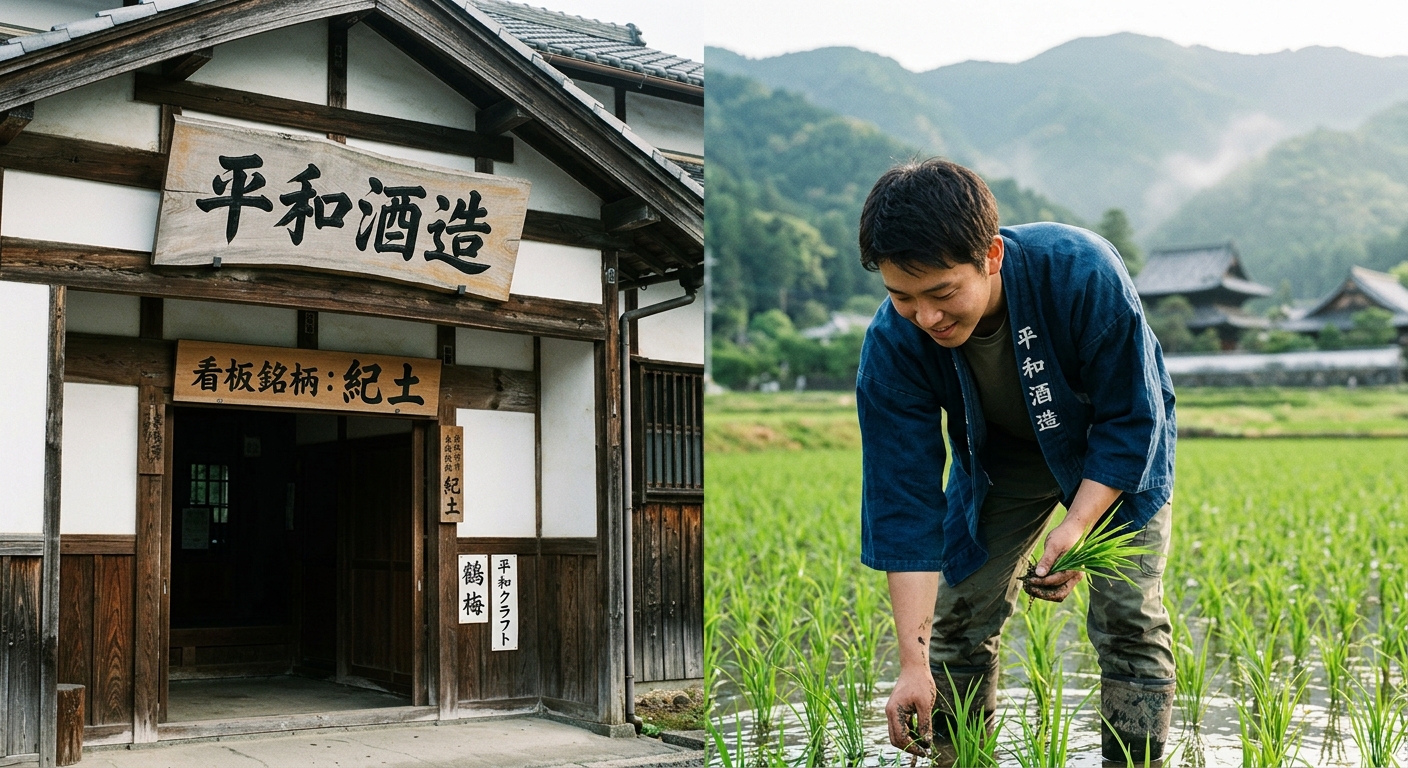
Heiwa Shuzou stands in the Mizonokuchi district of Kainan, Wakayama, and was founded in 1928. By the brewery’s own account, it began when Tamotsu Taniguchi — of Taniguchi Shuzou, a brewing house dating back to the Edo period — married into the Yamamoto family, took over as head of the household, and let his love of sake carry him into starting a brewery of his own.
The name came later.
During the war the brewery was shut down. Yasumasa Yamamoto, the second-generation head, went as far as the National Diet to petition for permission to resume brewing. What he spoke of there was his wish to brew sake in the peaceful era that would follow the war. That wish became the name of the brewery: heiwa, peace.
Those two characters were not chosen because they sounded auspicious. They were set down by someone who had lived through a time when sake could not be made, and who was looking at what came next.
The brewery’s flagship sake today is Kid. The Tsurume plum wine series and a craft beer line, Heiwa Craft, come from the same house.
There is one more thing the brewery has written down, about its rice. The toji and the brewery staff who make the sake in winter plant the seedlings themselves in early summer and tend the fields through to the harvest. This was not started as a whim, the site says: it came about when the worries of an area short of successors met the feelings of a young brewery worker who had grown up in a rice-farming family. “Sake is alive; people are the bridge” is how the brewery puts it.
The Story of the Land
On the western side of the Kii Peninsula, where Kainan sits, things that have lasted a thousand years are scattered about.
Chohoji Temple, a twenty-minute drive from the brewery, is said to have been founded in the year 1000 by imperial decree of Emperor Ichijo. Its main hall, its pagoda and its great gate are all three National Treasures — a set the temple notes is matched only by Horyuji in Nara. In 1666 it was designated the family temple of Yorinobu, the first lord of the Kishu branch of the Tokugawa clan.
In a place where a temple has stood for a thousand years, a brewery that was stopped once by a war started making sake again. The two run on very different timescales, and yet both are doing the same thing: continuing.
The Story of the Song
Fuyumi Sakamoto was born on 30 March 1967 in Kamitonda, Nishimuro District, Wakayama. From April 1986 she spent roughly two years as a live-in apprentice to the composer Koshou Inomata, and in 1987 she made her debut with “Abare Daiko.”
“Iwai-zake” came in 1988, with lyrics by Kashi Takata, music by her teacher Inomata, and arrangement by Jinzou Kosugi. It won a Gold Prize at the 30th Japan Record Awards that year, and it was the song she sang at the end of that same year on her first appearance at the 39th NHK Kohaku Uta Gassen.
It is a song about the sake poured at a celebration, sung straight.
Why This Pairing
“Iwai-zake” is a song about sake poured in order to celebrate. And the name Heiwa was given out of a wish for a time in which celebration would be possible.
What I find interesting is that the order is reversed. The song stands inside a celebration that has already arrived. The brewery named itself toward a peace that had not yet come.
A singer born in Wakayama, singing in 1988 about celebratory sake. A brewery in Wakayama that renamed itself after the war and is brewing still. Put the two side by side and something becomes faintly visible: that being able to pour a drink for one another is not quite as ordinary as it looks.
Kid Junmai Daiginjo is fragrant and clear. It suits a celebration, and it suits an evening with nothing in particular happening. Being able to drink it on an evening with nothing happening is probably the greater luxury.
Where to Find This Bottle
The Rakuten Ichiba link below is an affiliate link.
- Brewery’s official site: https://www.heiwashuzou.co.jp/
- Buy on Rakuten Ichiba: View the product page (720ml, ¥1,996)
Note: the links above lead to Japan-based retailers. They’re most convenient for readers in Japan, or for those elsewhere who are able to arrange international shipping. Stock and availability change over time, so if you’re near a specialty sake shop, it’s well worth asking for this label by name.
Pairing Dishes Worth Trying
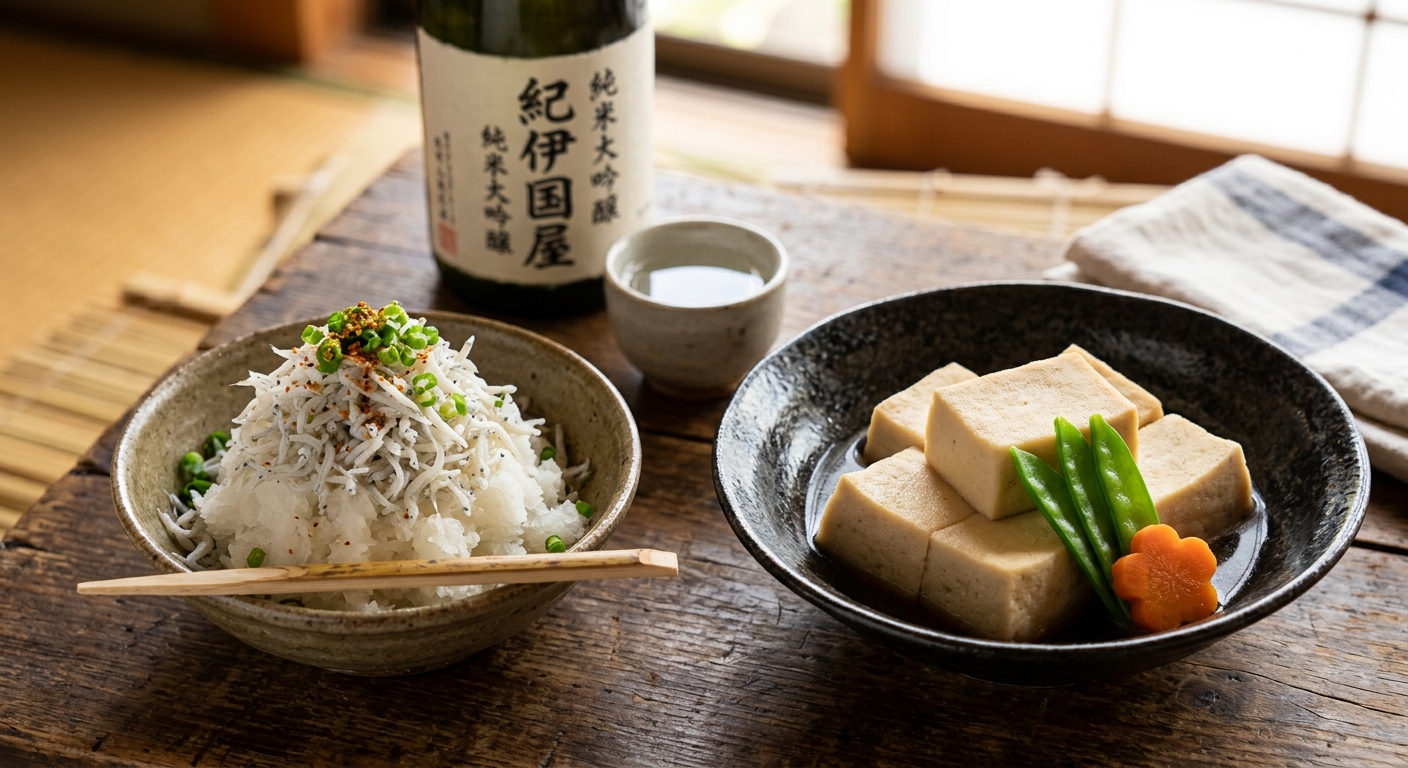
- Shirasu oroshi (whitebait with grated daikon)
Wakayama has active whitebait fisheries at Kada, Yuasa and elsewhere. Nothing more than the sharpness of grated daikon and the salt of the fish — a dish that asks almost nothing of you and does not get in the way of a daiginjo’s clean aroma.
Recipe (in Japanese): Kurashiru, “Turnip Shirasu Oroshi” (the same method works with daikon) - Koya-dofu simmered in dashi
Koya-dofu, freeze-dried tofu, is said to have originated on Mount Koya in Wakayama. Simmered full of dashi, its quiet flavor settles the palate without flattening the sake’s aroma.
Recipe (in Japanese): Kurashiru, “Koya-dofu Simmered in Dashi”
A note on the science: the pungent compounds in grated daikon (isothiocyanates) are highly volatile and quickly lower the impression of fat or fishiness in the mouth. Simmered dishes heavy with dashi, like koya-dofu, leave umami compounds such as glutamate behind instead, which makes the next sip of sake read as sweeter. A fragrant junmai daiginjo pairs well with dishes that reset the palate this way.
Visiting the Brewery
Heiwa Shuzou Co., Ltd.
119 Mizonokuchi, Kainan, Wakayama. About a 15-minute drive from Kainan Station on the JR Kisei Main Line.
Besides the sake brand Kid, the brewery makes the Tsurume plum wine series and a craft beer line, Heiwa Craft.
Sights Nearby
- Chohoji Temple / Kainan | ~20 min, ~18 km by car from the brewery
Founded in the year 1000 by imperial decree of Emperor Ichijo, according to tradition. Its main hall, pagoda and great gate are all three designated National Treasures — a combination the temple’s own site notes is shared only with Horyuji in Nara. In 1666 it was made the family temple of the Kishu branch of the Tokugawa clan. - Kimiidera Temple / Wakayama City | ~18 min, ~15 km by car from the brewery
Said to have been founded in 770 by Ikou, a monk who came from Tang China. It is known for its cherry blossoms, and the Saigoku Kannon pilgrimage it belongs to is registered as a Japan Heritage route.
Hot Springs Nearby
- Kishu Kuroshio Onsen / Wakayama City (inside Wakayama Marina City) | ~15 min, ~12 km by car from the brewery
A day-use hot spring looking out over the sea, open 11:00–23:00 (last entry 22:00). Admission is 1,100 yen for adults on weekdays, 1,200 yen on weekends and holidays.
Opening hours, closing days and day-use bathing availability can change. Please check each facility’s official information before visiting.
A Quick Glossary of Sake Terms
- Junmai daiginjo: sake made only from rice, rice koji and water, with the rice polished down to 50% or less of its original size. It tends toward fragrance and clarity.
- Seimai buai (rice-polishing ratio): the percentage of the rice grain that remains after milling. A lower number means more of the outside has been polished away.
Sources
- Heiwa Shuzou Co., Ltd. — official site
- The history of Heiwa Shuzou
- OUR STORY — Heiwa Shuzou
- Chohoji Temple — official site
- Kimiidera Temple — official site
- Kishu Kuroshio Onsen — Wakayama Marina City
- “Iwai-zake” — Wikipedia (Japanese)
- Sakamoto Fuyumi — Wikipedia (Japanese)
If you notice any errors in this article, please don’t hesitate to reach out at info@soundrecords.jp.
Read this article in Japanese: 平和な時代に、酒を造りたい