日本語で読む | This is the English version of a bilingual article.
Today’s Pairing
- Sake: “Miyamizu no Hana” Tokubetsu Junmai — brewed with 100% Hyogo-grown Yamada Nishiki sake rice, rice-polishing ratio (seimai buai) 65%, 15–16% alcohol / Sakuramasamune Co., Ltd. (5-10-1 Uozaki-Minamimachi, Higashinada-ku, Kobe, Hyogo Prefecture)
Official site: https://www.sakuramasamune.co.jp/ - Kayoukyoku (classic Japanese popular song): “Soshite, Kobe” (“And, Kobe”) by Uchiyamada Hiroshi and Cool Five, 1972
YouTube: https://www.youtube.com/watch?v=nIV6gbn3JhU
▶ If the player above doesn’t play, open it on YouTube
The Story of the Brewery
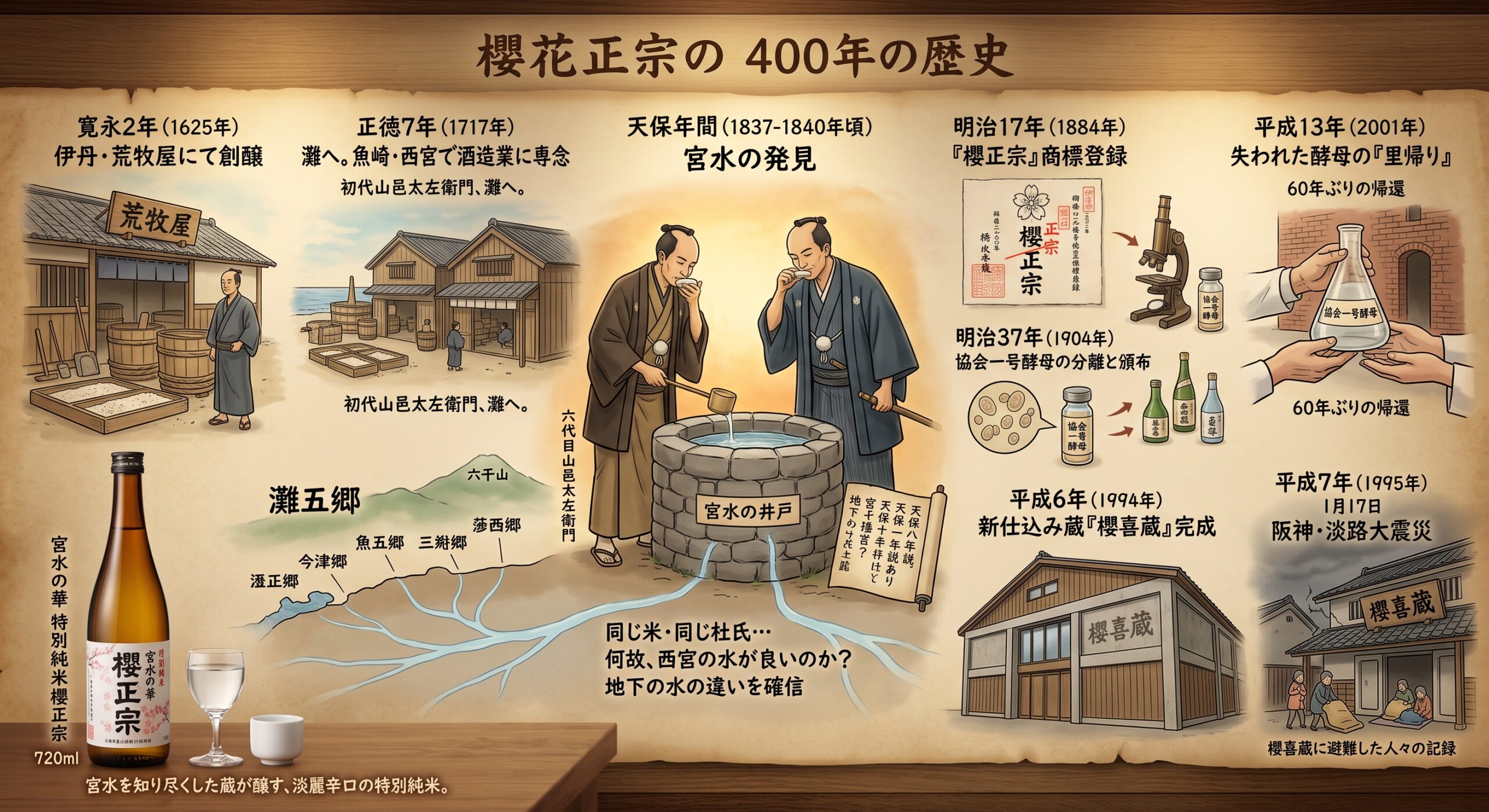
Sakuramasamune Co., Ltd. traces its brewing back to 1625, when it began as Aramaki-ya in Itami, in what was then Settsu Province. In 1717, the first-generation Yamamura Tazaemon took that name and devoted the business fully to sake brewing in Uozaki and Nishinomiya, in the Nada region — the year the company now recognizes as its founding as a brewery. The name Yamamura Tazaemon has been passed down through the generations ever since; the current head of the brewery is the 11th to bear it.
In the time of the sixth-generation Tazaemon, the brewery was making sake at two locations, Nishinomiya and Uozaki. Despite using the same rice and the same toji (master brewer), the Nishinomiya sake was always noticeably better. After much trial and error, he traced the difference to the water — specifically, the well water at the Umenoki brewery in Nishinomiya. This discovery, later known as “Miyamizu,” would go on to underpin Nada’s reputation as one of Japan’s great sake-brewing regions. It happened sometime in the late Edo period, during the Tenpo era; historical accounts differ on the exact year (some say 1837, others 1840), so no single date can be pinned down here. By identifying a difference in underground water invisible to the eye, this discovery dramatically improved the quality of Nada’s sake.
In 1884, the brewery attempted to register “Masamune” as a trademark, but the application was rejected because the term was already in common use; it registered instead as “Sakuramasamune,” adding its own house name, Sakura (“cherry blossom”). Then, in 1904, a yeast strain isolated from this brewery’s fermenting mash was distributed nationwide as “Kyokai (Brewing Society) Yeast No. 1,” helping raise sake quality at breweries across Japan. That strain was believed to have been lost from the brewery amid the chaos of the postwar years. In 2001, however, a sample preserved outside the brewery was found, and the yeast made its way “home” after 60 years — something once thought lost, quietly returning.
In 1994, the brewery completed a new fermentation building, Sakuki-gura. The following year, on January 17, 1995, the Great Hanshin-Awaji Earthquake struck. According to the brewery’s own records, many local residents who had lost their homes found their way to the newly built Sakuki-gura and took shelter there for a time. The bottle in this pairing, “Miyamizu no Hana” Tokubetsu Junmai, is a light, slightly dry junmai brewed by a brewery that knows that water intimately, using Hyogo-grown Yamada Nishiki rice polished to a seimai buai of 65%.
The Story of the Land
Uozaki, in Kobe’s Higashinada Ward, sits within Uozaki-go, one of the five brewing districts collectively known as “Nada Gogo” (Nishinomiya-go, Imazu-go, Uozaki-go, Mikage-go, and Nishi-go) — one of Japan’s foremost sake-producing regions. According to the Nada Gogo Brewers’ Association, Miyamizu is groundwater flowing down from the Rokko mountain range. Sakuramasamune shares this same Uozaki-Sumiyoshi stretch of the city with other major Nada breweries such as Kikumasamune and Hakutsuru, making it a small area packed with historic sake houses — a special place for anyone who loves Japanese sake.
The Story of the Song
“Soshite, Kobe” was released on November 15, 1972, the 14th single by Uchiyamada Hiroshi and Cool Five. The lyrics are by Senke Kazuya, the music by Hama Keisuke, and the arrangement by Morioka Kenichiro. It reached a peak of No. 6 on the Oricon charts and won the Composition Award at the 15th Japan Record Awards, as well as the 6th Japan Cable Broadcasting Grand Prize.
Maekawa Kiyoshi, the group’s lead vocalist, has performed the song multiple times on NHK’s Kohaku Uta Gassen year-end song contest: in 1991 (the 42nd edition), 1995 (the 46th), 2004 (the 55th, with The Gospellers), and 2007 (the 58th, with Cool Five). The 1995 performance fell at the very end of the year in which the Great Hanshin-Awaji Earthquake caused massive damage centered on Kobe, the city at the heart of this song.
Why This Pairing
This brewery’s history is full of things that supported the city from out of sight. Miyamizu had been welling up beneath the ground all along, quietly shaping the quality of Nada’s sake long before the sixth-generation brewer ever noticed it. The Kyokai No. 1 yeast, once distributed across the country, was thought lost — only to make its way back to the brewery sixty years later. And a fermentation building, just completed, ended up doing the opposite of what a major earthquake might have done to it: it became a place where people found shelter.
The end of 1995, when “Soshite, Kobe” was sung on Kohaku, came less than a year after that earthquake. The song itself isn’t about the disaster, but a song set in Kobe was, once again, playing in living rooms across the country in the very year the city had been hit hardest.
Water that had been resting unseen underground, yeast that found its way back to the brewery, and a building that held firm through the shaking — each of them quietly supported the city without drawing attention to itself. As you take a sip of this sake, take a moment to think about the things that hold a city up from beneath the ground.
Where to Find This Bottle
The Rakuten Ichiba link below is an affiliate link.
- Brewery’s official site: https://www.sakuramasamune.co.jp/
- Buy on Rakuten Ichiba: View the product page (720ml, ¥2,023)
Note: the links above lead to Japan-based retailers. They’re most convenient for readers in Japan, or for those elsewhere who are able to arrange international shipping. Stock and availability change over time, so if you’re near a specialty sake shop, it’s well worth asking for this label by name.
Pairing Dishes Worth Trying
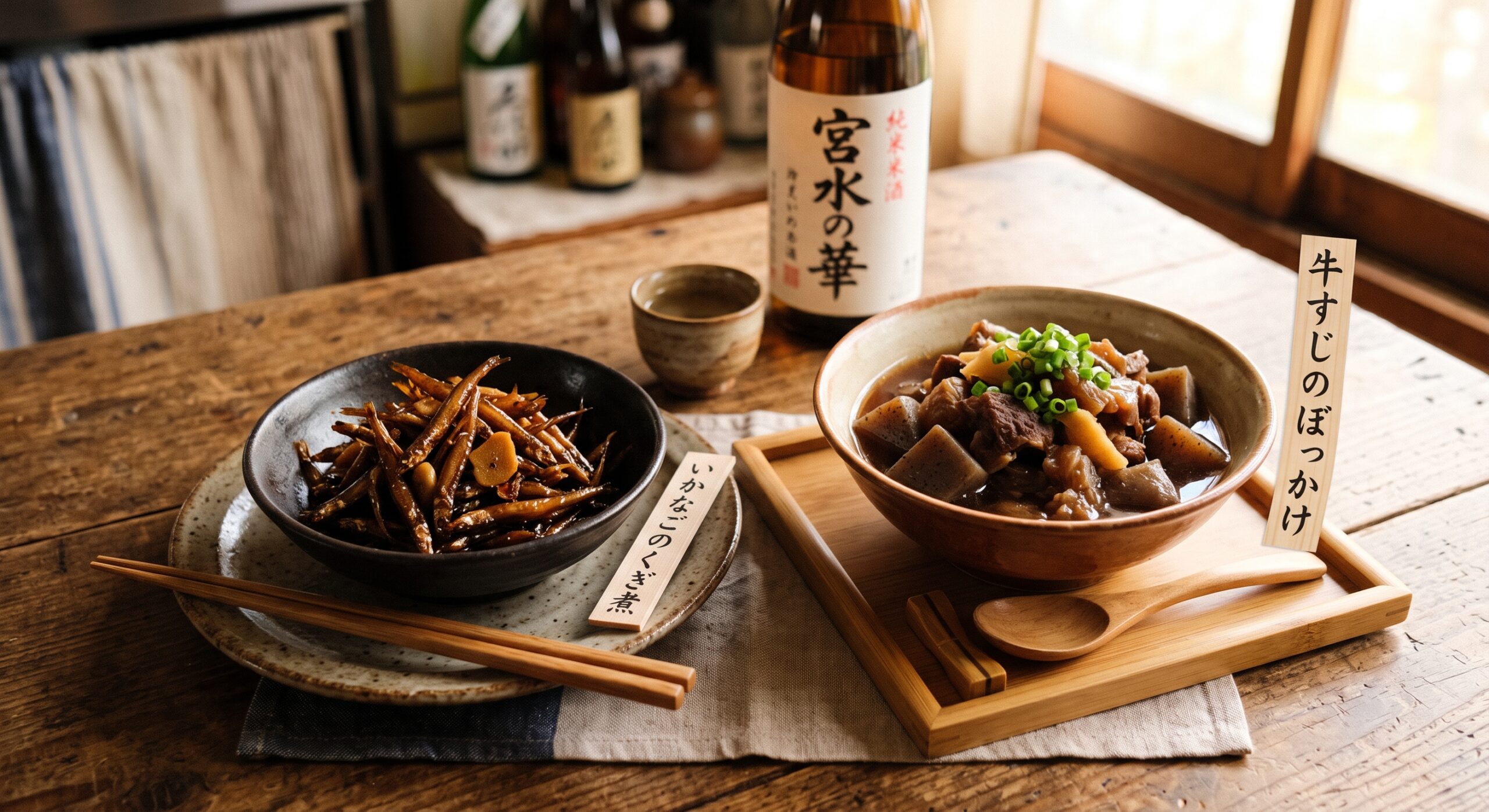
- Ikanago no Kugini (simmered young sand lance)
A springtime local specialty said to have originated in Kobe and Hyogo. Young sand lance are simmered down in soy sauce, sugar, and ginger into a sweet-savory preserve — a taste of the sea right off Nada’s coast. Its toasty, caramelized notes and gentle sweet-and-salty balance pair naturally with the crisp, slightly dry finish of “Miyamizu no Hana.”
Recipe (in Japanese): Cookpad, “Easy, No-Fail Ikanago no Kugini” - Gyusuji no Bokkake (simmered beef tendon and konnyaku)
A Kobe soul food: beef tendon and konnyaku simmered in a sweet-savory sauce until tender. The rich, gelatinous depth of the long-simmered beef tendon stands up well to a junmai sake with a straightforward, rice-forward umami.
Recipe (in Japanese): Kurashiru, “Carefully Made Sweet-and-Savory Beef Tendon Bokkake”
A note on the science: the long-simmered sweet-savory sauces in both dishes are rich in Maillard-reaction aromatic compounds from prolonged heating, along with glutamic acid and other umami compounds from the ingredients themselves. These resonate with the amino-acid umami in junmai sake, producing a synergistic boost of savoriness on the palate.
Visiting the Brewery
Sakuramasamune (head brewery)
5-10-1 Uozaki-Minamimachi, Higashinada-ku, Kobe, Hyogo. Within walking distance of Hanshin Railway’s Uozaki Station and the Rokko Liner’s Minami-Uozaki Station.
It stands in Uozaki-go, one of the five brewing districts of Nada; the same neighborhood is home to the breweries and museums of other major Nada sake makers such as Kikumasamune and Hakutsuru.
Sights Nearby
- Kikumasamune Sake Brewery Memorial Museum / Uozaki, Higashinada-ku | ~10 min on foot from Sakuramasamune
A sake-brewing museum run by Kikumasamune, another brewery in the same Uozaki-go district. Free admission (9:00–16:30; closed Tuesdays from April 2026 onward, plus New Year’s). See the tools and vats once used for brewing in Nada up close. - Hakutsuru Sake Brewery Museum / Sumiyoshi-Minamimachi, Higashinada-ku | ~10 min, ~2 km by car from Sakuramasamune
A museum in the neighboring Sumiyoshi area, in the same Uozaki brewing district. Free admission. Life-size figures and tools recreate a full year of sake brewing in Nada. As of 2026, construction of a new brewhouse limits some parking, so check the official site before visiting.
Hot Springs Nearby
- Koino-yu Onsen Uhara no Yu / Sumiyoshi-Higashimachi, Higashinada-ku | ~10 min, ~3 km by car from Sakuramasamune
A day-use bathhouse drawing on natural hot spring water pumped from underground. Open 6:00–23:30 (adults ¥1,200, ¥1,300 on weekends/holidays). A bath towel and face towel set is included free of charge.
Opening hours, closing days and day-use bathing availability can change. Please check each facility’s official information before visiting.
A Quick Glossary of Sake Terms
- Tokubetsu Junmai: Junmai (sake made only from rice, rice koji, and water, with no added brewing alcohol) brewed with a special method or rice, disclosed on the label.
- Seimai buai (rice-polishing ratio): The percentage of the original grain remaining after milling. The lower the number, the more the rice has been polished down.
Sources
- Sakuramasamune Co., Ltd. – Official Site
- Brewery History & Company Profile – Sakuramasamune Official Site
- “Miyamizu no Hana” Tokubetsu Junmai – Sakuramasamune Official Site
- Miyamizu – Wikipedia (Japanese)
- On the Preservation of Miyamizu Groundwater – Nada Gogo Brewers’ Association
- Soshite, Kobe – Wikipedia (Japanese)
- Koino-yu Onsen Uhara no Yu – Official Site
If you notice any errors in this article, please don’t hesitate to reach out at info@soundrecords.jp.
Read this article in Japanese: 地面の下で、街をずっと守っていたもの