日本語で読む | This is the English version of a bilingual article.
Today’s Pairing
- Sake: Shinkame Junmai Sake (dry) — Shinkame Shuzo Co., Ltd. (3-74 Magome, Hasuda City, Saitama Prefecture)
Official site: https://shinkame.co.jp/ - Kayoukyoku (classic Japanese popular song): “Honoo” (“Flame”) by Kanmuri Jiro, 1992
YouTube: https://www.youtube.com/watch?v=o9U5b8qsYnE
▶ If the player above doesn’t play, open it on YouTube
The Story of the Brewery
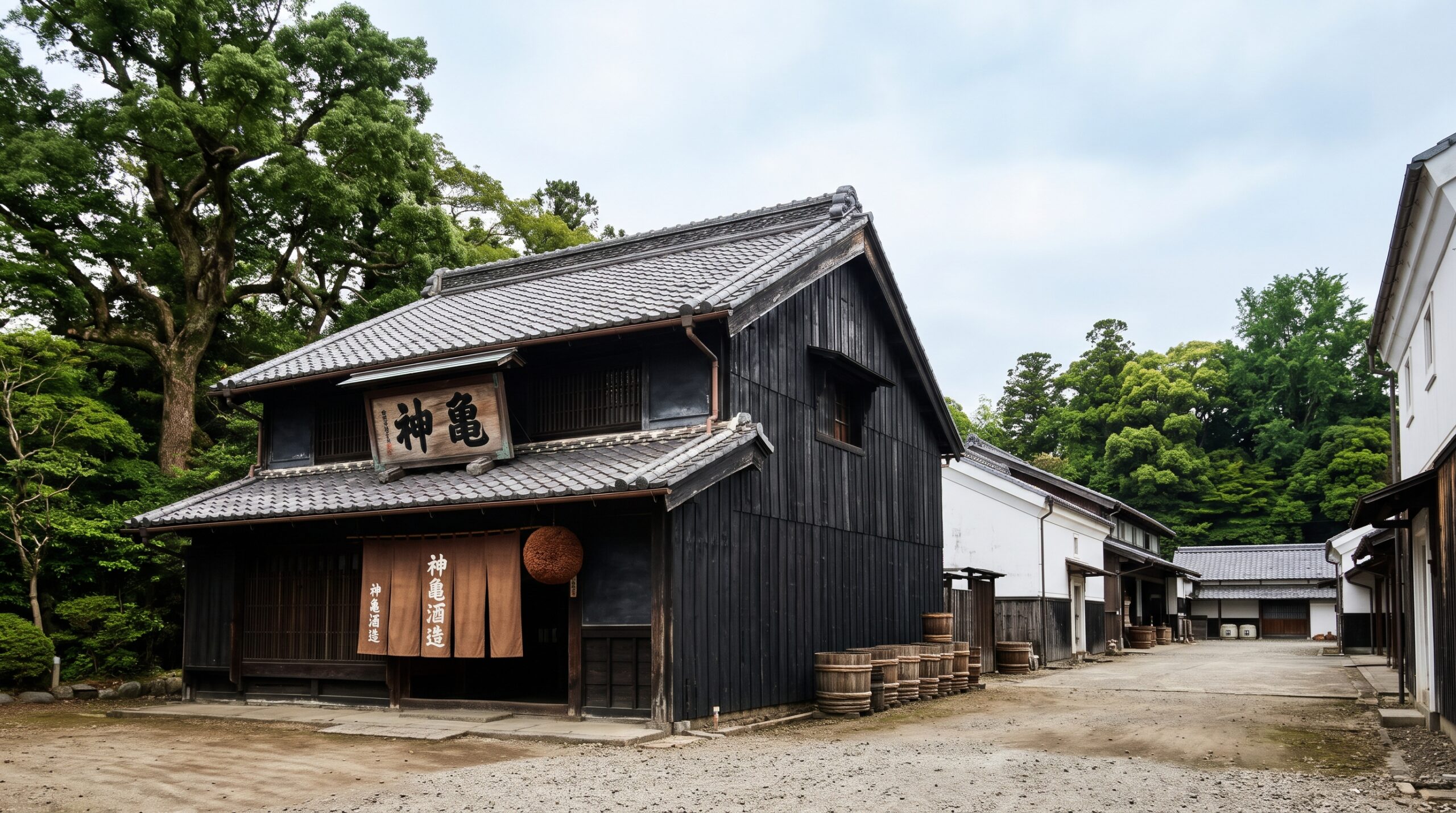
Shinkame Shuzo, in Hasuda City, Saitama Prefecture, was founded in 1848 under the trade name “Iseya Honten.” In 1987, seventh-generation brewery owner Ogawahara Yoshimasa made a decision that turned the entire operation over to Junmai — sake made only from rice, rice koji, and water, with no added brewing alcohol — making Shinkame the first brewery in postwar Japan to go fully Junmai. The addition of brewing alcohol, which had begun as a wartime response to rice shortages, had by then settled into the industry as simple common practice. Ogawahara chose a path almost no one else was taking at the time, driven by his conviction that “sake only truly shows what it’s capable of as a drink meant to accompany food.”
After that decision, brewery owners and sake retailers from struggling regions, unsure of their own future, began visiting Shinkame one after another, and Ogawahara is said to have shown them everything in the brewery and shared his knowledge freely. In 1990 he formed the “Kuramoto Koryukai” (Brewery Owners’ Exchange) to share Junmai brewing techniques, and held events such as “Kanshu Rakuen” (“Paradise of Warmed Sake”) to promote warmed sake as a drink meant for the table. Through these efforts he spread, nationwide, the practice of adjusting the serving temperature of warmed sake to match the dish at hand. He continued serving as the representative secretary of an association pursuing all-Junmai brewing until his death on April 23, 2017, at the age of 70. Today, the brewery is led by Ogawahara Takao, the husband of Ogawahara Yoshimasa’s eldest daughter. Eighteen refrigerated aging chambers now sit on the brewery grounds, carrying forward the belief that sake’s flavor opens up and grows richer through aging.
The Story of the Land
Hasuda City, where Shinkame Shuzo is based, borders the northeastern edge of Saitama City and sits along the Tohoku Expressway and the JR Utsunomiya Line. Behind the brewery there is said to have once been a pond called “Tenjin-ike,” home, according to local lore, to a sacred messenger tortoise — the origin of the brand name “Shinkame” (“divine tortoise”).
The Story of the Song
The pairing is with “Honoo” (“Flame”), by enka singer Kanmuri Jiro (born Horiguchi Yoshihiro), who was born in Chichibu City, Saitama Prefecture. Discovered by lyricist Miura Yasuteru, he debuted on Japan Victor in 1967 with “Inochi Hitotsu.”
His signature song, “Honoo,” was released on September 21, 1992, with lyrics by Miura Yasuteru and music by Wada Kanae. It marked a sharp turn away from the orthodox enka he had sung until then, drawing attention for incorporating English into its hook (“Ai, ai, ai like enka”) and backing chorus (“Flame, Flame, Flame”) — a style with no precedent in enka at the time. It won over younger listeners as well, taking the Japan Cable Award for Wired Music in 1992 and earning Kanmuri an appearance on NHK’s Kohaku Uta Gassen New Year’s Eve broadcast. It peaked at only No. 48 on Oricon’s weekly singles chart, but has gone on to become the song most closely tied to his name.
Why This Pairing
In 1987, Ogawahara Yoshimasa, Shinkame’s seventh-generation owner, abandoned the addition of brewing alcohol — standard practice in postwar sake brewing — and converted the entire brewery to Junmai, a path no one else was taking at the time. Five years later, in 1992, Kanmuri Jiro, from the same prefecture’s Chichibu City, stepped away from the conventions of orthodox enka and released “Honoo” in a style that broke the mold, mixing in English lyrics.
In both cases, staying true to one’s own convictions — rather than worrying about how it would be seen — produced the work that would go on to define them. A brewery and a singer, both from Saitama Prefecture, each breaking their own mold. We’ve paired this Junmai sake with this song as two stories of staying true to one’s own path.
Where to Find This Bottle
The Rakuten Ichiba link below is an affiliate link.
- Brewery’s official site: https://shinkame.co.jp/
- Buy on Rakuten Ichiba: View the product page (720ml, ¥2,057)
Note: the links above lead to Japan-based retailers. They’re most convenient for readers in Japan, or for those elsewhere who are able to arrange international shipping. Stock and availability change over time, so if you’re near a specialty sake shop, it’s well worth asking for this label by name.
Pairing Dishes Worth Trying
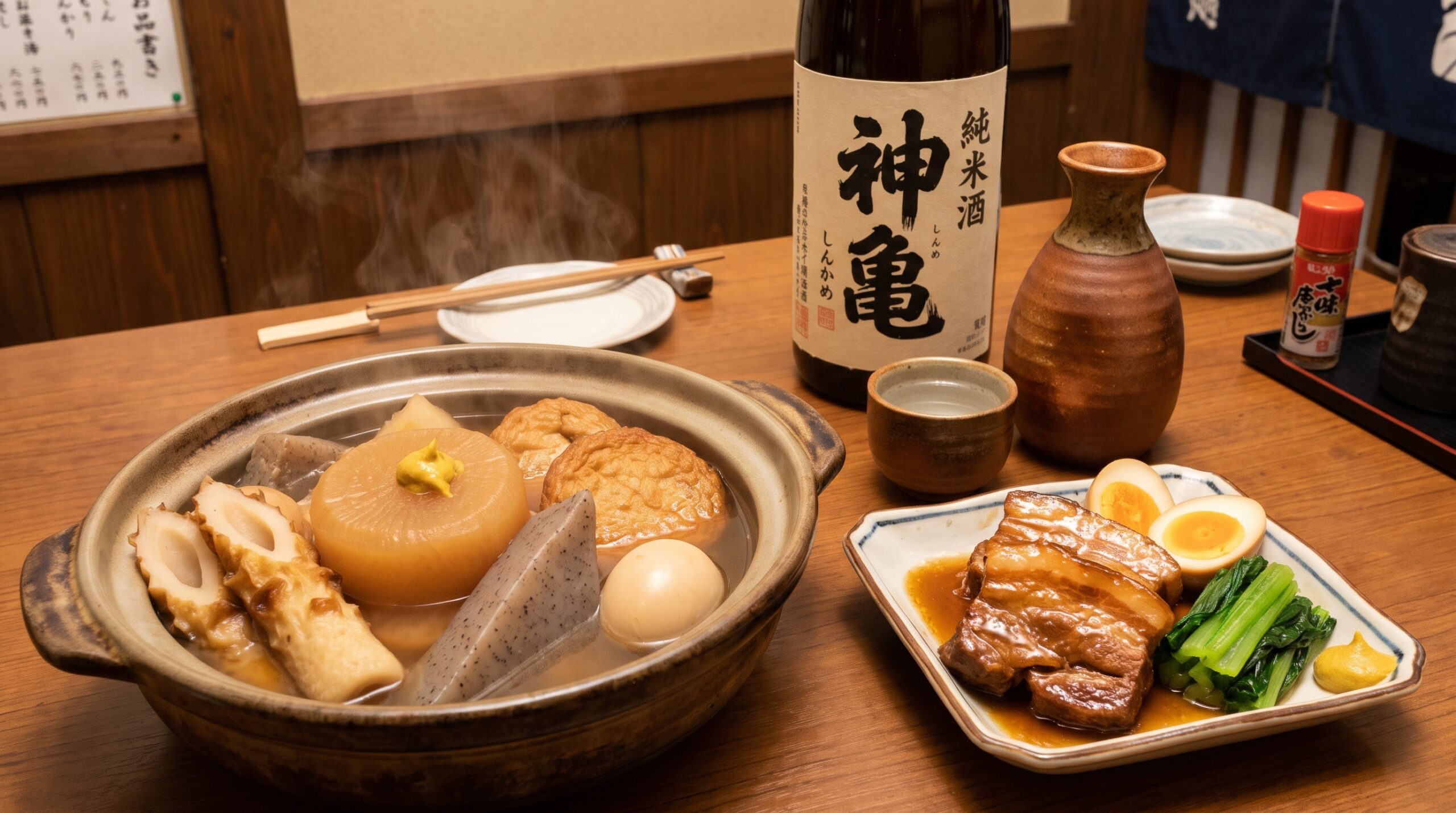
- Oden
This dry Junmai’s firm acidity pairs naturally with daikon radish, chikuwa fish cake, and konnyaku soaked in savory dashi broth. It’s a warming dish that echoes Ogawahara’s own practice of matching the serving temperature of warmed sake to what’s on the table.
Recipe (in Japanese): Kurashiru, “Classic Oden for Cold Days” - Buta no kakuni (simmered pork belly)
The firm acidity and rich, aged umami of this Junmai sake stand up to the melting fat of slow-simmered pork belly, cutting through it cleanly and leaving the palate refreshed for the next bite.
Recipe (in Japanese): Kurashiru, “Soft and Rich Buta no Kakuni”
A note on the science: with a fatty dish like simmered pork belly, the organic acids in the sake cut through the richness of the fat, refreshing the palate for the next bite. In a dashi-based dish like oden, the glutamic acid from kombu and inosinic acid from dried fish flakes resonate with the amino-acid umami unique to Junmai sake, creating a synergistic boost of savoriness.
A Quick Glossary of Sake Terms
- Junmai: Sake made only from rice, rice koji, and water, with no added brewing alcohol. The rice’s own umami comes through directly.
Sources
- Sake Brewing – Shinkame Shuzo Official Site
- The Brewery – Shinkame Shuzo Official Site
- Shinkame Shuzo – Wikipedia (Japanese)
- “The Work of Conviction the Senmu Took On at Shinkame Shuzo,” Part 1 – dancyu
- “The Work of Conviction the Senmu Took On at Shinkame Shuzo,” Part 2 – dancyu
- Shinkame Shuzo President Ogawahara Yoshimasa Passes Away
- Kanmuri Jiro – Wikipedia (Japanese)
- “Honoo” (Kanmuri Jiro song) – Wikipedia (Japanese)
If you notice any errors in this article, please don’t hesitate to reach out at info@soundrecords.jp.
Keep reading in English
Sake and Kayokyoku
- Polished by the Fierce Current, It Only Grows Better
- The Moon Over the Mountain Castle Fills Even a Lost Heart
- The Moon Over the Tone River Has Always Lit the Ones Who Keep Changing
Browse all articles in English
Read this article in Japanese: 消えない炎のように、一途を貫いた