日本語で読む | This is the English version of a bilingual article.
Today’s Pairing
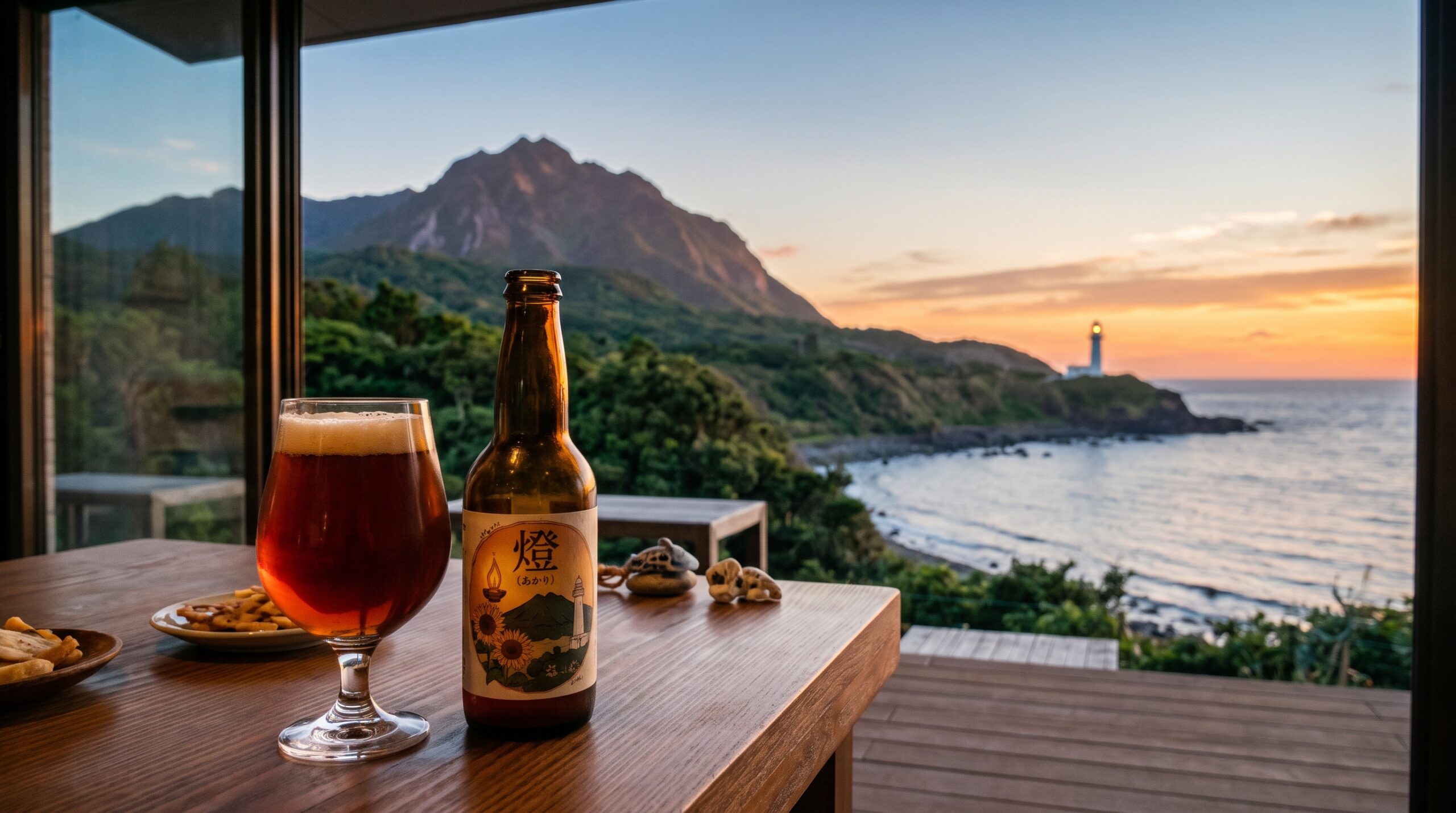
- Craft beer: Hyuga Brewery “Akari” — Brown ale, 5% ABV, 330ml, blending several roasted caramel malts into a medium-to-full-bodied beer with a smoky, rich malt depth; classified as happoshu under Japanese liquor tax law since its malt ratio is under 25% / Hyuga Brewery (142-2 Kozushima Village, Tokyo)
Online shop: https://tousyosyuhan.easy-myshop.jp/ - Music: “Yorokobi mo Kanashimi mo Ikutsukigetsu” (“The Joys and Sorrows of Years”) by Akira Wakayama (1957)
YouTube: https://www.youtube.com/watch?v=iDnIXG1sVN0
▶ If the player above doesn’t play, open it on YouTube
The Story of the Brewery
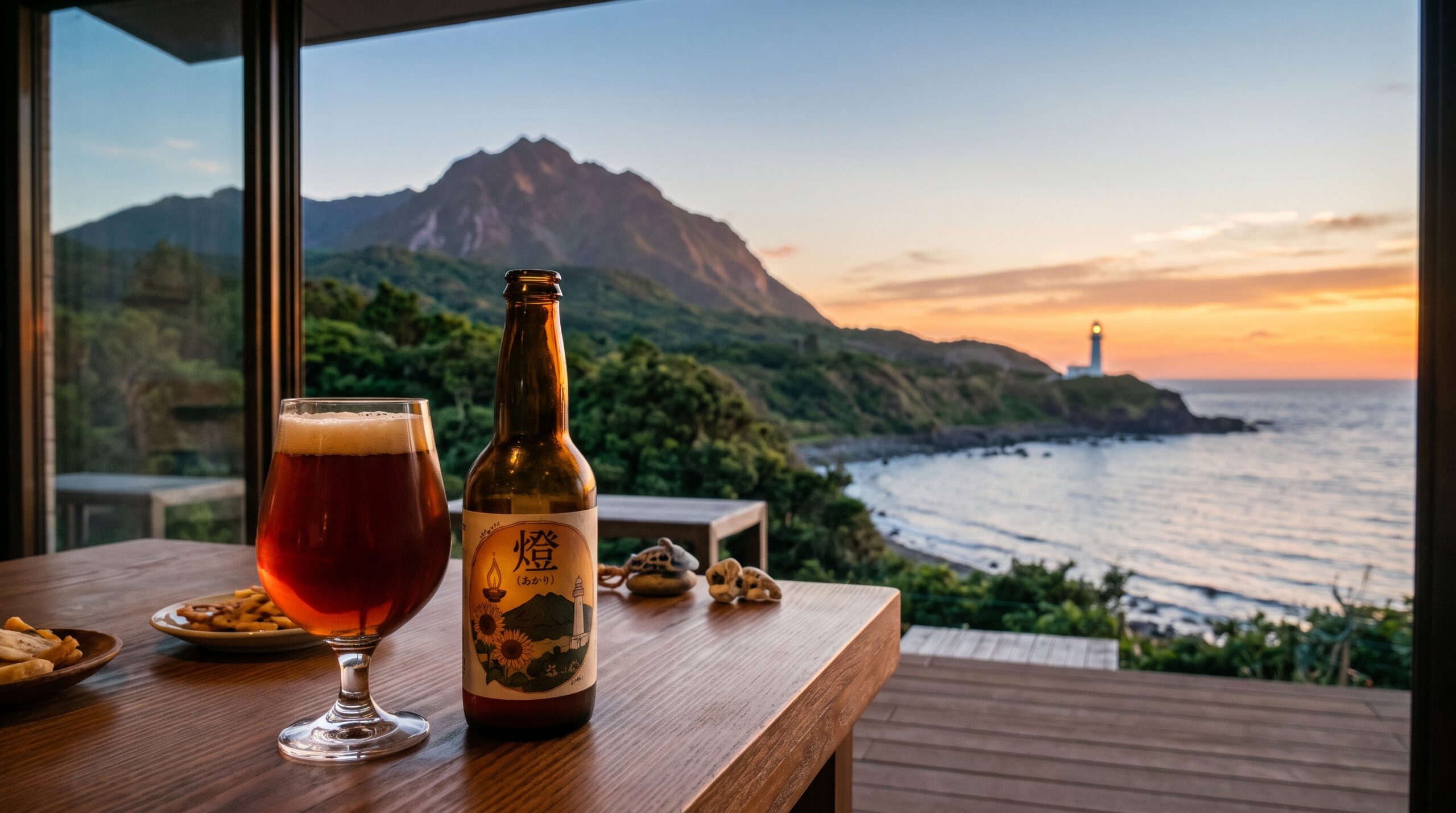
Hyuga Brewery is the only craft brewery on Kozushima, and the only one in the entire Izu Islands chain. Its founder, Fumiko Miyagawa, had run a liquor wholesaler on the island called Tousho Sake Sales for years. She’d dreamed of brewing her own craft beer for more than a decade, but it was only around the time Tokyo was chosen to host the Olympics that she finally acted. With German brewing equipment that had almost no domestic equivalent, and limited brewing experience of her own, she opened the taproom in March 2017, got her brewing license in June, and started brewing that July.
The interior is wood-toned, with tatami and sofa seating, built to feel as easy to walk into as a café. Its concept flower is the sunflower. Out of Miyagawa’s wish to make “a place women could walk into easily,” her three regular ales carry names that sound like women’s names: Akari (light), Himawari (sunflower), and Sō (freshness). The one featured here, Akari, is a brown ale: several roasted caramel malts blended together for a medium-to-full body with a smoky, rich malt depth. It’s named for the light of a lighthouse beacon, with the hope that it could become a place where anyone who comes feels found, not lost, and warmly looked after. The brewing water comes from a clear spring at the foot of Mount Tenjo, the mountain at the island’s center.
The Story of the Land
Kozushima carries a legend about Mount Tenjo known as the “water distribution legend.” Long ago, the gods of the Izu Islands are said to have gathered on the mountain to decide how to divide up water among the islands. Water was handed out in order of arrival, and by the time the god of Toshima arrived last, almost none was left. Furious, that god dove into what little remained and thrashed about, scattering water in every direction — and that, the legend says, is why springs still bubble up all over Kozushima today. The very spring water Hyuga Brewery uses to brew flows down from the foot of the mountain where that legend is set.
Nearly every resident of the island lives clustered in a single settlement around Kozushima Port. About a 15-minute drive from there, on a cape at the island’s southwest tip, stands Kozushima Lighthouse. First lit on December 18, 1951, it still actively watches over passing ships today. For people living on a remote island, a lighthouse’s light has long served as a silent signal: land is here, this is safe.
The Story of the Song
Akira Wakayama was born on July 4, 1927, in Mihara, Hiroshima Prefecture (real name Sumio Hirakawa). After graduating from Musashino Academia Musicae, he debuted in 1951 with “Hoshizora” (“Starry Sky”).
“Yorokobi mo Kanashimi mo Ikutsukigetsu” is the theme song of the film of the same name, directed and written by Keisuke Kinoshita and released October 1, 1957. Both lyrics and music were by his younger brother, Chuji Kinoshita. Released on the Columbia label that September, it became a massive hit. The film follows a lighthouse keeper and his wife, played by Keiji Sada and Hideko Takamine, across 25 years from before the war into the postwar period, as they’re transferred from one remote lighthouse to another — starting at Kannonzaki Lighthouse, then on to Hokkaido, Kyushu, Sado Island and beyond — keeping watch over the sea’s safety through hard, isolated postings. The theme song has been used in every version of the film since, and became such a standard that Wakayama himself re-recorded it for a 1986 remake.
Why This Pairing
Miyagawa named the beer Akari with the hope that, like a lighthouse’s beacon, it would keep anyone who came to her brewery from feeling lost. “Yorokobi mo Kanashimi mo Ikutsukigetsu,” meanwhile, tells the story of a couple who spent 25 years keeping that very kind of light burning. It was only because someone kept that flame alive, night after night, that a lighthouse could keep telling ships: land is here. The beer’s name and the song’s subject may not have been consciously linked by anyone, but they point at the same thing.
Kozushima’s water-distribution legend traces back to the same root. Water the gods scattered in anger has kept bubbling up across the island for centuries, and some of it is the very water Hyuga Brewery uses to brew today. A lighthouse’s light and a spring’s water both help the people who pass through — not because someone is always there, but simply because they keep existing. On a remote island, where it’s hard for anyone to always be present, maybe that’s exactly what makes the gratitude for “the things that simply keep being there” stand out so clearly.
Where to Find This Beer
The Rakuten Ichiba link below is an affiliate link.
- Brewery official site:https://tousyosyuhan.easy-myshop.jp/
- Search on Rakuten Ichiba:see results for “日向麦酒 燈”
These are Japanese storefronts. If you are visiting the brewery, drinking it fresh at their own taproom is by far the best option.
Pairing Dishes Worth Trying
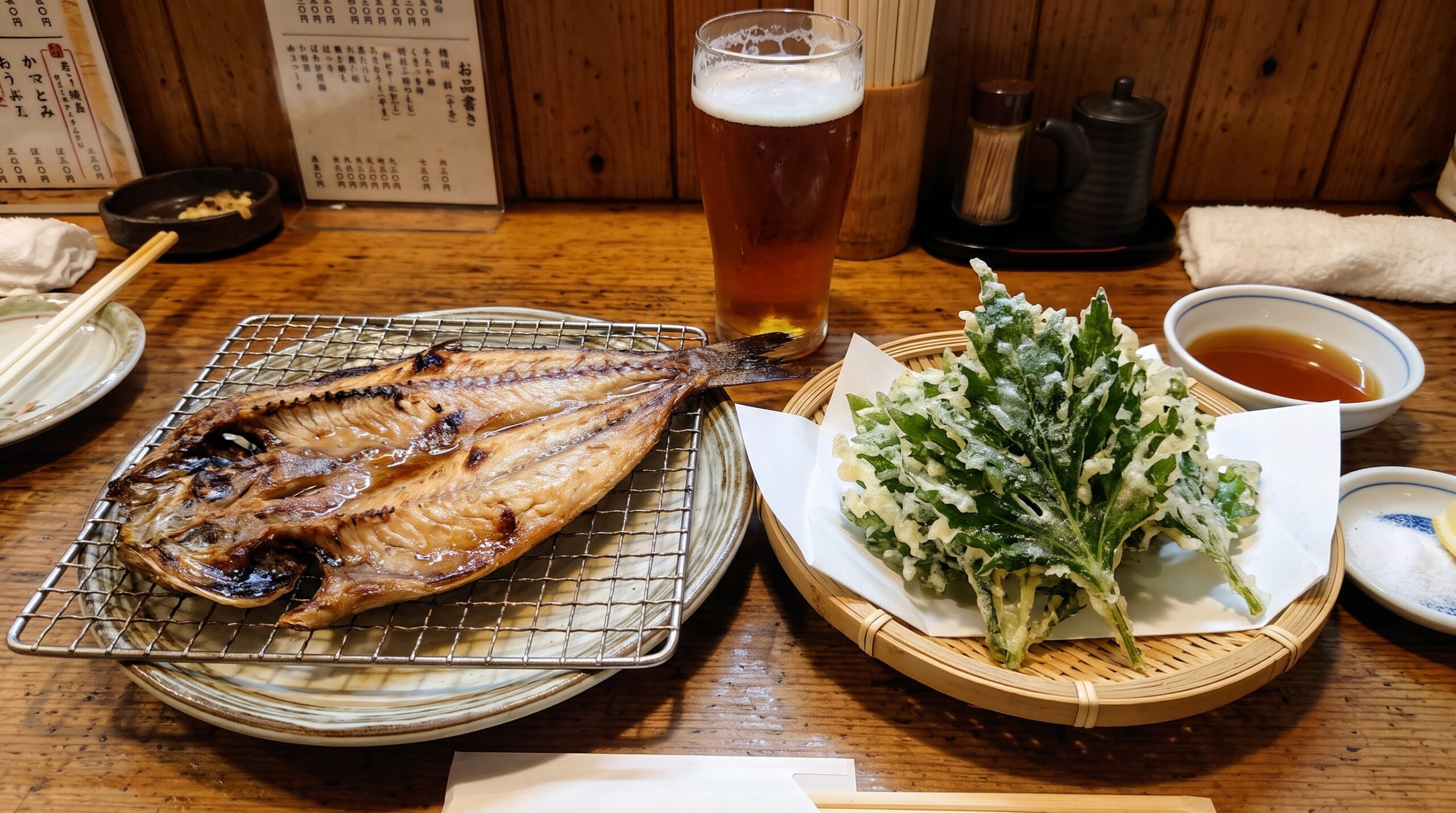
- Kusaya
A pungent fermented dried fish that’s a specialty across the Izu Islands. Grilled slowly, skin-side down, over low heat. The toasty roastedness of Akari’s malt wraps around kusaya’s famously strong aroma rather than fighting it.
Recipe: Cookpad, “The Delicious Way to Eat Kusaya” (Japanese) - Ashitaba tempura
A fried dish made from ashitaba, a bitter, vitamin- and mineral-rich leafy green grown across the Izu Islands, including Kozushima. The malt’s sweetness catches the leaf’s bitterness and lightens the finish.
Recipe: Cookpad, “A Pro’s Ashitaba Tempura” (Tokyo Island) (Japanese)
A note on the science: roasting caramel malt drives the Maillard reaction between sugars and amino acids, producing toasty aroma compounds called melanoidins. Kusaya’s famously strong smell comes mainly from volatile sulfur compounds and amines; layering roasted malt aromas over that tends to soften the overall impression and make it easier to eat. Ashitaba’s bitterness, meanwhile, comes from polyphenols, and the malt’s sweetness wraps around that bitterness in the mouth, lightening the finish.
Visiting the Brewery
Hyuga Brewery
142-2 Kozushima Village, Tokyo. Kozushima is a one-village island where almost everyone lives clustered around Kozushima Port, and the village office is about a 5-minute walk from the port. The brewery sits in the same small settlement.
Sights Nearby
- Kozushima Lighthouse / Kozushima Village | ~15 min by car from the brewery
First lit on December 18, 1951, this lighthouse stands on a cape at the island’s southwest tip and still watches over ships today. It’s a place where you can see, in person, both the namesake of today’s beer, “Akari” (light), and the very work of a lighthouse keeper that the song describes.
Hot Springs Nearby
- Kozushima Onsen Hoyo Center / Sawajiri Bay | ~5 min by car from the brewery
A day-bathing hot spring facility about 5 minutes by car from Kozushima Port, overlooking Sawajiri Bay. It has both indoor and outdoor baths, open 11:00-20:00 (last entry 19:00), closed Wednesdays.
Opening hours, closing days and day-use bathing availability can change. Please check each facility’s official information before visiting.
A Quick Glossary of Beer Terms
- Craft beer: Beer made by small breweries that put the character of the maker front and centre, as opposed to the uniformity of mass production.
- Ale: Beer made by top fermentation, with the yeast working near the surface at close to room temperature. It tends toward fruity aromas and a fuller body.
- Hops: The cones of a climbing plant, which give beer its bitterness and aroma. Depending on the variety, that aroma can read as citrus, tropical fruit or open grassland.
- Malt: Germinated barley. It forms the foundation of a beer’s sweetness, colour and body; how deeply it is roasted determines colour and toastiness.
- ABV: Alcohol By Volume. Beer typically runs around 5%; above 8% is considered a strong, heavier-drinking beer.
- Ji-biru: The name given to the beers that appeared across Japan after the 1994 liquor tax reform opened small-scale brewing. Today most of them are simply called craft beer.
Sources
- Hyuga Brewery online shop (Tousho Sake Sales Co., Ltd.)
- Hyuga Brewery, official Instagram
- Kozushima Tourism Guide, official site, “Hyuga brewery”
- Japan Beer Journalists Association, “Tokyo’s Southernmost Brewery, Hyuga Brewery”
- Japan Beer Journalists Association, “Let’s Travel With a Beer in Hand: 3 [Hyuga brewery]”
- Rakuten Ichiba, “Akari 330ml Craft Beer… Kuroshio Shoukai”
- Kozushima Tourism Guide, official site, “Kozushima Lighthouse”
- Kozushima Onsen Hoyo Center, official site
- “Yorokobi mo Kanashimi mo Ikutsukigetsu” — Wikipedia (Japanese)
- Akira Wakayama — Wikipedia (Japanese)
If you notice any errors in this article, please don’t hesitate to reach out at info@soundrecords.jp.
Keep reading in English
Craft Beer and Music
- Where Things From Far Away Become One
- Thickest, Just Before It Freezes
- Two Steps Back, Three Steps Forward
Browse all articles in English
Read this article in Japanese: 波の向こうで灯り続ける