日本語で読む | This is the English version of a bilingual article.
Today’s Pairing
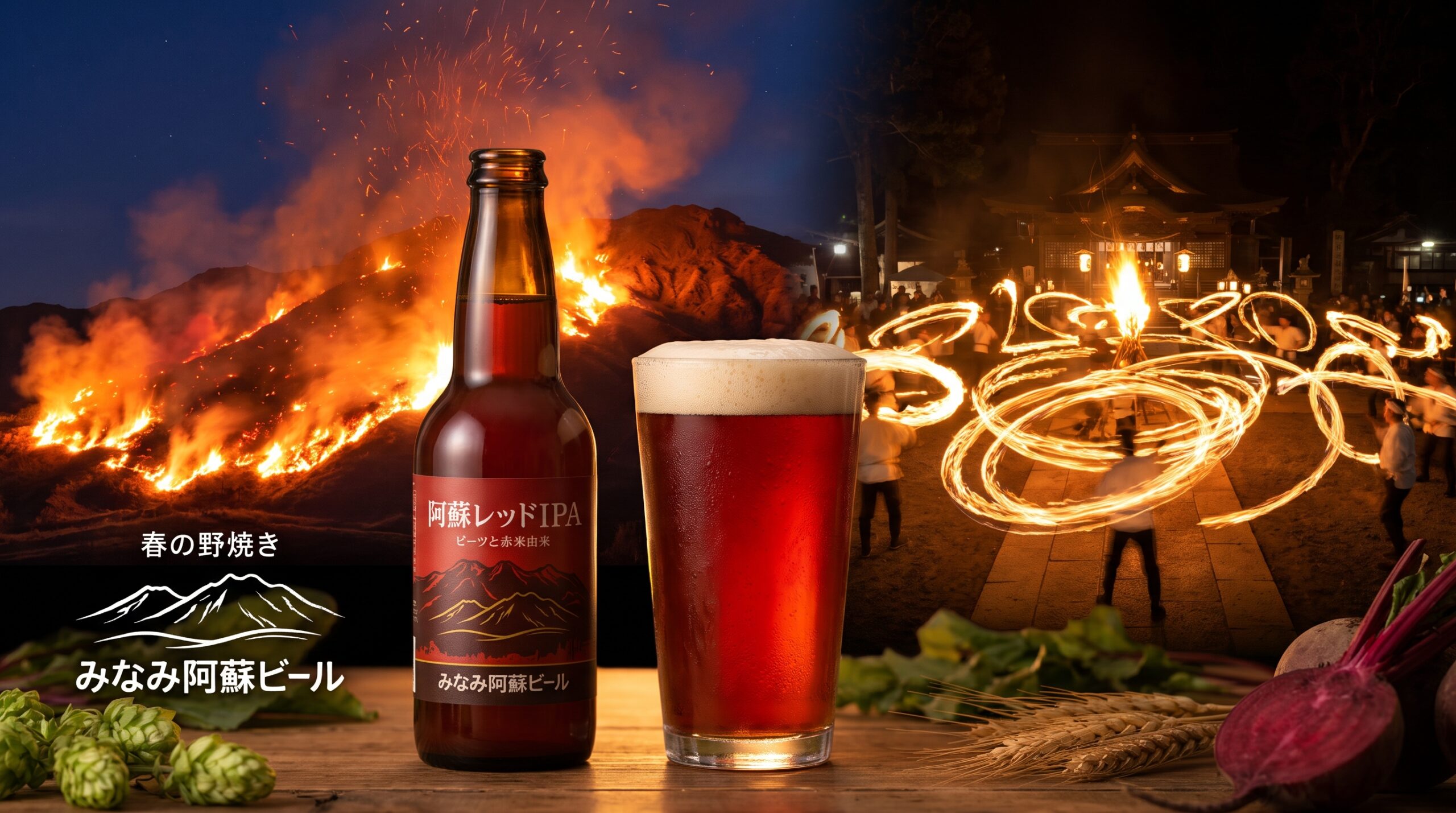
- Craft beer: Minami Aso Beer “Aso Red IPA” — India Pale Ale, 5% ABV, 30 IBU, brewed with malt, red rice, hops and dried beets, using water from Ikeyama Suigen, one of Japan’s “100 Famous Waters” in neighboring Ubuyama Village / Minami Aso Beer Co., Ltd. (Hisaishi, Minami-Aso Village, Aso District, Kumamoto)
Official site: https://minamiaso-beer.com/ - Music: “365 Steps March” (“Sanbyaku Rokujugo Ho no March”) by Kiyoko Suizenji (1968)
YouTube: https://www.youtube.com/watch?v=hEXAdhFPp7M
▶ If the player above doesn’t play, open it on YouTube
The Story of the Brewery
Minami Aso Beer Co., Ltd. was founded in 2021, launched in the hard early years of the pandemic and still not five years old. It is based south of Mount Aso, inside one of the largest calderas on Earth, in Minami-Aso Village. The company builds its craft beer around local resources: spring water such as the famous Shirakawa Suigen, and barley and hops grown nearby. Its official site states that it works from a base of Aso’s agriculture — recognized as a Globally Important Agricultural Heritage System — through circular farming and partnerships with welfare organizations, and aims to contribute to recovery from the Kumamoto earthquake.
Its lineup centers on two beers, Aso Blonde Ale and Aso Red IPA. It registered a combined trademark for the brand name “Minami Aso Beer” in April 2022, and trademarks for both product names that December, and its beers are now carried as gift items in major supermarkets across the prefecture. The direct-sales shop sits inside the Michi-no-Eki roadside station “Aso Bo no Sato Kugino” in Hisaishi, Minami-Aso Village.
The beer featured here, Aso Red IPA, is an India Pale Ale brewed with malt, red rice, hops and dried beets, using water from Ikeyama Suigen, a “100 Famous Waters” spring in the neighboring village of Ubuyama. It runs 5% ABV and 30 IBU. The official site describes it as built around the image of “the flames of the controlled spring burning climbing the Aso Five Peaks, and the Hifuri fire-swinging ritual at Aso Shrine.”
The Story of the Land
Mount Aso is an active volcano holding one of the largest calderas in the world, stretching 25 km north to south and 18 km east to west. Minami-Aso Village sits on the southern rim of that caldera, and the village alone counts eleven spring-water sites. Among them, Shirakawa Suigen flows at 60 tons a minute and is listed among Japan’s “100 Famous Waters” — about an 11-minute drive from the roadside station where the brewery’s shop stands.
Every spring, the hillsides are deliberately set alight in a practice called “noyaki,” burning back the grassland to keep it alive for another year. The sight of flames climbing the mountainside at night is a familiar signal of spring for people here. Nearby, at Aso Shrine, the Hifuri Shinji — a fire-swinging ritual that forms the centerpiece of Tatsukuri Matsuri, a farming festival over 2,000 years old — is held partway through the week-long rite. Parishioners swing bundles of lit miscanthus grass to welcome the bride deity into the shrine grounds, and the ritual is designated a National Important Intangible Folk Cultural Property. Both of these fires are what the Aso Red IPA’s label has in mind.
The Story of the Song
Kiyoko Suizenji, born Tamiko Hayashida, came into the world on October 9, 1945, in the Kogai shopping street of Chuo Ward, Kumamoto City. Her stage name borrows “Suizenji” from Suizenji Jojuen, a famous garden in her hometown, and “Kiyoko” from Kato Kiyomasa, the feudal lord long associated with Kumamoto. She debuted in 1964, and her small frame moving like a drum major leading a marching band became her signature on stage.
“365 Steps March” was released on November 10, 1968, on the Nippon Crown label. Tetsuro Hoshino wrote the lyrics, Masao Yoneyama composed the music, and Hitomi Kosugi arranged it. Opening with the line “Happiness doesn’t come walking to you, so you have to walk toward it,” and carrying the famous phrase “three steps forward, two steps back,” the song sold over a million copies. It won the Popularity Award at the 11th Japan Record Awards and the Popularity Award at the 2nd Japan Lyricist Awards in 1969, and that same year it was adopted as the entrance march for the 41st Spring Koshien high school baseball tournament.
Why This Pairing
Kiyoko Suizenji’s name was borrowed from a landmark of her hometown and from a warlord tied to that same ground. Aso Red IPA borrows its name and image the same way — from the fire of the mountainside burning and the ritual held at Aso Shrine. Neither one invented itself from nothing; both took their shape by borrowing the strength of a place outside themselves.
The famous line “three steps forward, two steps back” is a song about keeping your face forward even on the days you can’t move ahead as far as you’d like. There’s something in common with a brewery that launched in the thick of the pandemic and set out aiming to help a region recover from an earthquake. And then there’s the color: red rice and beets coloring a beer called “Red,” the flames of the spring burning, the lit torches of the Hifuri ritual — all of it red, all of it in motion. A rhythm that keeps marching forward, and the clear, pushing bitterness of an IPA, suit each other well.
Where to Find This Beer
The Rakuten Ichiba link below is an affiliate link.
- Brewery official site:https://minamiaso-beer.com/
- Search on Rakuten Ichiba:see results for “みなみ阿蘇ビール 阿蘇レッドIPA”
These are Japanese storefronts. If you are visiting the brewery, drinking it fresh at their own taproom is by far the best option.
Pairing Dishes Worth Trying
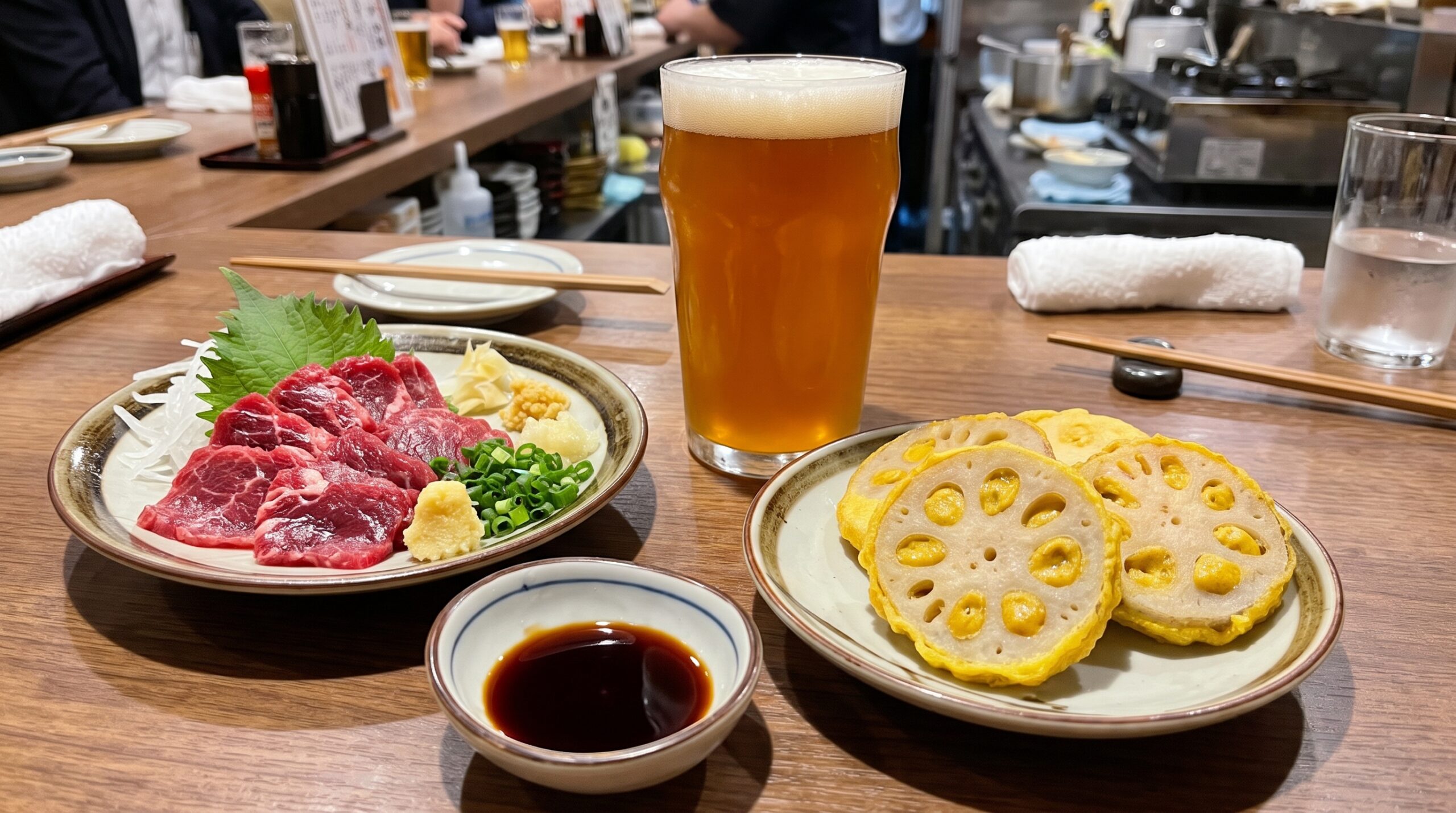
- Basashi (raw horse meat)
A signature Kumamoto dish. Eaten with a dipping sauce of soy sauce, grated ginger and garlic, the fat of the meat is cut cleanly by the IPA’s firm bitterness and aroma.
Recipe: Kurashiru, “Basashi Dipping Sauce, Homemade” - Karashi renkon (mustard-stuffed fried lotus root)
A Kumamoto local dish: lotus root packed with white miso and Japanese mustard, battered and deep-fried. Both the frying oil and the sharp mustard heat find company in the IPA’s bitterness and citrus-and-pine hop aroma.
Recipe: Cookpad, “Karashi Renkon”
A note on the science: the iso-alpha acids that carry hop bitterness, together with the pressure of carbonation, strip away the film that fried and fatty food leaves in the mouth, resetting the palate. The sharp sting of mustard and the citrus-and-pine aroma hops carry both register through the same route at the back of the nose, so rather than competing, they tend to layer together.
Visiting the Brewery
Minami Aso Beer
2807 Hisaishi, Minami-Aso Village, Aso District, Kumamoto — a direct-sales shop inside the “Aso Bo no Sato Kugino” roadside station (Shoko Booth B).
The roadside station has a 70-metre wood deck looking out over the Aso Five Peaks, the same view pictured on the beer’s label.
Sights Nearby
- Shirakawa Suigen Spring / Minami-Aso Village | ~11 min, ~6.8 km by car from the brewery
One of Japan’s “100 Famous Waters,” flowing at 60 tons a minute from the same groundwater system used for the Blonde Ale. Shirakawa Yoshimi Shrine, guardian of the water, stands right beside it.
Hot Springs Nearby
- Jigoku Onsen Seifuso / Minami-Aso Village | ~15 min, ~6 km by car from the brewery
A day-use hot spring just past the Kugino intersection the road from Aso Kumamoto Airport runs through. Known for “Suzume no Yu,” a bath fed straight from the spring at your feet. Day bathing 10:00-17:00, closed Tuesdays.
Opening hours, closing days and day-use bathing availability can change. Please check each facility’s official information before visiting.
A Quick Glossary of Beer Terms
- Craft beer: Beer made by small breweries that put the character of the maker front and centre, as opposed to the uniformity of mass production.
- IPA: India Pale Ale. A pale ale with hops pushed much further, so bitterness and aroma both come forward.
- Hops: The cones of a climbing plant, which give beer its bitterness and aroma. Depending on the variety, that aroma can read as citrus, tropical fruit or open grassland.
- Malt: Germinated barley. It forms the foundation of a beer’s sweetness, colour and body; how deeply it is roasted determines colour and toastiness.
- IBU: International Bitterness Units, a scale for how bitter a beer tastes. Around 10 is barely noticeable bitterness; above 60 lands in clearly bitter IPA territory.
Sources
- Minami Aso Beer, official site
- Aso Shrine official site, “Tatsukuri Matsuri”
- Kiyoko Suizenji — Wikipedia (Japanese)
- “365 Steps March” — Wikipedia (Japanese)
If you notice any errors in this article, please don’t hesitate to reach out at info@soundrecords.jp.
Keep reading in English
Craft Beer and Music
- Until the Scrap Wood Becomes Fire, Until the Melting Snow Becomes a Letter
- A Glass That Crossed the Sea, a Bride Who Crossed the Sea
- A Toast Is Always for Someone Else
Browse all articles in English
Read this article in Japanese: 二歩下がっても、三歩進む