日本語で読む | This is the English version of a bilingual article.
Today’s Pairing
- Craft beer: ForestBrewing “Kikori no Pilsner” (“Woodcutter’s Pilsner”) — a German-style pilsner; 5% ABV; brewed only with German barley malt and hops / ForestBrewing (238-60 Kawanai Kitakawarayama, Kawasaki-machi, Shibata-gun, Miyagi Prefecture)
Official site: https://forestbrewing.jp/ - Music: “Kitaguni no Haru” (“Spring in a Northern Country”) by Masao Sen, 1977 / Words by Haku Ide, music by Minoru Endo
YouTube: https://www.youtube.com/watch?v=_Is08HAtQQE
▶ If the player above doesn’t play, open it on YouTube
The Story of the Brewery
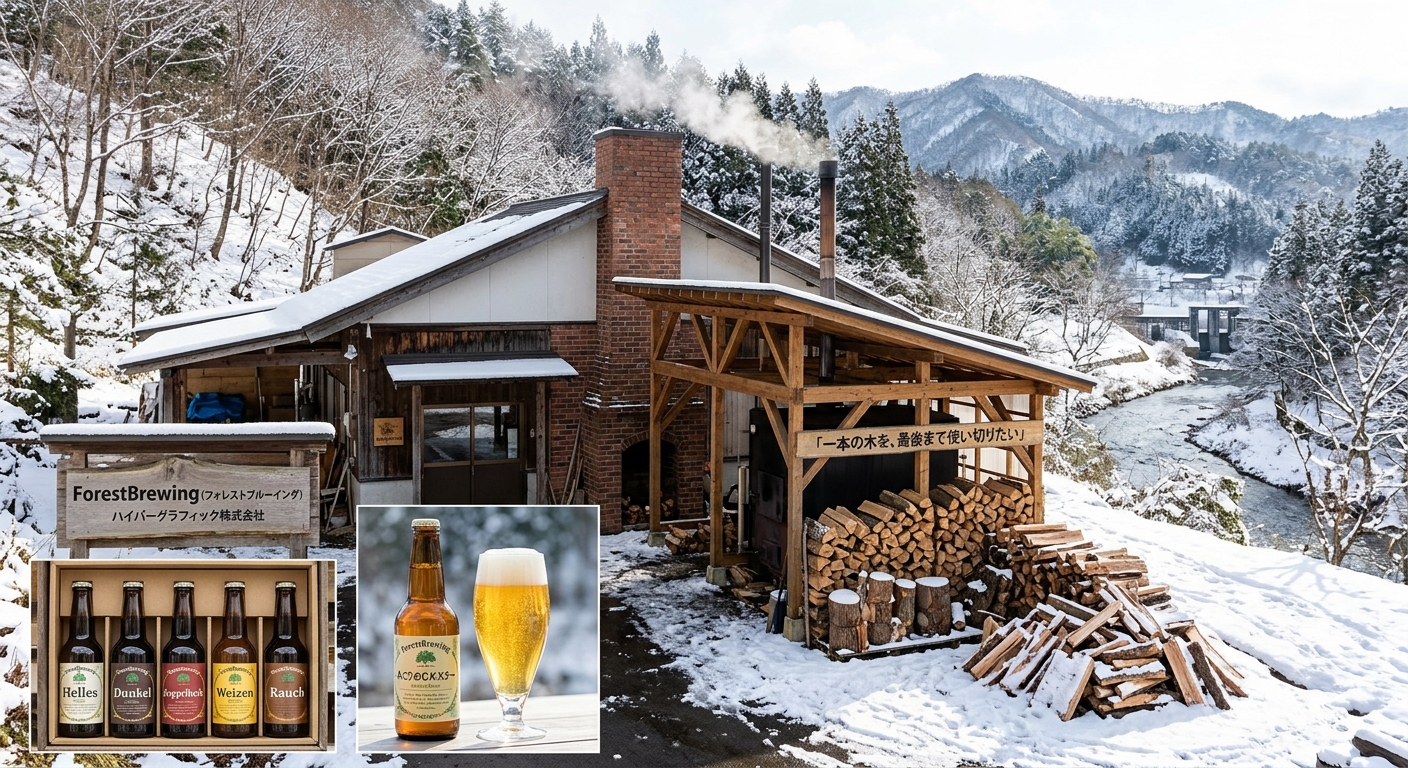
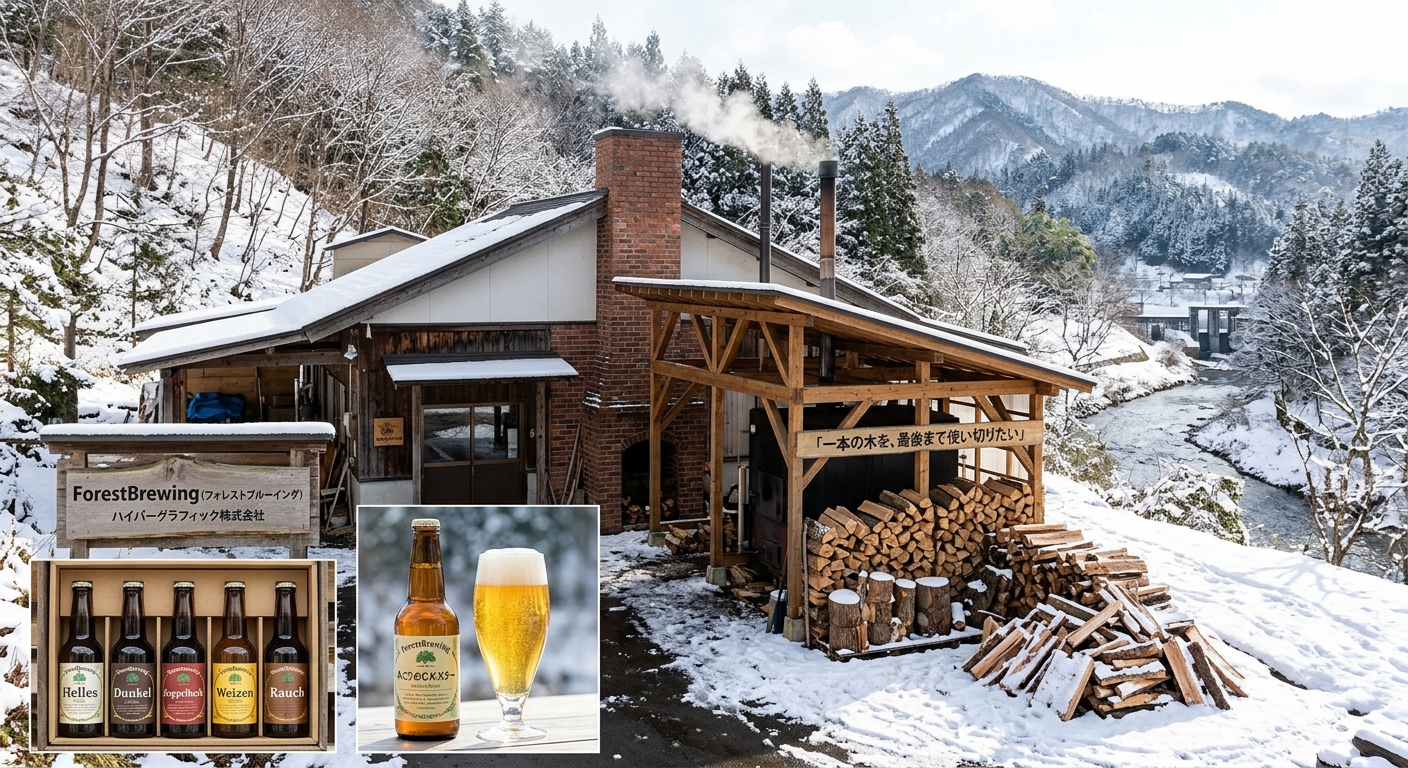
ForestBrewing is a craft beer brand launched in May 2023 by Hyper Graphic Co., Ltd., a printing company in Kawasaki-machi, Miyagi Prefecture that had long been making firewood for wood stoves and importing Italian forestry winches. The company’s president, Kazuhiro Suzuki, grew up in a family home that owns a stretch of forest on the northern slopes of Mount Zao — “a forest equal to four Tokyo Domes,” as the official site puts it.
According to the brewery’s “About us” page, the idea began when Suzuki travelled to Austria and Germany, both advanced forestry nations, on an inspection trip. He was moved by “the variety of flavours brewed by the small breweries that dot every village and town,” and came home thinking, “what if we could brew beer with our own firewood?” According to a feature in the outdoor magazine BE-PAL, that dream first took shape around 2017, and it became a real business only after Suzuki met brewers who had trained in both Japan and Germany.
What makes ForestBrewing distinctive is that it burns the scrap wood left over from its own firewood production to fuel the brewing itself. Pieces too crooked for the log-splitter, or odd leftover chunks, become scrap; these are burned in a wood-fired boiler on site to heat the water used for brewing. Per BE-PAL, heating 2,000 litres of water takes roughly two-thirds of a cubic metre of scrap wood. The official site sums up the philosophy in one line: “We want to use a single tree, right down to the very end.” The brewing water itself is drawn from the upper reaches of the Kamafusa Dam reservoir, fed by snowmelt from the Zao mountain range and also a water source for the city of Sendai downstream. The core lineup leans German: Helles, Dunkel, Doppelbock, Weizen, Rauchbier, and the Kikori no Pilsner featured here — a German-style pilsner brewed solely from German barley malt and hops, 5% ABV, with a grassy hop aroma and a smooth, rounded bitterness.
The Story of the Land
Kawasaki-machi sits inland in Miyagi Prefecture, on the northern side of the Zao mountain range. Under Miyagi Prefecture’s official snow-load standards for buildings, the expected snow depth in this area rises with elevation, from 0.5 metres up past 1.5 metres — a textbook case of the deep mountain winters typical of Tohoku, getting harsher the higher you climb. ForestBrewing’s brewery sits at the foot of northern Mount Zao, on the bank of the Kitagawa River, with the Kamafusa Dam — one of Sendai’s water sources — downstream.
The firewood industry itself is bound up with this land’s winters. Firewood for wood stoves is burned all through the snowbound season, cut from the mountains of Kawasaki-machi and shaped into product at the factory. The scrap that this process inevitably leaves behind — pieces too misshapen to sell — is, instead of being discarded, turned into the fire for brewing beer. A winter’s byproduct of surviving the cold becomes the fuel for next season’s glass.
The Story of the Song
Masao Sen (real name Kentaro Abe) was born in 1947 in Rikuzentakata, Iwate Prefecture, the second son of a farming family; his father died when Sen was in the fourth grade. In 1965 he apprenticed under composer Minoru Endo and debuted with “Kimi ga Suki.” His 1966 single “Hoshikage no Waltz” became a huge hit from around autumn 1967, reaching million-seller status and earning him his first appearance on NHK’s Kohaku Uta Gassen in 1968.
“Kitaguni no Haru” was released on April 5, 1977, on Minolphon Records / Tokuma Music Industry (now Tokuma Japan Communications), with words by Haku Ide, music by Minoru Endo, and arrangement by Kensuke Kyo. According to Wikipedia, it took a cumulative 92 weeks inside Oricon’s singles Top 100 (not 92 weeks in a row — it dropped out and re-entered several times along the way) to reach million-seller status. That was the fastest climb to a million-seller on record at the time, a mark that stood until Miyuki Nakajima’s “Chijou no Hoshi / Headlight, Taillight” broke it in 2003 (139 weeks). Its peak weekly position was No. 6 (on the charts dated February 5 and April 2, 1979), and it ranked No. 139 for 1977, No. 55 for 1978, and No. 5 for 1979 on Oricon’s year-end charts. It became Sen’s second million-selling single, after 1966’s “Hoshikage no Waltz,” and won the Long Seller Award at the 21st Japan Record Awards.
According to Wikipedia, lyricist Haku Ide’s hometown was Minamimaki, a village in Nagano Prefecture, and the lyrics draw on the scenery of that Shinshu region. Composer Minoru Endo, meanwhile, wrote the melody picturing his own boyhood in Niigata Prefecture. In other words, the hometown that “Kitaguni no Haru” describes is a composite — built from a memory of Nagano layered over a memory of Niigata — not any single, namable place. What the song sings about is a man now living in the city, who receives a small package from home and, thinking of his family and an early-spring hometown and someone he once loved, repeats the line “I wonder if I should go back home.” The second verse pictures the scenery of that homecoming season directly: “melting snow, a babbling stream, a log bridge.”
According to Wikipedia, for televised performances of the song Sen pushed past his mentor Minoru Endo’s objections and performed dressed as a dekasegi — a seasonal labourer who leaves home to find work elsewhere — in a worn overcoat and hat, round-rimmed glasses, a battered suitcase, rubber boots, a hand towel around his neck, and a cloth-wrapped bundle on his back, an outfit he reportedly bought secondhand for ¥54,000. Endo initially objected, saying it was “too undignified,” but the styling is thought to have helped drive the song’s success, and he is later quoted as conceding, “I’m impressed — Sen really is quite the producer.” Sen himself was born in Rikuzentakata, Iwate Prefecture — a man from Tohoku, playing, in the song, a man who had left his own hometown behind.
Why This Pairing
First, both stand on the same northern winter. The hometown “Kitaguni no Haru” sings of is a composite scene, built from a Nagano memory layered over a Niigata one, not any single real place. Kawasaki-machi, where ForestBrewing is based, is every bit the kind of mountain town the prefecture’s own snow-load standards describe — deeper snow the higher you climb — a genuine “northern country” by any definition. Because the song never pins its hometown to one place, it can be layered onto any unnamed snow country hometown you like. Kawasaki-machi is one of them.
Second, both follow the same shape: something accumulated over winter changes form just as spring arrives. In the song, a small package arrives from home at the moment the snow is melting, and that arrival becomes the trigger for the line “I wonder if I should go back.” At ForestBrewing, the scrap wood left over from a winter’s worth of firewood production — pieces too misshapen to sell — becomes, burned in the boiler, the fire that heats the brewing water. In both cases, something small that piled up over winter (a package; scrap wood) turns, right on the cusp of the next season, into something else entirely (the resolve to go home; a glass of beer).
Third, the people involved occupy mirrored positions. Masao Sen was born in Rikuzentakata, a town in Tohoku, and for this song’s television performances dressed as a dekasegi labourer who had left his hometown for work. ForestBrewing’s president, Kazuhiro Suzuki, likewise left the family home that owns forest land on northern Mount Zao — travelling as far as Austria and Germany, forestry-advanced nations — before bringing home the dream of “brewing beer with our own firewood” and making it real on the very mountain where he was born. The man in the song remains away, endlessly turning over whether to go back. Suzuki is the one who actually did: he left, and then returned to the mountain of his birth. The directions differ slightly, but both are, at heart, a single scene in a life lived around the idea of a “northern hometown.”
Where to Find This Beer
The Rakuten Ichiba link below is an affiliate link.
- Brewery official site:https://forestbrewing.jp/
- Buy on Rakuten Ichiba: View the product page (set of 6, ¥3,980)
These are Japanese storefronts. If you are visiting the brewery, drinking it fresh at their own taproom is by far the best option.
Pairing Dishes Worth Trying
- Sasa-kamaboko no isobe-age (deep-fried bamboo-leaf fish cake with seaweed)
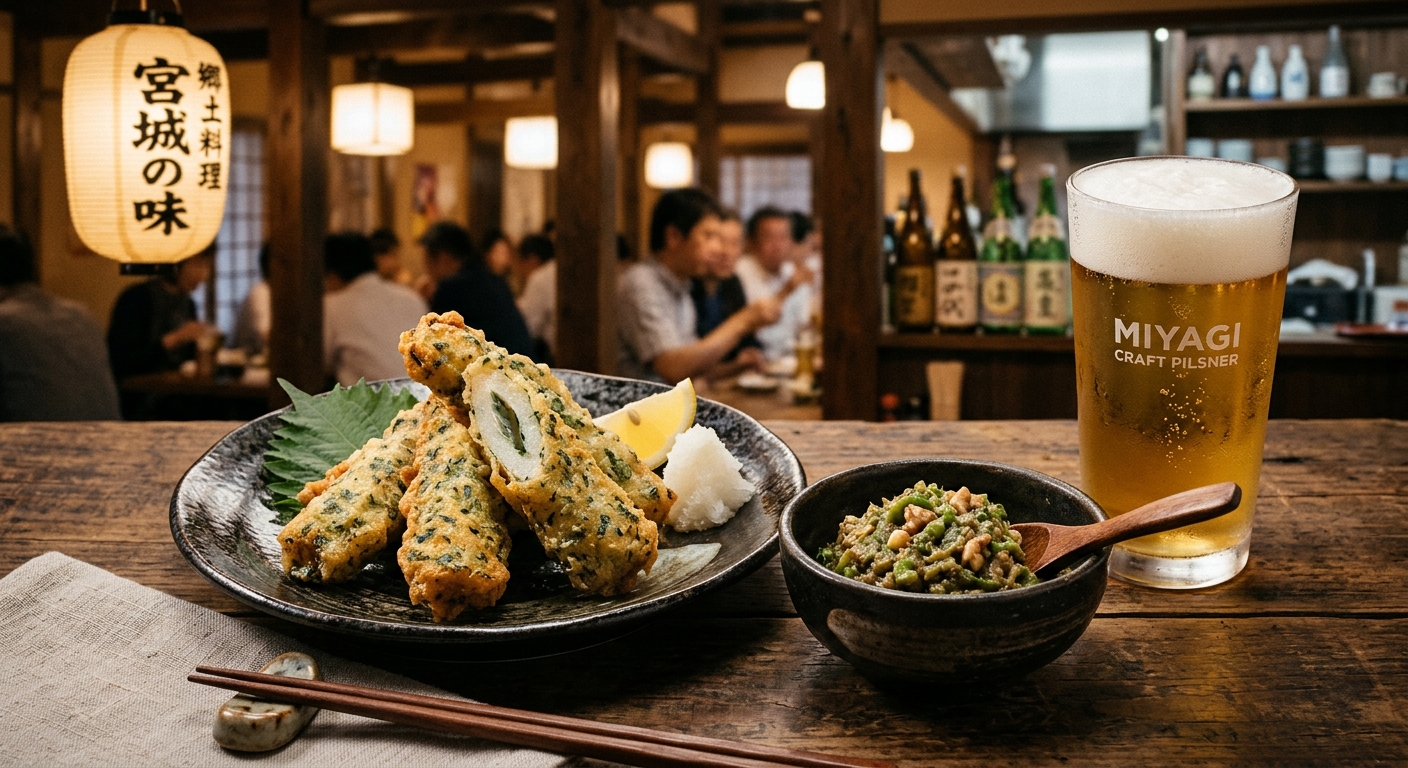
According to the Ministry of Agriculture, Forestry and Fisheries’ “Our Regional Cuisines,” sasa-kamaboko was born in the mid-Meiji era as a way to preserve the catch from Miyagi’s rich fishing grounds — Kesennuma, Ishinomaki, Shiogama, Yuriage — as a grilled fish cake, named for the “bamboo and sparrow” crest of the Date clan, former lords of Sendai. Today it’s mostly made from the surimi of white fish such as walleye pollock. For this dish, the cake is dipped in a batter of flour, egg, aonori seaweed and water, then deep-fried at 180°C for about two minutes. The seaweed’s aroma and the fish cake’s gentle flavour pair naturally with the pilsner’s grassy hop aroma and fine carbonation.
Recipe (in Japanese): Kurashiru, “Sasa-kamaboko no Isobe-age” - Bakke miso (butterbur-sprout miso)
The same MAFF source lists this as a Miyagi dish made from fukinotou (butterbur flower buds), called “bakke” in the local dialect. In the Edo period, a custom arose of pairing miso with wild greens and tree leaves when eating them, which gave rise to seasonal “neri-miso” pastes — and in Miyagi, the spring version made with fukinotou, bakke-miso, became a local favourite. The buds are blanched to remove bitterness, chopped, then ground together with walnuts, miso, sugar and sake, and simmered over low heat. Its wild, herbal bitterness echoes the pilsner’s own clean bitterness, while the carbonation lightens the finish.
Recipe (in Japanese): Kurashiru, “A Spring Treat: Fukinotou Miso”
A note on the science: the “open grassland” aroma of a German pilsner comes from hop compounds such as myrcene and humulene. Against deep-fried food like sasa-kamaboko isobe-age, strong carbonation and restrained bitterness wash away the oil; against the wild bitterness of a mountain vegetable like fukinotou, the hop’s own mild bitterness sits alongside it rather than competing.
Visiting the Brewery
ForestBrewing
238-60 Kawanai Kitakawarayama, Kawasaki-machi, Shibata-gun, Miyagi. About 5 min, 2.4 km by car from the Miyagi-Kawasaki IC on the Yamagata Expressway.
It stands at the foot of northern Mount Zao, on the bank of the Kitagawa River.
Sights Nearby
- Michinoku Park (Michinoku Mori no Kohan Koen) / Kawanai, Kawasaki-machi | about 5 min, 3.6 km by car from the brewery
The only national government park in Tohoku, spread along the shore of Lake Kamafusa — in the same Kawanai district of Kawasaki-machi as the brewery. Admission is ¥450 for adults (15 and over) and ¥210 for seniors (65 and over); free for junior-high students and younger. Open 9:30–17:00 from March 1 to October 31, and 9:30–16:00 from November 1 to the end of February. Closed on Tuesdays (the following weekday when Tuesday is a public holiday), on the second and third Wednesdays of December, and from December 29 to January 3.
Hot Springs Nearby
- Aone Onsen Jappo-no-Yu / 9-1 Aone Onsen, Kawasaki-machi | about 20 min, 13.2 km by car from the brewery
The public bathhouse of Aone Onsen, where day visitors can bathe in 100% free-flowing spring water. Open 7:00–21:00 (last entry 20:30), every day of the year (occasional unscheduled closures). ¥400 for adults (junior-high age and up), ¥200 for elementary-school children, free for preschoolers.
Opening hours, closing days and day-use bathing availability can change. Please check each facility’s official information before visiting.
A Quick Glossary of Beer Terms
- Craft beer: Beer made by small breweries that put the character of the maker front and centre, as opposed to the uniformity of mass production.
- Pilsner: A pale lager born in Pilsen, Czechia, known for its clear golden colour and refined hop bitterness. The most widely drunk style in the world.
- Hops: The cones of a climbing plant, which give beer its bitterness and aroma. Depending on the variety, that aroma can read as citrus, tropical fruit or open grassland.
- Malt: Germinated barley. It forms the foundation of a beer’s sweetness, colour and body; how deeply it is roasted determines colour and toastiness.
- ABV: Alcohol By Volume. Beer typically runs around 5%; above 8% is considered a strong, heavier-drinking beer.
Sources
- ForestBrewing – Official Site
- About Us – ForestBrewing Official Online Store
- ForestBrewing, Brewing Beer with Scrap Wood at the Foot of Northern Mount Zao, Miyagi – BE-PAL
- ForestBrewing “Kikori no Pilsner,” 6-can set – Rakuten Ichiba
- Snow Load Standards for Ohgawara Area – Miyagi Prefecture Official Site
- Kitaguni no Haru – Wikipedia (Japanese)
- Masao Sen – Profile, ORICON NEWS
- Sasa-kamaboko no Isobe-age (Miyagi) – MAFF, “Our Regional Cuisines”
- Bakke Miso (Miyagi) – MAFF, “Our Regional Cuisines”
If you notice any errors in this article, please don’t hesitate to reach out at info@soundrecords.jp.
Keep reading in English
Craft Beer and Music
- A Glass That Crossed the Sea, a Bride Who Crossed the Sea
- A Toast Is Always for Someone Else
- Still Chasing a Hundred-Year-Old Dream
Browse all articles in English
Read this article in Japanese: 端材が火になるまで、雪どけが便りになるまで