日本語で読む | This is the English version of a bilingual article.
Today’s Pairing
- Sake: Kunimare Daiginjo — brewed with 100% Yamada Nishiki rice, polished to a seimai buai (rice-polishing ratio) of 35%, 15.5% alcohol, nihonshu-do (sake meter value) +5 / Kunimare Shuzo Co., Ltd. (1-17 Inaba-cho, Mashike, Mashike District, Hokkaido)
Official site: https://www.kunimare.co.jp/ - Kayoukyoku (classic Japanese popular song): “Ishikari Banka” (“Ishikari Elegy”) by Kitahara Mirei, 1975
YouTube: https://www.youtube.com/watch?v=DNXaJkGu1qI
▶ If the player above doesn’t play, open it on YouTube
The Story of the Brewery
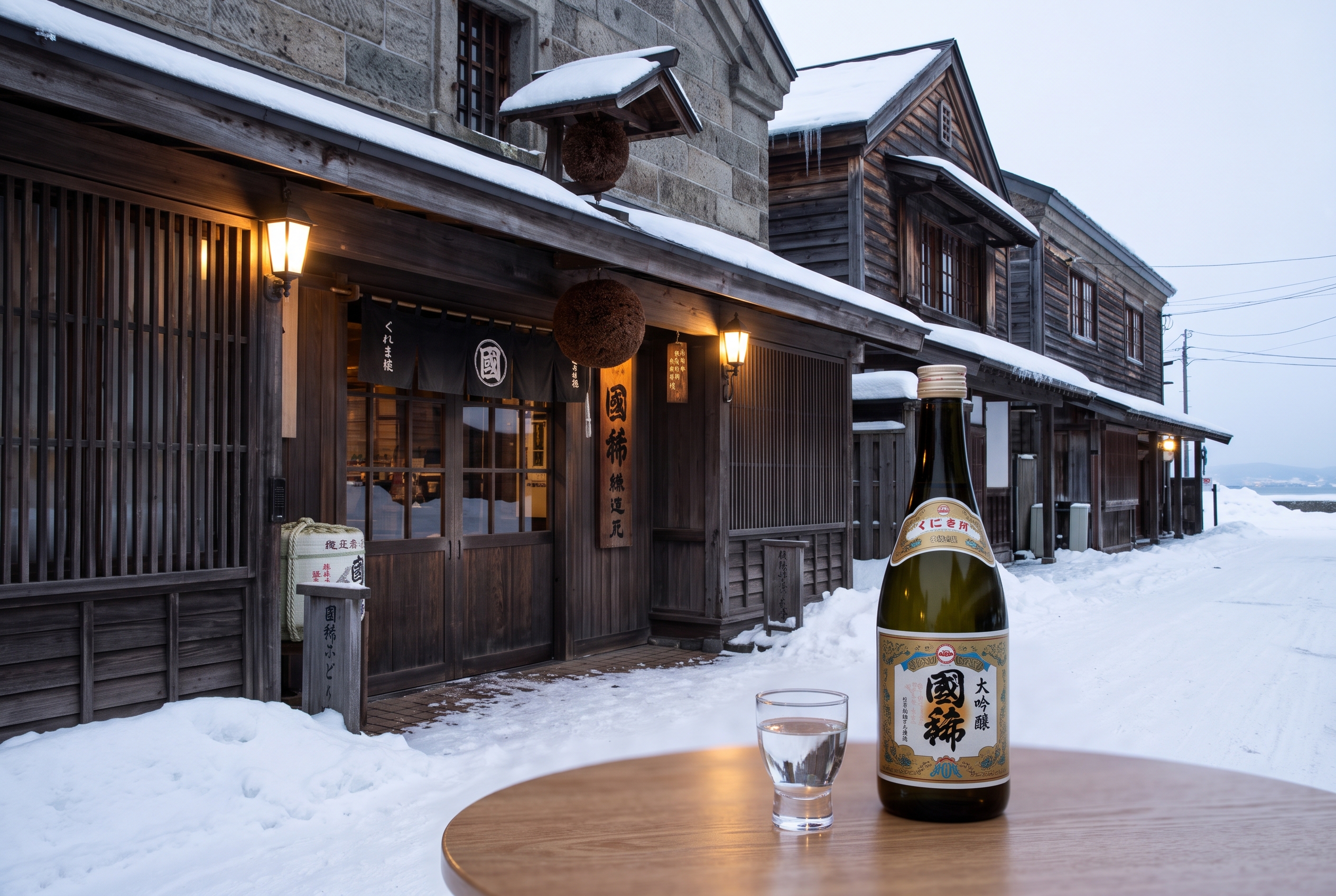
Kunimare Shuzo Co., Ltd., based in Mashike, Hokkaido, was founded in 1882. Its founder, Homma Taizo, was born in 1849 on Sado Island, Niigata Prefecture, and moved to Otaru in 1873 at the age of 23 to work as a clerk in a kimono shop. His frequent business trips to Mashike — then booming with the herring fishery — led him to settle there in 1875 and open a kimono business of his own. As the herring boom continued and demand for sake kept rising, his original brewing facilities could no longer keep up, so in 1902 he built a new brewery at the current site using locally quarried soft stone.
That building was named one of the structures making up “Mashike’s Historic Buildings,” a Hokkaido Heritage site, in 2001, and received the Hokkaido Red Brick Architecture Award in fiscal 2005. That same year, the company changed its name from Marui Homma Gomei Kaisha to its current name, Kunimare Shuzo Co., Ltd. Its current president is Hayashi Kaori. Its main brands are Kunimare and Hokkai Onigoroshi, and it’s known today as Japan’s northernmost sake brewery. The brewery welcomes visitors year-round for tours and tastings.
The bottle in this pairing, Kunimare Daiginjo, is brewed with 100% Yamada Nishiki rice polished to a seimai buai of 35%, at 15.5% alcohol with a nihonshu-do of +5. The brewery’s own site describes it as carrying “a gentle, elegant aroma, with a deep, layered flavor that leaves a pleasant lingering finish on the palate.”
The Story of the Land
Mashike was once a port town that thrived on the herring fishery. Kunimare’s own history was born directly out of that boom — its founder settled there precisely because demand for sake was swelling along with the herring-driven economy. Right next to the brewery still stands the former Marui Homma merchant house, a National Important Cultural Property that once belonged to the Homma family who founded Kunimare, a living record of the prosperity that herring brought to this town.
But the herring fishery along Hokkaido’s Sea of Japan coast declined rapidly through the Showa era, and that old bustle gradually faded. Mashike is one of many towns that lived through that same rise and fall.
The Story of the Song
“Ishikari Banka” was released on June 25, 1975, and became a hit for Kitahara Mirei. The lyrics are by Nakanishi Rei, the music by Hama Keisuke, and the arrangement by Mukaino Shunichi. It peaked at No. 70 on Oricon’s weekly singles chart, sold 45,000 copies, and won the Lyrics Award at that year’s Japan Lyricist Awards (Nihon Sakushi Taisho).
The song’s setting is said to be Shukutsu, in Otaru, where the cargo-passenger ship Kasato Maru and the “herring mansion” (nishin goten) at Otamoi Point both appear in the lyrics. A monument bearing Nakanishi Rei’s own handwriting now stands at the old Aoyama estate in Shukutsu, one such herring mansion. Nakanishi was born in Mudanjiang, in what was then Manchuria, and moved to Otaru at age eight, attending the old Temiya Nishi Elementary School there. His own brother once landed a huge haul of herring, only to let it spoil while trying to sell it for a higher price on the mainland, leaving the family deep in debt and eventually breaking it apart. When Nakanishi was stuck while writing the lyrics, that same brother is said to have told him, “Why don’t you just write about the herring?” The song looks back fondly on the sea that once brought in the herring, and mourns the quiet that settled in after that bustle was gone.
Kitahara Mirei, born Minami Reiko, is from Toyokawa City, Aichi Prefecture. She debuted as a singer in 1970 with “Zange no Neuchi mo Nai,” and “Ishikari Banka” remains one of the songs she’s best known for.
Why This Pairing
“Ishikari Banka” is set in Otaru, but what the song mourns is a history shared by many port towns along Hokkaido’s Sea of Japan coast: the rise and fall of the herring fishery. Mashike was one of those towns, swept up in the same herring-driven boom on the same sea.
Kunimare, in fact, is a brewery born directly out of that boom. It grew larger to meet the rising demand for sake that came with the herring boom, and it has kept brewing in Mashike ever since the herring shoals moved on. The song mourns the memory of that bustle; the brewery building is something that bustle actually built. The herring shoals themselves never came back — but the brewery’s light, lit by that same boom, still hasn’t gone out in Mashike.
Where to Find This Bottle
The Rakuten Ichiba link below is an affiliate link.
- Brewery’s official site: https://www.kunimare.co.jp/
- Buy on Rakuten Ichiba: View the product page (720ml, ¥6,600)
Note: the links above lead to Japan-based retailers. They’re most convenient for readers in Japan, or for those elsewhere who are able to arrange international shipping. Stock and availability change over time, so if you’re near a specialty sake shop, it’s well worth asking for this label by name.
Pairing Dishes Worth Trying
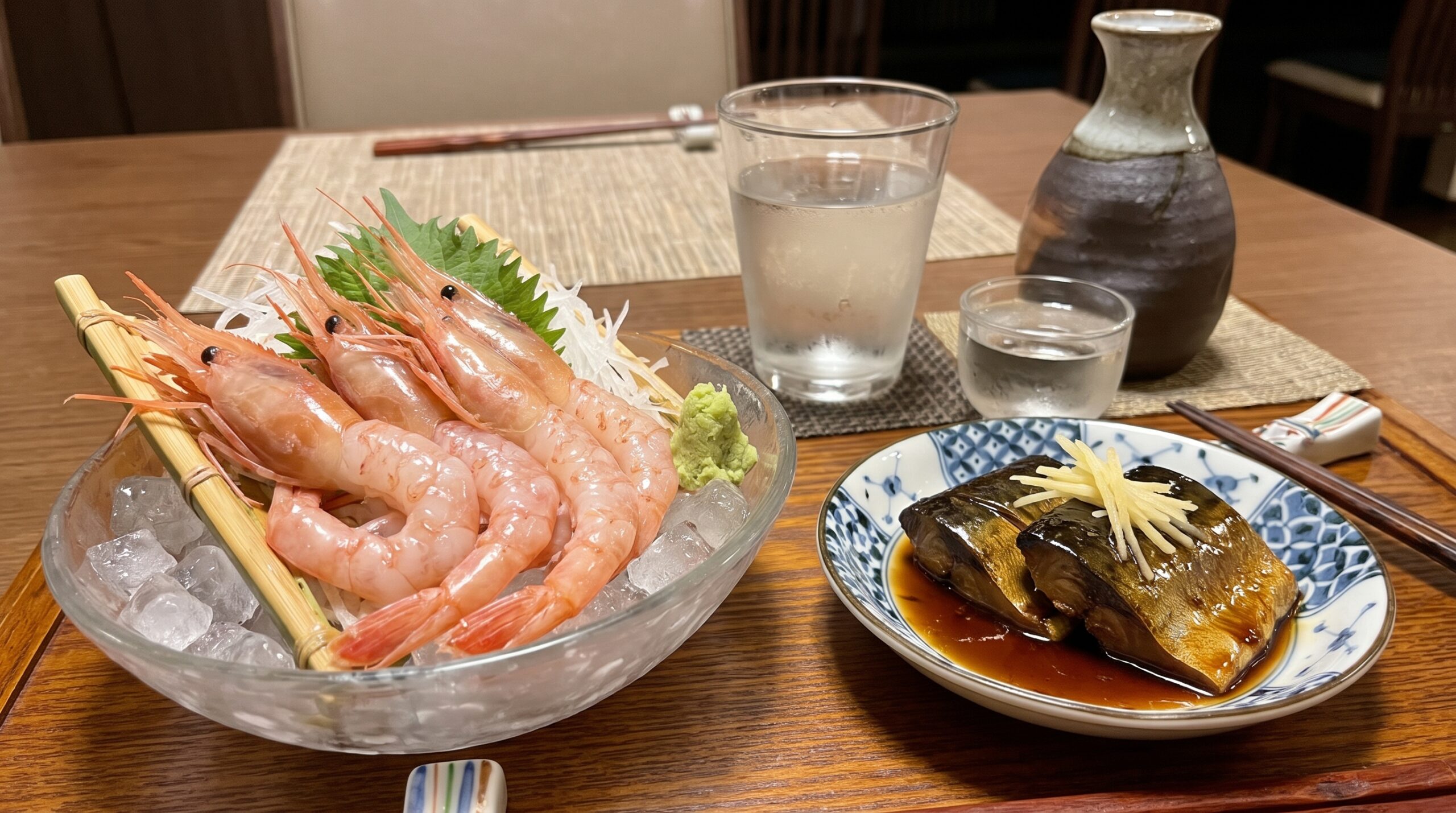
- Mashike-caught sweet shrimp (amaebi) sashimi
Mashike’s fishing port is one of Japan’s top landing sites for amaebi (Hokkoku red shrimp), and it’s famous as a sweet-shrimp region. The shrimp’s plump sweetness echoes the elegant ginjo aroma of this daiginjo.
Recipe (in Japanese): Rakuten Recipe, “Amaebi Sashimi (Prep and How to Eat It)” - Migaki-nishin kanroni (sweet-simmered dried herring)
A classic Hokkaido home dish made from the very fish that once sustained Mashike. The sweet-salty glaze of soy sauce and mirin pairs naturally with the deep flavor of this daiginjo.
Recipe (in Japanese): Kurashiru, “Migaki-nishin Kanroni”
A note on the science: glycine and betaine, the compounds behind amaebi’s natural sweetness, combine with the fruity ginjo aroma of a daiginjo to leave an elegant lingering finish on the palate. The sweet-salty flavor of the soy sauce and mirin glaze on migaki-nishin kanroni resonates with the amino-acid umami that comes from rice, so each brings out more of the other.
Visiting the Brewery
Kunimare Shuzo
1-17 Inaba-cho, Mashike, Mashike District, Hokkaido. The brewery sits in the heart of Mashike, on the same street as the old Marui Homma merchant house.
Free brewery tours (9:00–16:30, groups of 10 or more need to book ahead) and a shop with tastings (9:00–17:00).
Sights Nearby
- Former Marui Homma Merchant House (an Important Cultural Property) / Mashike | ~2 min on foot (~1 min by car) from Kunimare
The former shop of the Homma family, who founded Kunimare, preserved as a monument to Mashike’s herring-boom prosperity. Open seasonally, roughly late April through early November, and closed for winter; check the official site before visiting. - Mashike Itsukushima Shrine (a Hokkaido Tangible Cultural Property) / Mashike | a few minutes on foot (~2–3 min by car) from Kunimare
A shrine on the hill above the same Inaba-cho neighborhood as the brewery. The grounds are open to visitors year-round; viewing the main hall requires a reservation (¥300). - Former Mashike Station / Mashike | walking distance (~2 min by car) from Kunimare
The station building of the old JR Rumoi Line, which closed in 2016 and was restored as a free tourist exhibit in 2018 (9:00–16:00).
Hot Springs Nearby
- Auberge Mashike / Mashike | a few minutes by car from Kunimare
A hot-spring inn offering day-use bathing (11:00–22:00, last entry 21:30, ¥600 for adults). - Iwao Onsen “Attamaru” / Mashike | ~20 min, ~18 km by car from Kunimare
A town-run day-use hot spring (11:00–21:00, last entry 20:15, ¥500 for adults). Open April 1–November 30; check the season before visiting.
Opening hours, closing days and day-use bathing availability can change. Please check each facility’s official information before visiting.
A Quick Glossary of Sake Terms
- Ginjo: Sake made from rice polished to a seimai buai of 60% or less and fermented slowly at low temperatures, giving it a fragrant aroma. Unlike junmai ginjo, a small amount of brewing alcohol is added to round out the aroma and flavor.
- Seimai buai (rice-polishing ratio): The percentage of the original grain remaining after milling. The lower the number, the more the rice has been polished down.
Sources
- Kunimare Shuzo Co., Ltd. – Official Site
- The History of Kunimare – Kunimare Shuzo Official Site
- Kunimare Daiginjo 720ml – Kunimare Shuzo Official Online Shop
- Kunimare Shuzo – Wikipedia (Japanese)
- Ishikari Banka – Wikipedia (Japanese)
- Kitahara Mirei – Wikipedia (Japanese)
If you notice any errors in this article, please don’t hesitate to reach out at info@soundrecords.jp.
Keep reading in English
Sake and Kayokyoku
- Until It Becomes a Place You Can Visit Again
- The Tunnels That Once Mined Gold Now Nurture Something Else
- Beyond the Glittering Tokyo, Three Hundred Years of Unchanging Water
Browse all articles in English
Read this article in Japanese: ニシンの群れが去っても、蔵の灯りは消えなかった