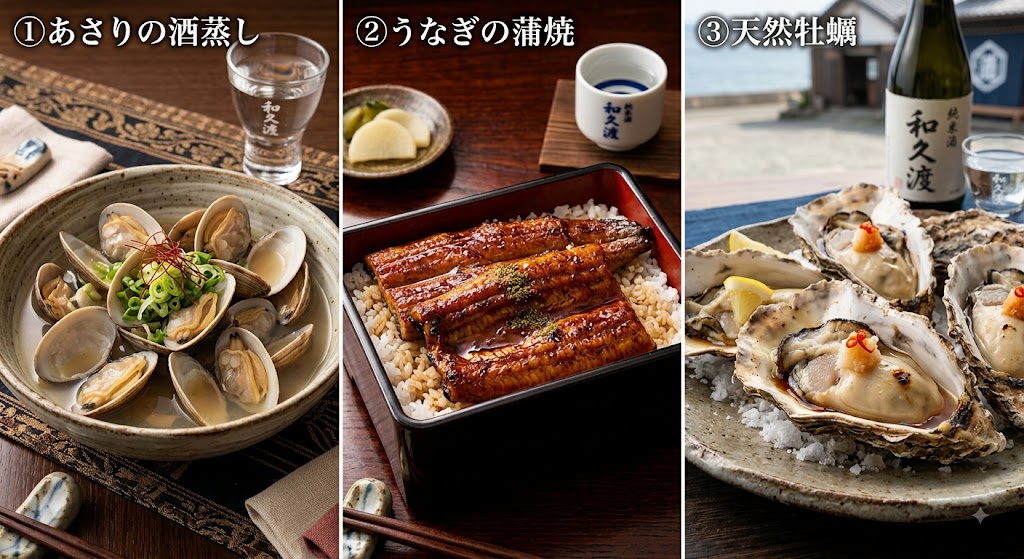
① あさりの酒蒸し 三河湾のあさりは、身がふっくらと丸く、甘みが強いことで知られる春の味覚だ。酒蒸しにすることで引き出される優しい塩気と旨みは、和久渡の華やかな香りの奥にある旨みの層と重なり合う。貝の出汁に日本酒そのものを使えば、酒同士の共鳴でさらに輪郭がくっきりする。レシピはこちら:クラシル「あさりの酒蒸し」
② うなぎの蒲焼 西尾市は一色産をはじめ、うなぎの名産地でもある。甘辛いタレの濃厚さと脂の乗った身の厚みは、和久渡の高いアルコール感と濃醇な辛口の余韻がちょうどよく受け止めてくれる。脂を酒の苦みと酸がすっと洗い流し、次の一口への呼び水になる。レシピはこちら:クラシル「ふっくら美味しい市販のうなぎの温め方」
③ 天然牡蠣(焼き牡蠣) 三河湾は天然カキも獲れる豊かな漁場だ。ミネラル感の強い牡蠣を焼くことで凝縮された旨みは、和久渡の熟成感のある香りとよく馴染む。磯の香りと酒の芳醇な甘みが、口の中でひとつの情景を作り上げる。レシピはこちら:クラシル「トースターで作る殻付き焼き牡蠣」
“The Land Raises the Sake” — A Brewery Rooted in Hazu
Hazu, in Nishio City, Aichi Prefecture: a town that looks south toward Mikawa Bay and rests its back against Mount Mikane to the north. It was here, in 1903, that the Yamazaki Partnership Company built its sake brewery. From its founding, the brewery has held to a single conviction — “sake unlike anywhere else” — and beneath that, a deeper credo: the land itself raises the sake.
Its flagship label, “Sonnoh,” was born in 1920 and remains, more than a century later, the face of the brewery.
This region enjoys the mild warmth typical of Japan’s Pacific coastal climate, with snow a rarity through the year. Groundwater flowing down from Mount Mikane has, for generations, been the soft water that underpins the brewery’s sake making.
The rice, too, is a point of pride — sourced locally from Aichi, with particular emphasis on sake rice varieties bred in the Oku-Mikawa region. This is not a flashy, attention-seeking place. But precisely because Hazu draws blessings from both sea and mountain, it yields a character of sake that could only be brewed here — a belief every hand at the brewery carries to the fermentation vats.
“Wakuto” — A Sake Born to Meet Music
One expression that Sonnoh Brewery has sent out into the world is “Wakuto.” Brewed from Aichi-grown “Yumesansui” sake rice polished down to 60%, this Junmai Ginjo genshu (undiluted, cask-strength sake) carries an alcohol content of 18.5%, a sake meter value of +2.0, and an acidity of 1.8 — figures that add up to a rich, sharply defined flavor.
It rises in the glass with a showy, fragrant lift, yet never drifts off light. Sweetness, bitterness, and umami fold over one another in layers, seeping slowly into some deep place in the drinker.
What makes “Wakuto” fascinating is that it was, from the start, a sake born to meet music. A QR code on the bottle lets drinkers stream a song while they taste, built around the concept of “connecting a sake brewery that has always chased the true flavor with musicians who know the true sound.” In other words, Wakuto has, from its very conception, been waiting for someone’s song.
A Song to “Cross” for a Sake That “Ferries”
The name Wakuto (和久渡) carries within it the character 渡 — to cross, to ferry over. For a sake with that resonance of crossing and carrying, the song I want to pair it with is Ishikawa Sayuri’s “Amagi-goe” (“Crossing Amagi,” 1986).
Set on a mountain road in Izu, the song follows a woman climbing over a pass while carrying passion she cannot suppress. It is more than simple lyricism — there is a quiet, smoldering intensity to it, heat banked inside and burning low.
As the melody builds toward the chorus, the voice never cracks into a bright, piercing high note. Instead it is wrung up from somewhere deep in the chest — heavy, dense, resonant. That texture answers, almost uncannily, to Wakuto’s own aroma: showy, yet never light.
Drink it chilled, straight, and the first thing to appear is a gentle sweetness reminiscent of banana or apple. But it doesn’t stop there. The moment it’s on the tongue, a crisp bitterness sharpens its outline, and once swallowed, a rich, dry finish rises slowly as an aftertaste.
This double structure — bitterness hidden beneath sweetness, heat hidden beneath coolness — mirrors the structure of “Amagi-goe” itself. On the surface, a quiet travelling song; underneath, passion swirling out of control.
Three Pairing Dishes from the Sea That Raised Hazu, to Match with Wakuto
Facing Mikawa Bay, this region is also blessed with the sea’s bounty. Here are three pairing dishes (アテ), native to Hazu, chosen to echo Wakuto’s richness.
① Sake-steamed Asari clams — Asari clams from Mikawa Bay are famous as a spring delicacy: plump, round, and notably sweet. Steaming them in sake draws out a gentle salinity and umami that overlaps with the layer of umami tucked beneath Wakuto’s showy aroma. Use the sake itself as the broth for the clams, and the two echo each other into an even sharper focus. Recipe here (Japanese-language recipe site): Kurashiru: “Sake-steamed Asari Clams”
② Grilled Eel (Unagi no Kabayaki) — Nishio City, including the Isshiki area, is also renowned for eel. The dense sweetness of the glaze and the rich, fatty thickness of the fillet meet their match in Wakuto’s high alcohol presence and rich, dry finish. The sake’s bitterness and acidity rinse the fat cleanly away, priming the palate for the next bite. Recipe here (Japanese-language recipe site): Kurashiru: “How to Warm Store-Bought Eel Until Plump and Delicious”
③ Wild Oysters (Grilled) — Mikawa Bay is also a rich fishing ground for wild oysters. Grilling concentrates the mineral-forward umami of the oyster, which sits beautifully alongside Wakuto’s aged, mellow aroma. The scent of the sea and the sake’s rich sweetness together create a single vivid scene in the mouth. Recipe here (Japanese-language recipe site): Kurashiru: “Shell-on Grilled Oysters Made in a Toaster Oven”
A note of science: the succinic-acid-rich umami found in clams and oysters overlaps with the sake’s own rich sweetness to create a “synergy of umami,” while the fat in eel is cleanly rinsed away by the sake’s acidity and alcohol presence.
Warmed Gently, for a Night of Crossing the Pass
Warmed, Wakuto shows an entirely different face. Heated to nurukan or jokan (lukewarm to warm), the sharp edges of the alcohol round out into a full, enveloping sweetness. If you find yourself tasting this sake tonight, try it: a small side of sake-steamed clams or grilled oysters, a cup warmed just slightly, and “Amagi-goe” playing quietly in the background.
Raised by the sea breeze and mountain water of Mikawa, this is not a light, urbane sake. If anything, it carries the weight of its land, the weight of time. That’s exactly why, set alongside the voice singing of a woman’s passion as she crosses a mountain pass, sake and song each draw out the other’s depth.
Watching the amber sake sway in the glass, a distant mountain road comes to mind. Just as the water of Mount Mikane wound its way, eventually, into this single cup, a song too carries the road someone once crossed. True to its name, Wakuto invites you tonight to quietly ferry yourself, glass in hand, over some distant mountain of your own.
Sonnoh Brewery, Yamazaki Partnership Company (Nishihazu-cho, Nishio City, Aichi Prefecture) / “Wakuto Junmai Ginjo Sake (Wakuto)”
🌡️ Recommended serving temperature: Warmed to nurukan or jokan (lukewarm to warm) — the sharp edges of the alcohol round out into a full, enveloping sweetness. Served chilled, it opens with a gentle sweetness reminiscent of banana or apple, followed by a crisp bitterness and a rich, dry finish.
Where to Find This Bottle
The Rakuten Ichiba link below is an affiliate link.
Note: Rakuten Ichiba and Amazon.co.jp are Japan-based retailers. These links are most useful for readers in Japan, or those elsewhere who can arrange international shipping. Stock and availability change over time — your local sake shop may also be able to source this bottle by name.
Visiting the Brewery
Sonno Brewery — Yamazaki Goshi Kaisha (Wakuto, Sonno) 57 Kakita, Nishi-hazu-cho, Nishio City, Aichi. About an 8-min walk from Nishi-hazu Station (Meitetsu Gamagori Line). The brewery faces Mikawa Bay in the Hazu district (it has a shop; ask the brewery about visits).
Sights Nearby
Aichi Children’s Land / Nishio City | ~7 min, ~4 km by car from the brewery A large children’s park across two hills, “Asahi-ga-oka” and “Yuhi-ga-oka.” 9:00-17:00, free entry, with a steam locomotive, big play structures and views of Mikawa Bay.
Sangane-san Skyline / Nishio City to Gamagori City | ~10 min by car to the toll gate from the brewery A 5.1 km toll road along a ridge about 350 m high (¥420 for a standard car; toll gate open 8:00-20:00), known for early-summer hydrangeas and views over Mikawa Bay.
Hot Springs Nearby
Kira Onsen / Nishio City | ~15 min, ~8 km by car from the brewery A seaside hot spring looking out over Mikawa Bay (a chloride spring). Inns such as Miyajimakan and Ryugu Hotel accept day-use bathers; check each one’s hours.
Opening hours, closing days and day-use bathing availability can change. Please check each facility’s official information before visiting.
A Short Glossary of Sake Terms
Junmai (pure rice sake): Sake made only from rice, rice koji, and water, with no added distilled alcohol. Its defining trait is a direct, unfiltered sense of the rice’s own umami.
Junmai Ginjo: A Junmai sake made from rice polished to 60% or less of its original size and fermented slowly at low temperatures. Known for its fragrant, showy aroma.
Genshu: Sake bottled straight from pressing, with no water added to adjust its strength. Tends to have a higher alcohol content than standard sake.

コメントを残す