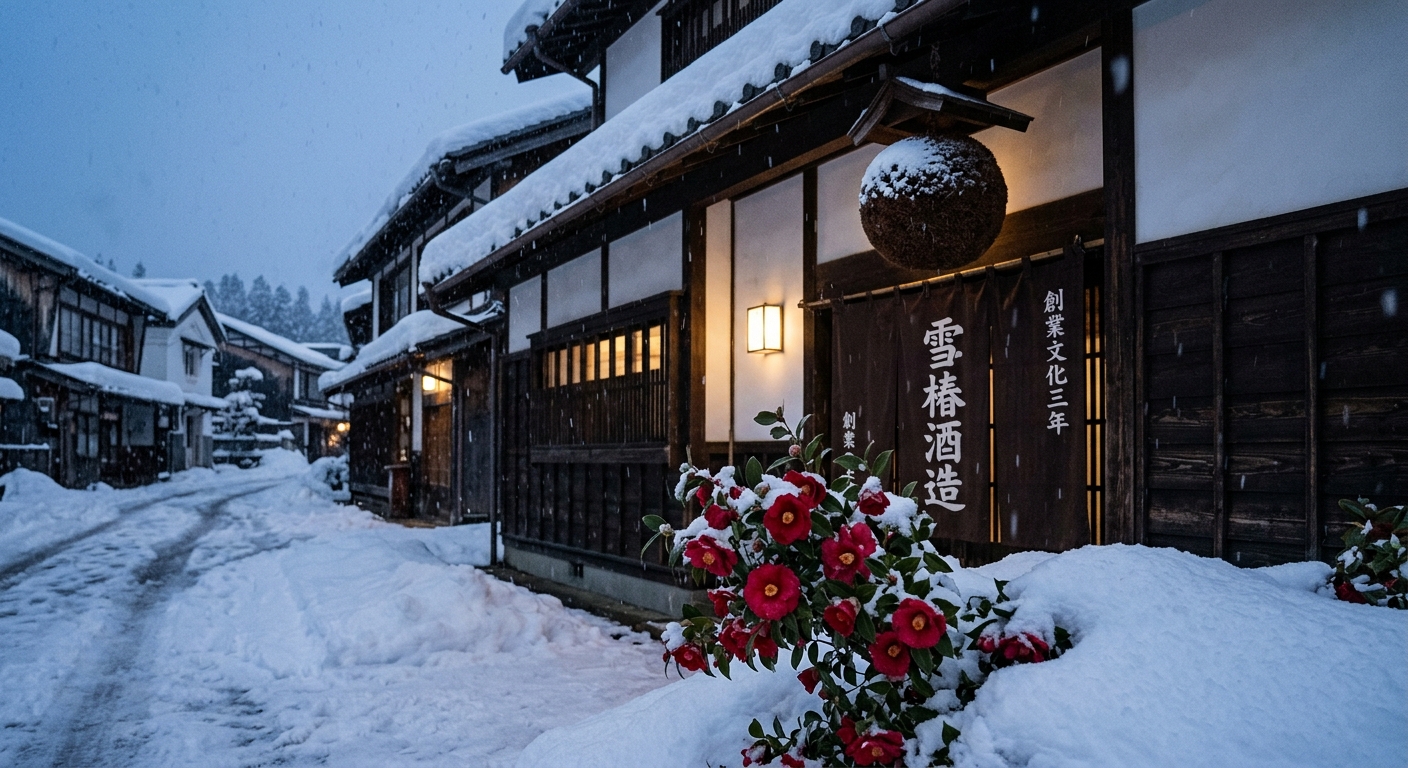
Yukitsubaki Shuzo was founded in 1806, in the Bunka era, under the name “Maruwaka Shuzo.” For more than two centuries since, this sake brewery has kept its roots planted firmly in Kamo City, Niigata Prefecture.
A defining turning point came in 2011. The brewery walked away from its earlier focus on ordinary table sake (futsushu) and committed instead to becoming a “junmai-only brewery,” producing nothing but Junmai, Junmai Ginjo, and Junmai Daiginjo. It was a choice of honesty over efficiency — a declaration, in effect, of the brewery’s own resolve to let the true flavor of rice speak for itself.
The brewery’s guiding philosophy is disarmingly simple: “enjoy the craft of making sake.” Even while holding fast to old-fashioned, hands-on methods, what they’re really chasing is a bottle where richness, clarity, and balance meet in harmony. Behind their easygoing motto — “sake-making that’s fun, a little playful, and always sincere” — lies a stubborn, almost uncompromising craftsman’s spirit.
The Land’s Story
Kamo City has long been known as the “Little Kyoto of the North” — Hokuetsu no Sho-Kyoto. Its streets, still lined with the quiet traces of old temples and merchant houses, carry a refined stillness that stands out even amid the deep snows of Echigo.
No account of this town would be complete without mentioning the snow camellia (yukitsubaki), officially designated the prefectural flower of Niigata. Crushed under the weight of heavy snowfall, it endures silently beneath the drifts, only to burst into red bloom the moment the thaw arrives. Kamo City is known as one of its natural growing grounds, and both the brewery’s name and the sake’s name are drawn directly from this flower. A blossom that survives a brutal winter to bloom again — it’s hard not to read that as a portrait of the land itself.
The Song’s Story
Kobayashi Sachiko’s “Yukitsubaki” was released in 1987 as her first single after going independent. Written by lyricist Hoshino Tetsuro and composed by Endo Minoru — a heavyweight pairing in the world of enka — the song stayed on the Oricon charts for 104 weeks, becoming a long-running hit that eventually sold over a million copies. Alongside “Omoide Zake,” it remains one of her signature songs.
The motif at the heart of the song is the snow camellia that grows wild in her home prefecture of Niigata. The flower’s quiet endurance beneath the snow becomes a metaphor for a woman standing firm through hardship — and it’s in that restraint, favoring inner strength over spectacle, that the song finds its real dignity.
Why This Pairing
What makes this pairing so compelling is that the sake and the song approach the very same name and the very same motif — the snow camellia — from two different directions.
The brewery turned its back on efficient, mass-produced sake in favor of the painstaking work of a junmai-only approach. The song turned away from flash and spectacle to sing instead of the strength found in enduring hardship. Both refuse to be swept along by the trends of their time, choosing instead to hold their ground. Like a camellia that bears the weight of snow and still blooms red, this sake, too, blossoms quietly but unmistakably on the tongue.
Where to Find This Bottle
The Rakuten Ichiba link below is an affiliate link.
The Rakuten Ichiba link below is an affiliate link.
The Rakuten Ichiba link below is an affiliate link.
Note: These Rakuten and Amazon links point to Japan-based retailers, so they’re most useful for readers in Japan or those who can arrange international shipping. Availability and stock may change over time — your local sake shop may also be able to order it in if you mention the name.
🌡️ Recommended way to drink it:Gently warmed (nurukan, around 40°C). “Hana” took the top gold award in the value nurukan category at the 2022 National Warm Sake Contest, and warming does bring out the fine-grained umami that low-temperature fermentation builds into it — especially welcome on a cold night. Served chilled, its floral aroma lifts and the dry finish sharpens.
Pairing Dishes to Try
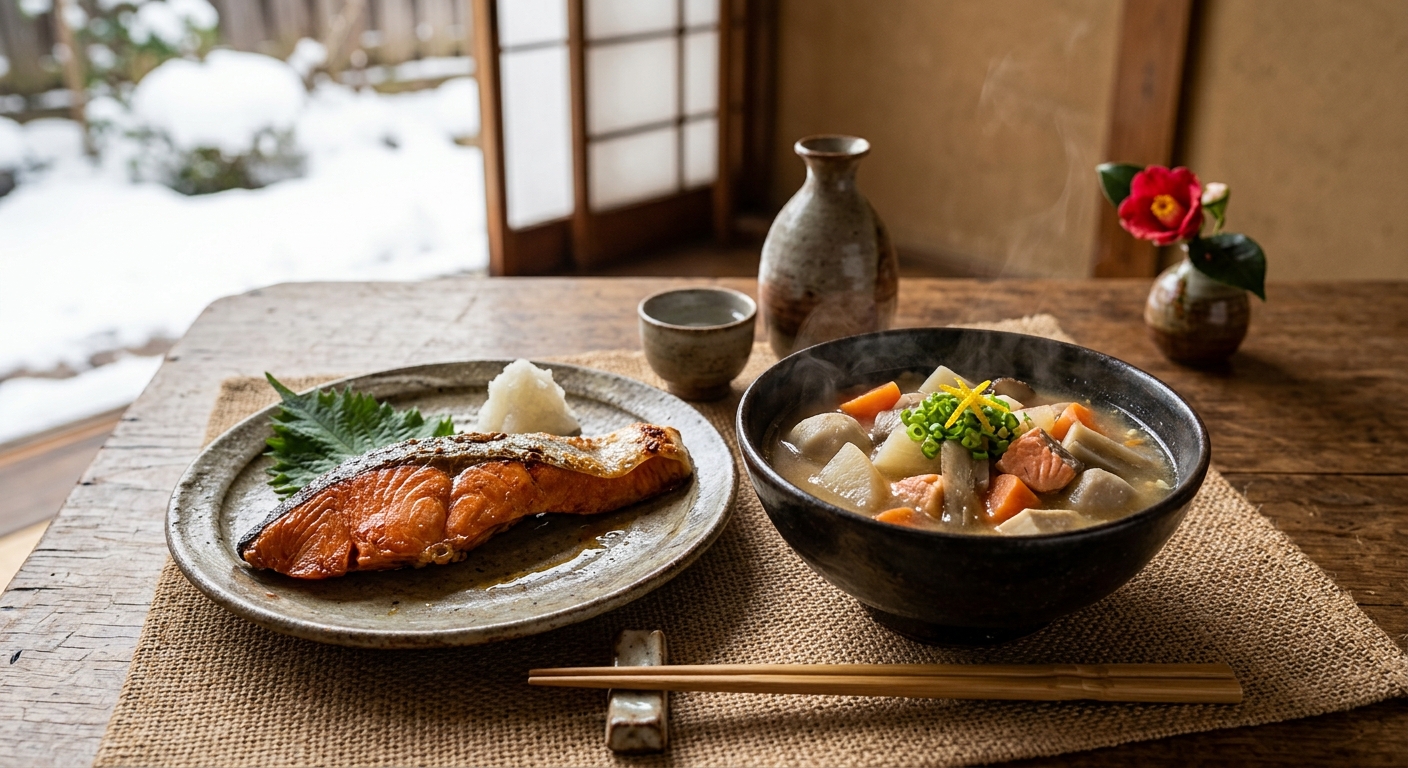
Shiobiki-zake (salt-cured salmon)
A preserved dish that defines winter in Niigata. The deep, slow-cured richness of salmon aged carefully in salt, along with its concentrated fattiness, speaks directly to the balance of richness and clarity that defines Yukitsubaki. It’s a dish that carries within it all the wisdom of how snow country has survived its long winters.
Recipe (in Japanese): クラシル「鮭ハラスの塩焼き」
Noppei-jiru
A hearty Niigata home-style soup simmered with root vegetables, salmon, and taro. Its gentle, slightly thickened broth and mild sweetness fold softly into the rice-forward richness of a junmai ginjo. Its unassuming depth of flavor pairs beautifully with the sake’s own quiet, enduring-to-bloom character.
Recipe (in Japanese): クラシル「新潟風のっぺい汁」
A quick scientific note: the amino acids derived from rice — the source of umami — found in junmai ginjo overlap with the glutamic acid in the broths of salmon and noppei-jiru. Together they create a synergistic boost in umami, giving the pairing more depth than either would offer alone.
Visiting the Brewery
Yukitsubaki Sake Brewery 3-14 Nakamachi, Kamo City, Niigata. About a 12-min walk from Kamo Station (JR Shinetsu Main Line). A hands-on brewery that has made only junmai sake since 2011.
Sights Nearby
Kamoyama Park / Kamo City | ~15-min walk (~5 min by car) from the brewery A city park in the wooded grounds of Aoumi Shrine, with a free squirrel enclosure and a roller slide. Wild yukitsubaki (snow camellia), the plant the brewery is named for, grows here.
Aoumi Shrine / Kamo City | ~15-min walk from the brewery The guardian shrine of Kamo, at the entrance to Kamoyama Park. The place name “Kamo” comes from its past as an estate of Kyoto’s Kamo shrines.
Hot Springs Nearby
Kamo Nanatani Onsen “Bijin no Yu” / Kamo City | ~20 min, ~12 km by car from the brewery A day-use hot spring up a valley. 10:00-21:00 (last entry 20:30), closed the 2nd and 4th Wednesday, ¥900 for adults; the water has a soft, slippery feel.
Opening hours, closing days and day-use bathing availability can change. Please check each facility’s official information before visiting.
A Quick Glossary (Sake Terms)
Junmai (pure rice sake): Sake made only from rice, rice koji, and water, with no added distilled alcohol. Its defining trait is a direct, unfiltered expression of the rice’s own richness.
Junmai Ginjo: A junmai sake made from rice milled down to 60% or less of its original size and fermented slowly at low temperatures. Known for its fragrant, floral aroma.
Junmai Daiginjo: Brewed from rice milled down to 50% or less, this represents the most refined, aromatic tier of junmai sake.
コメントを残す