今日のペアリング
▶ 上のプレーヤーで再生できない場合は、YouTubeで開く
醸造所の話
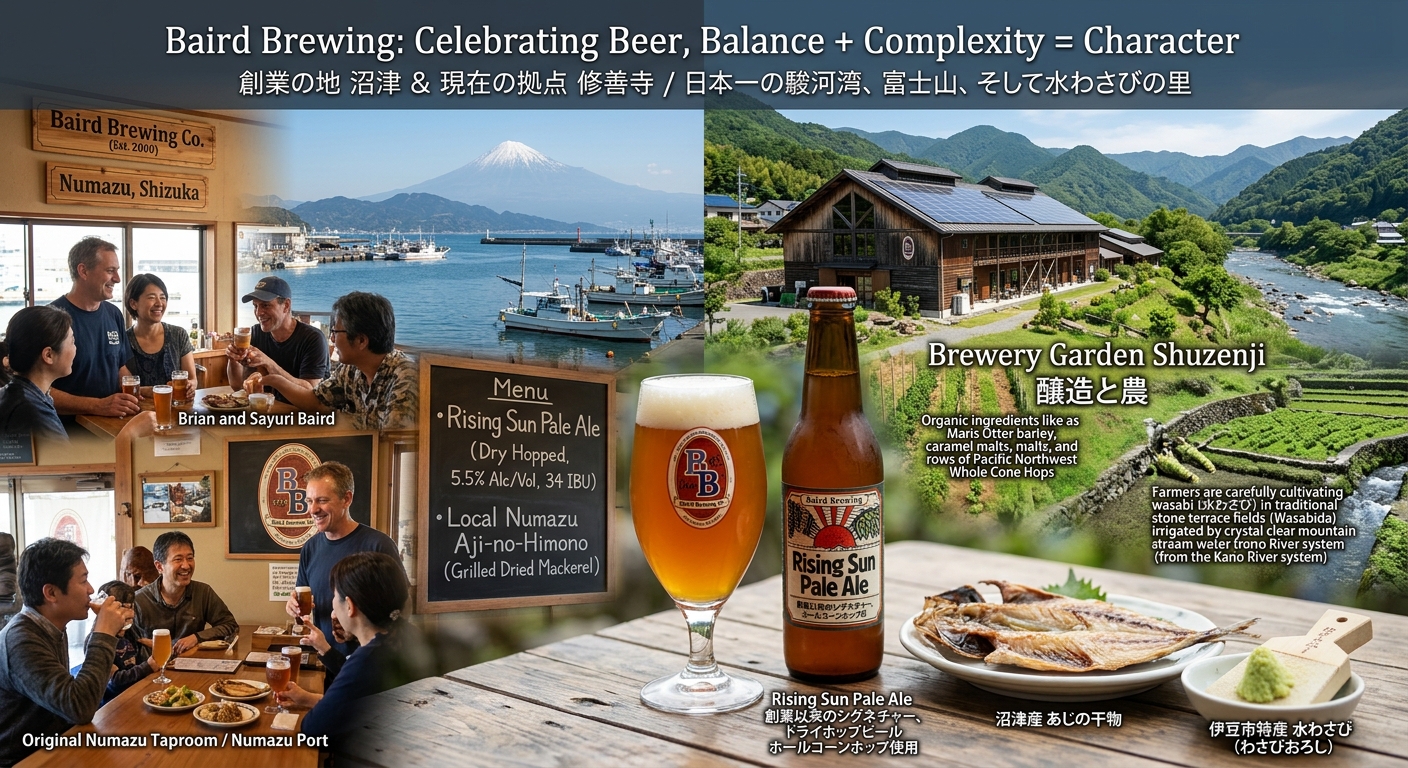
ベアードブルーイングの創業は2000年。ブライアン・ベアードさんとさゆりさん夫妻が、静岡県沼津市で立ち上げました。ブライアンさんは大学卒業後の1989年から3年間、大阪で英語教師として働いた経験を持ちます。その後、米国のジョンズ・ホプキンス大学大学院に進み、国際政治経済学を専攻。在学中は、1000種類以上のビールを扱うことでギネス記録にも載った伝説的なビアバー「ブリックスケラー」に足しげく通っていたといいます。当時の日本は規制緩和が進んでいた時期で、クラフトビールそのものだけでなく、日本人が得意とする職人文化に強く惹かれたことが、日本でビール造りを始める動機になったと語っています。
拠点に沼津を選んだ理由について、ブライアンさんは「水質が良く、東京への近さから流通に有利で、コストも低かった」と説明しています。掲げるモットーは「Celebrating Beer(ビールを祝福する)」。経営哲学は「Balance + Complexity = Character(バランスと複雑さが個性をつくる)」というシンプルな式で表され、大量生産にはない風味と尊厳をビールに取り戻すことを目指す家族経営の会社です。
2014年春には、醸造の拠点を伊豆市修善寺の狩野川沿いへ移転しました。3ヘクタールの敷地に建つ「ブルワリーガーデン修善寺」は、醸造と農をひとつの場所で営む農園型のブルワリーです。公式サイトはその狙いを「ここで醸造と栽培を行うことで、土地とビールの間にある複雑なつながりを浮かび上がらせることを目指している」と説明しています。
今回の一本「ライジングサン ペールエール」は、創業以来のシグネチャーとなるドライホップビールです。イギリス伝統のフロアモルティング製法で仕上げたマリスオッター麦芽をベースに、カラメルモルトとロースト大麦を加え、ホップは太平洋岸北西部(パシフィック・ノースウエスト)産のホールコーンのみを使用。ペレットやエキスには頼らず、シトラスと松を思わせる香りを引き出しています。アルコール5.5%、IBU34。
土地の話
創業の地・沼津は、日本一深い湾として知られる駿河湾に面した港町です。ベアードブルーイングも当初、沼津港のほど近くにタップルームを構え、駿河湾で揚がった魚とともにビールを提供するところから歩みを始めました。沼津港といえば、いまも全国有数の生産量を誇る「あじの干物」の産地でもあります。
そして現在の醸造拠点がある伊豆市大平は、狩野川の流れる伊豆半島のただ中にあります。伊豆市はもうひとつ、日本一の座を持つ産地でもあります。水わさびです。静岡県は水わさびの根茎の生産量・産出額ともに全国一位で、そのうち県内の栽培面積の約7割が伊豆市に集中しています。山林から湧き出る清らかな水を引いて育てるこの土地の農業と、良い水を求めて拠点を移してきたビール造りは、根っこの部分でよく似ています。
音楽の話
坂本九は1941年12月10日、神奈川県川崎市の生まれ。1959年にデビューし、1961年10月15日に発売されたのが「上を向いて歩こう」です。作詞は永六輔、作曲は中村八大。
1963年、この曲はイギリスのパイ・レコード社の目にとまります。同社社長ルイス・ベンジャミンは来日中に聴いたこの曲を気に入り、自国でのリリースを決めますが、日本語のタイトルを読むことができませんでした。そこで採用されたのが「SUKIYAKI」という英語圏向けの別題です。歌詞には一度も登場せず、内容とも無関係な、「短くて覚えやすく、いかにも日本的な単語」というだけの理由で選ばれたタイトルでした。同年5月3日にキャピトル・レコードから全米発売されると、5月11日付のビルボードHot100に79位で初登場し、着実に順位を上げて6月15日付で1位に到達。その後3週にわたって首位の座を守りました。
涙がこぼれないよう上を向いて歩く、という歌詞が描くのは、悲しみを抱えたまま前へ進もうとする姿です。坂本九自身は1985年8月12日、日本航空123便墜落事故で43歳の生涯を閉じましたが、この曲はいまも歌い継がれています。
なぜこの組み合わせなのか
どちらも、「上」を向いています。ビールの名前「ライジングサン」は昇る太陽そのものを指し、原料のホップはつる性の植物として、夏のあいだ空に向かって伸び続けます。そして「上を向いて歩こう」は、その名の通り、上を向いて歩くことを歌にした曲です。見上げる先にあるものは違っても、両者は同じ方向を向いています。
そしてもう一つ、この二つは太平洋を逆向きに渡ってきました。ブライアン・ベアードさんはアメリカから日本へ渡り、イギリス伝統の麦芽とアメリカ産のホップを、伊豆の水で仕込むビールを作り上げました。一方「上を向いて歩こう」は日本からアメリカへ渡り、その過程で「SUKIYAKI」という、歌詞とは何の関係もない名前を与えられながらも、メロディーだけはそのままにチャートの頂点まで届きました。海を渡るとき、形は変わっても、芯にあるものは変わらない。そういう例が、ここにも一つ増えたのかもしれません。
味の面でも、共通するのはやはり軽やかな上向きさです。シトラスと松を思わせるホップの香りと、麦芽の甘みのバランスが取れたこのビールは、飲み口が軽く、グラスがどんどん進みます。悲しい歌詞を持ちながらもどこか明るいこの曲のリズムと、案外近いところにあります。
この一杯を、探すなら
※楽天市場へのリンクは広告(アフィリエイト)です。醸造所がタップルームや直営店を持っている場合は、できたてを現地で味わうのが一番のおすすめです。
🌡️ おすすめの飲み方(温度とグラス):8〜10℃、キンキンに冷やしすぎないのがおすすめです。ホップの香りが立つよう、口がすぼまったタンブラーやパイントグラスに注ぎ、2〜3cmほどの泡を作ってください。冷えすぎるとシトラスと松の香りが閉じてしまうので、少し温度が上がってからのほうが、香りの変化も楽しめます。
合わせたい「アテ」
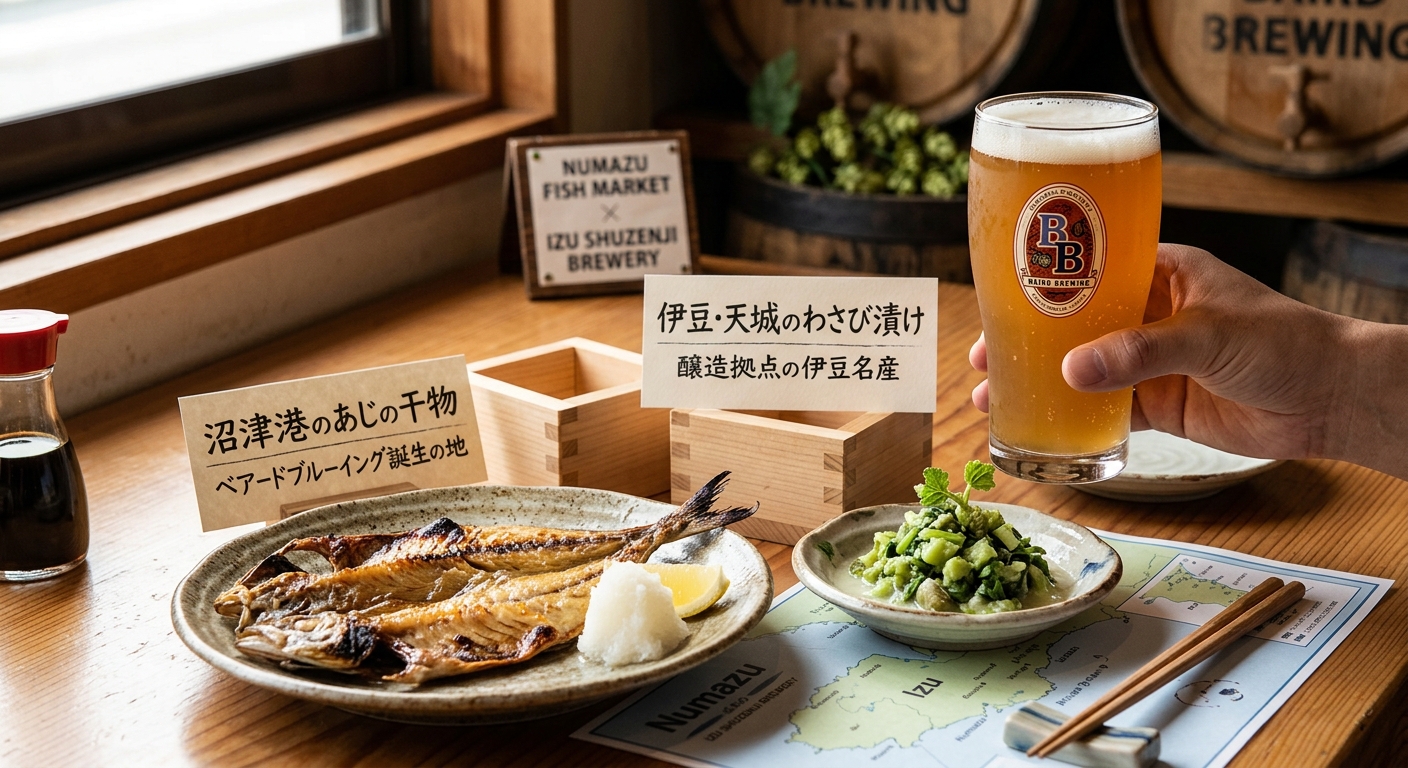
- 沼津港のあじの干物
ベアードブルーイングが産声を上げた沼津の名物です。凝縮したうま味と塩気が、ホップの苦みをやわらげながら麦芽の甘みを引き立てます。
- 伊豆・天城のわさび漬け
いまの醸造拠点がある伊豆の名産です。わさびの根や葉を酒粕に漬け込んだ一品で、ツンと抜ける辛みが脂を洗い流し、ホップのシトラスと松の香りに重なります。
科学的にひとこと:わさびの辛み成分(アリルイソチオシアネートなど)は揮発性が高く、鼻に抜ける香りとしても感じられます。ホップの香気成分も同じく揮発性の芳香物質で、感じ取る経路が近いため、両者の香りは競合するのではなく重なり合って一体感を生みます。あわせて、干物の持つ塩気には苦みの感じ方を抑える働きがあることが知られており、麦芽の甘みを浮かび上がらせます。
この醸造所をたずねるなら
ベアードブルーイング(ブルワリーガーデン修善寺)
静岡県伊豆市大平1052-1/伊豆箱根鉄道「修善寺駅」から車で約10分。
狩野川のほとりの農園型ブルワリー。3階のタップルームで、狩野川と伊豆の山を眺めながらできたてのビールを飲めます。
近くの観光スポット
- 修善寺温泉街/伊豆市修善寺|醸造所から車で約8分・約3km
弘法大師の開湯と伝わる、伊豆でもっとも古い温泉地のひとつ。桂川沿いの竹林の小径や、川床に湧く独鈷の湯があります。
- 修禅寺/伊豆市修善寺|醸造所から車で約8分・約3km
温泉街の中心に建つ、807年開創と伝わる寺。源頼家ゆかりの地としても知られます。
近くの温泉
- 修善寺温泉 外湯「筥湯(はこゆ)」/伊豆市修善寺|醸造所から車で約8分・約3km
桧の湯船の日帰り入浴施設。温泉街の旅館にも日帰り入浴を受け付けるところがあります。受付時間は各施設でご確認ください。
※営業時間・定休日・日帰り入浴の可否は変わることがあります。おでかけ前に各施設の公式情報をご確認ください。
ひとことメモ(ビールの用語)
- クラフトビール:小規模な醸造所が、造り手の個性を前面に出して仕込むビールの総称。大量生産の均一な味とは別の方向を目指しています。
- ペールエール:淡い色のエール。麦の甘みとホップの香りのバランスが取れた、エール入門にあたるスタイルです。
- モルト:発芽させた大麦(麦芽)のこと。ビールの甘み・色・コクの土台になり、焙煎の深さで色と香ばしさが決まります。
- ホップ:ビールに苦みと香りを与えるつる性植物の毬花(まりばな)。品種によって、柑橘・トロピカルフルーツ・草原のように香りが変わります。
- ドライホッピング:発酵後のビールにホップを漬け込む手法。煮込まないので苦みはあまり増えず、香りだけを大きく立ち上げられます。
- IBU:苦みの強さを表す国際的な数値。10前後だとほとんど苦みを感じず、60を超えるとはっきり苦いIPAの領域です。
参考
内容に誤りがございましたら、お手数ですが info@soundrecords.jp までご連絡いただけますと幸いです。
Today’s Pairing
- Craft beer: Baird Beer Rising Sun Pale Ale — Pale Ale, built on floor-malted Maris Otter with Caramel malt and Roast Barley, dry-hopped with whole-cone hops from the Pacific Northwest (no pellets or extracts), 5.5% ABV, 34 IBU / Baird Brewing (Oodaira, Izu City, Shizuoka; Brewery Gardens Shuzenji)
Official site: https://bairdbeer.com/products/rising-sun-pale-ale
- Music: “Ue wo Muite Arukou” (“I Look Up as I Walk”) by Kyu Sakamoto (1961; released in the US as “SUKIYAKI,” it reached No. 1 on the Billboard Hot 100 in 1963)
YouTube: https://www.youtube.com/watch?v=F284iB65-QU
▶ If the player above doesn’t play, open it on YouTube
The Story of the Brewery
Baird Brewing was founded in 2000 by the husband-and-wife team of Bryan and Sayuri Baird in Numazu, Shizuoka. After graduating college in 1989, Bryan spent three years teaching English in Osaka. He then went on to Johns Hopkins University for graduate school, studying international political economy, and during those years became a regular at the legendary Brickskeller beer bar in Washington, D.C. — a place that once held a Guinness World Record for stocking over a thousand different beers. Japan was in the middle of a wave of deregulation at the time, and Bryan has said what drew him back was not just craft beer itself, but the shokunin, or artisan, culture Japan is known for.
Asked why he chose Numazu, Bryan has explained that the water quality was good, the proximity to Tokyo made distribution easier, and costs were lower. The brewery’s motto is “Celebrating Beer,” and its guiding philosophy is summed up in a simple formula: “Balance + Complexity = Character.” It remains a family company built around restoring the flavor, character and dignity that mass production leaves behind.
In the spring of 2014, the brewery moved its main production to the banks of the Kano River in Shuzenji, Izu City. Brewery Gardens Shuzenji sits on three hectares of land and combines brewing with farming on the same site. The official site describes the goal this way: by brewing and farming here, the aim is to highlight the intricate connection that exists between land and beer.
Rising Sun Pale Ale, featured here, has been the brewery’s signature dry-hopped beer since its early days. It’s built on floor-malted Maris Otter, an English malting tradition, with Caramel malt and Roast Barley added, and dry-hopped exclusively with whole-cone hops from the Pacific Northwest — no pellets or extracts — for a citrus and pine character. 5.5% ABV, 34 IBU.
The Story of the Land
Numazu, where the brewery began, sits on Suruga Bay, known as Japan’s deepest bay. Baird Brewing’s first taproom opened near Numazu’s fish port, serving beer alongside the day’s catch from the bay. Numazu is also one of Japan’s leading producers of aji himono — dried, salted horse mackerel — to this day.
The brewery’s current home, Oodaira in Izu City, sits along the Kano River in the middle of the Izu Peninsula. Izu City happens to hold the top spot in another field, too: mizuwasabi, water-grown wasabi. Shizuoka Prefecture leads Japan in both the yield and the value of its wasabi rhizome harvest, and roughly 70% of the prefecture’s cultivated area is concentrated in Izu City. The clear spring water drawn from the surrounding mountain forests to grow that wasabi, and the search for good water that led this brewery here, share the same root.
The Story of the Song
Kyu Sakamoto was born on December 10, 1941, in Kawasaki, Kanagawa. He debuted in 1959, and “Ue wo Muite Arukou” was released on October 15, 1961, with lyrics by Rokusuke Ei and music by Hachidai Nakamura.
In 1963, the song caught the attention of Pye Records in the UK. Company president Louis Benjamin heard it during a trip to Japan, liked it, and decided to release it back home — but couldn’t read the Japanese title. The solution was a new name for English-speaking markets: “SUKIYAKI,” a word that never appears in the lyrics and has nothing to do with the song’s content. It was chosen simply because it was short, easy to remember, and unmistakably Japanese. Released across the US by Capitol Records on May 3 of that year, it entered the Billboard Hot 100 at No. 79 on the May 11 chart, climbed steadily, and reached No. 1 on the chart dated June 15 — holding the top spot for three weeks.
The lyrics describe looking up as you walk, so the tears won’t fall — someone carrying sorrow while still trying to move forward. Kyu Sakamoto himself died on August 12, 1985, in the crash of Japan Airlines Flight 123, at the age of 43. The song is still sung today.
Why This Pairing
Both of these look up. The beer’s name, Rising Sun, points straight at the sun climbing into the sky, and hops themselves are a climbing plant, a bine that reaches upward through the summer months. “Ue wo Muite Arukou” is, quite literally, a song about walking with your face turned up. What they’re each looking toward differs, but the direction is the same.
There’s another thing they share: both crossed the Pacific, in opposite directions. Bryan Baird crossed from America to Japan and built a beer that brews English malting tradition and American hops together in Izu’s water. “Ue wo Muite Arukou” crossed from Japan to America, picking up a new name along the way — “SUKIYAKI,” a word with no connection to its lyrics — and still climbed to the top of the chart with its melody intact. Something changes shape when it crosses the ocean, but whatever was at its core seems to survive the crossing. This may be one more example of that.
The flavors share that same light, upward quality. Balanced between a citrus-and-pine hop aroma and malt sweetness, this beer drinks easy, and the glass empties quickly. That’s not so far from the rhythm of a song that stays bright even while its lyrics carry sorrow.
Where to Find This Beer
The Rakuten Ichiba link below is an affiliate link.
These are Japanese storefronts. If you are visiting the brewery, drinking it fresh at their own taproom is by far the best option.
🌡️ How to serve it:8–10°C — not ice-cold. Pour into a tumbler or pint glass that narrows slightly at the rim, building two or three centimetres of foam, to gather the hop aroma. Serving it a touch too cold will close down the citrus and pine notes, so letting it warm a few degrees in the glass brings out more of the aroma’s range.
Pairing Dishes Worth Trying
- Aji himono (dried horse mackerel) from Numazu port
The specialty of the town where Baird Brewing was born. Its concentrated umami and salt soften the beer’s hop bitterness while bringing the malt sweetness forward.
- Wasabizuke from Amagi, Izu
A specialty of the area where the brewery now stands — wasabi root and leaves pickled in sake lees. Its sharp, sinus-clearing heat cuts through fat and layers neatly over the beer’s citrus and pine hop aroma.
A note on the science: wasabi’s pungent compounds, including allyl isothiocyanate, are highly volatile and register as aroma as much as taste. Hop aroma compounds are volatile in a similar way, perceived through much the same pathway, so rather than competing, the two aromas tend to layer into one impression. Salt, meanwhile, is known to soften the perception of bitterness, letting the malt sweetness in the beer come through more clearly against the dried fish.
Visiting the Brewery
Baird Brewing (Brewery Gardens Shuzenji)
1052-1 Odaira, Izu City, Shizuoka. About 10 min by car from Shuzenji Station (Izuhakone Railway).
A farm-style brewery on the bank of the Kano River. The third-floor taproom looks out over the river and the mountains of Izu.
Sights Nearby
- Shuzenji Onsen town / Izu City | ~8 min, ~3 km by car from the brewery
One of the oldest hot-spring towns in Izu, said to have been opened by Kobo Daishi. It has a bamboo-lined path along the Katsura River and the Tokko-no-yu spring welling up in the riverbed.
- Shuzen-ji Temple / Izu City | ~8 min, ~3 km by car from the brewery
A temple at the heart of the hot-spring town, said to have been founded in 807, and connected to the story of Minamoto no Yoriie.
Hot Springs Nearby
- Shuzenji Onsen public bath “Hakoyu” / Izu City | ~8 min, ~3 km by car from the brewery
A day-use bath with a cypress-wood tub. Some inns in the hot-spring town also accept day-use bathers; check each one’s hours.
Opening hours, closing days and day-use bathing availability can change. Please check each facility’s official information before visiting.
A Quick Glossary of Beer Terms
- Craft beer: Beer made by small breweries that put the character of the maker front and centre, as opposed to the uniformity of mass production.
- Pale Ale: A lightly coloured ale that balances malt sweetness against hop aroma — often the entry point into the world of ale styles.
- Malt: Germinated barley. It forms the foundation of a beer’s sweetness, colour and body; how deeply it is roasted determines colour and toastiness.
- Hops: The cones of a climbing plant, which give beer its bitterness and aroma. Depending on the variety, that aroma can read as citrus, tropical fruit or open grassland.
- Dry hopping: Steeping hops in beer after fermentation rather than boiling them. Because nothing is boiled, bitterness barely increases, while aroma is pushed dramatically forward.
- IBU: An international measure of bitterness. Around 10 you barely notice it; above 60 you are in clearly bitter IPA territory.
Sources
If you notice any errors in this article, please don’t hesitate to reach out at info@soundrecords.jp.
コメントを残す