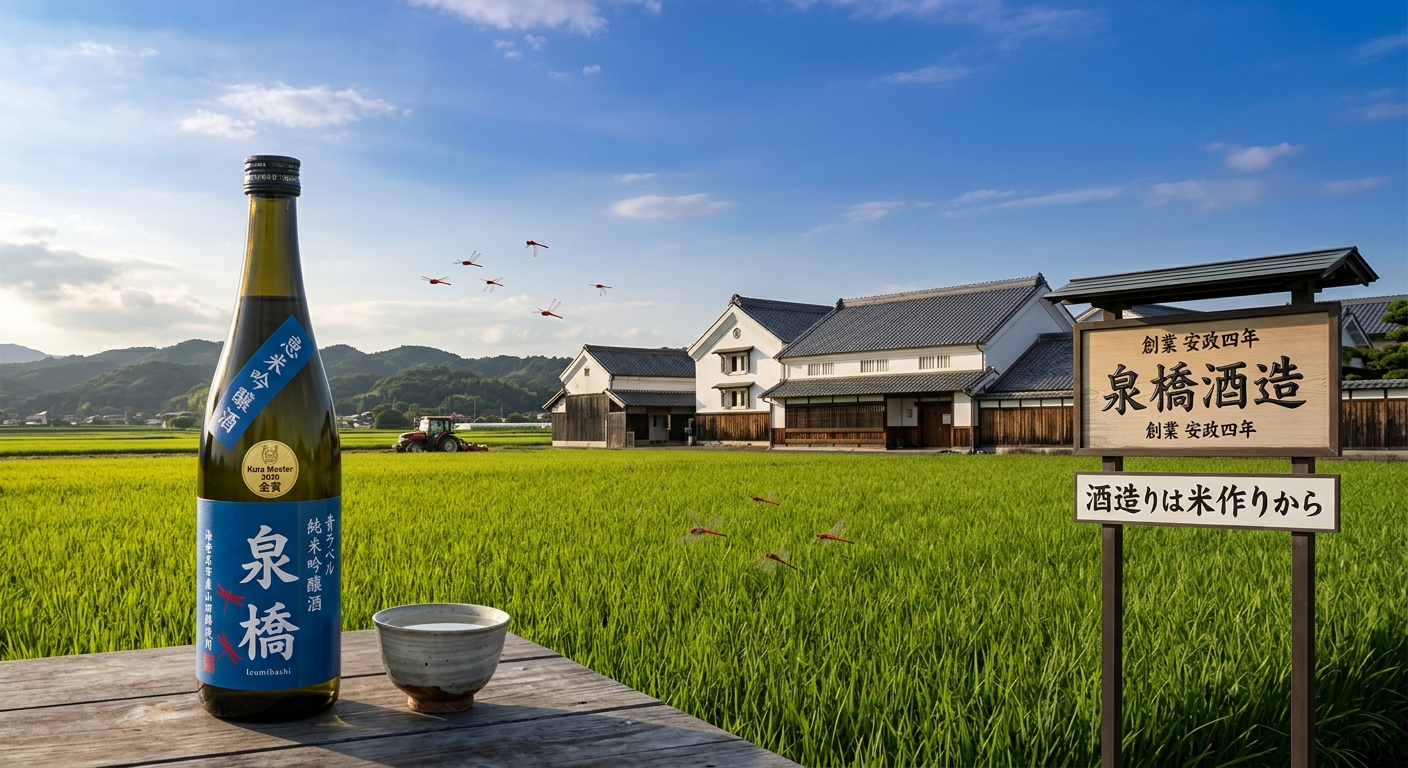
Izumibashi Shuzo was founded in 1857. The brewery sits in Ebina City, Kanagawa Prefecture, on the fertile floodplain carved out by the Sagami River, and from the very beginning it has held to one guiding principle: sake brewing starts with rice farming. Rather than simply buying in rice, the brewery handles cultivation, polishing, and fermentation entirely in-house — a “grow-and-brew” model that many breweries across Japan now aspire to, but one that Izumibashi was among the first to pioneer.
Every sake the brewery produces is junmai — made purely from rice, water, and koji, with no added alcohol — and roughly half of it is crafted using kimoto, the old, painstaking method of cultivating the yeast starter by letting natural lactic bacteria do their slow work. The bottle we’ve chosen today, “Megumi” Blue Label Junmai Ginjo, is the brewery’s everyday standard: Yamada Nishiki grown in Ebina itself, milled to 58% on the brewery’s own flat-polishing equipment and brewed by hand. The result is a gentle, citrus-like fragrance over a dry, balanced body where richness, sweetness and acidity move together. Its reputation has traveled well beyond Japan, too — in 2022 it won both a Gold Medal and a Platinum Medal at Feminalise, the French wine and spirits competition judged entirely by women, as well as a Silver Medal at the International Wine Challenge (IWC).
The Story of the Land
Ebina City, where the brewery stands, sits atop an alluvial plain built up over centuries by sediment carried down the Sagami River. The soil drains well and suits rice cultivation beautifully, and on this land Izumibashi works together with neighboring contract farmers to grow sake rice varieties like Yamada Nishiki, Omachi, and Rakufumai — nearly 90% of it cultivated right around the brewery itself.
The brewery’s symbol is the red dragonfly. Because these dragonflies return only to paddies where pesticide use has been kept to a minimum, their presence became a kind of marker for the brewery’s farming practices, and the dragonfly motif has appeared on its labels for generations. Even the name “Izumibashi” carries the land’s memory of water: it comes from the Izumi River, which once flowed along the brewery’s north side, combined with “Hashiba,” the family’s old trade name. You might say this is a brewery whose very name is built from water.
The Story of the Song
Sen Masao’s “Kitaguni no Haru” was released in April 1977. Lyricist Hakushi Ide is said to have written with the scenery of Minamimaki Village in Nagano Prefecture in mind, while composer Minoru Endo drew on memories of Niigata Prefecture, where he spent his boyhood. The song opens with the line “white birch, blue sky, southern wind,” and from there it carefully gathers up the images a young person who has moved to the city might picture: the hometown landscape stirring back to life as the snow melts away. It won the Long-Seller Award at the 21st Japan Record Awards, and it later became a beloved standard in China as well, known there as “Beiguo Zhi Chun.”
The second verse brings in the murmur of water — the sound of snowmelt trickling somewhere in the distance as the season turns. There are no dramatic key changes, no big swells in the arrangement; the song simply, quietly traces the passing of the seasons back home. That plainness, I think, is exactly why it has endured for so long.
Why This Pairing
Both the name “Izumibashi” and the song “Kitaguni no Haru” are built from a memory of water. The murmur of the Izumi River that once ran beside the brewery, and the murmur of snowmelt that rises in the song as spring arrives — it’s a coincidence, but the sound of water quietly links the two stories together.
There’s another thread that ties them, too: neither one turns its back on the land. Izumibashi chose to grow its own rice rather than simply buy it in. “Kitaguni no Haru” isn’t a story of success in the big city — it’s a song about longing for a hometown you can’t easily return to. Both express, without any pretense, what it means to put down roots in a place, through nothing more than quiet, patient effort. Take a sip of the Dragonfly Label, and beneath the polished sweetness of the Yamada Nishiki, you may catch a faint trace of paddy water and soil rising up — something not unlike the feeling of remembering a hometown far away.
Where to Find This Bottle
The Rakuten Ichiba link below is an affiliate link.
The Rakuten Ichiba link below is an affiliate link.
Search on Rakuten Ichiba: Izumibashi “Megumi” Blue Label Junmai Ginjo (720ml / 1800ml)
*Stock and availability change over time. It’s also worth asking for this sake by name at a local bottle shop. Note that the Rakuten and Amazon links above lead to Japan-based retailers — most useful for readers in Japan, or for those elsewhere who can arrange international shipping.
🌡️ How to enjoy it:Serve well chilled. It’s at cold temperatures that this sake’s showy ginjo aroma and soft sweetness truly come into their own.
A Pairing Dish to Try
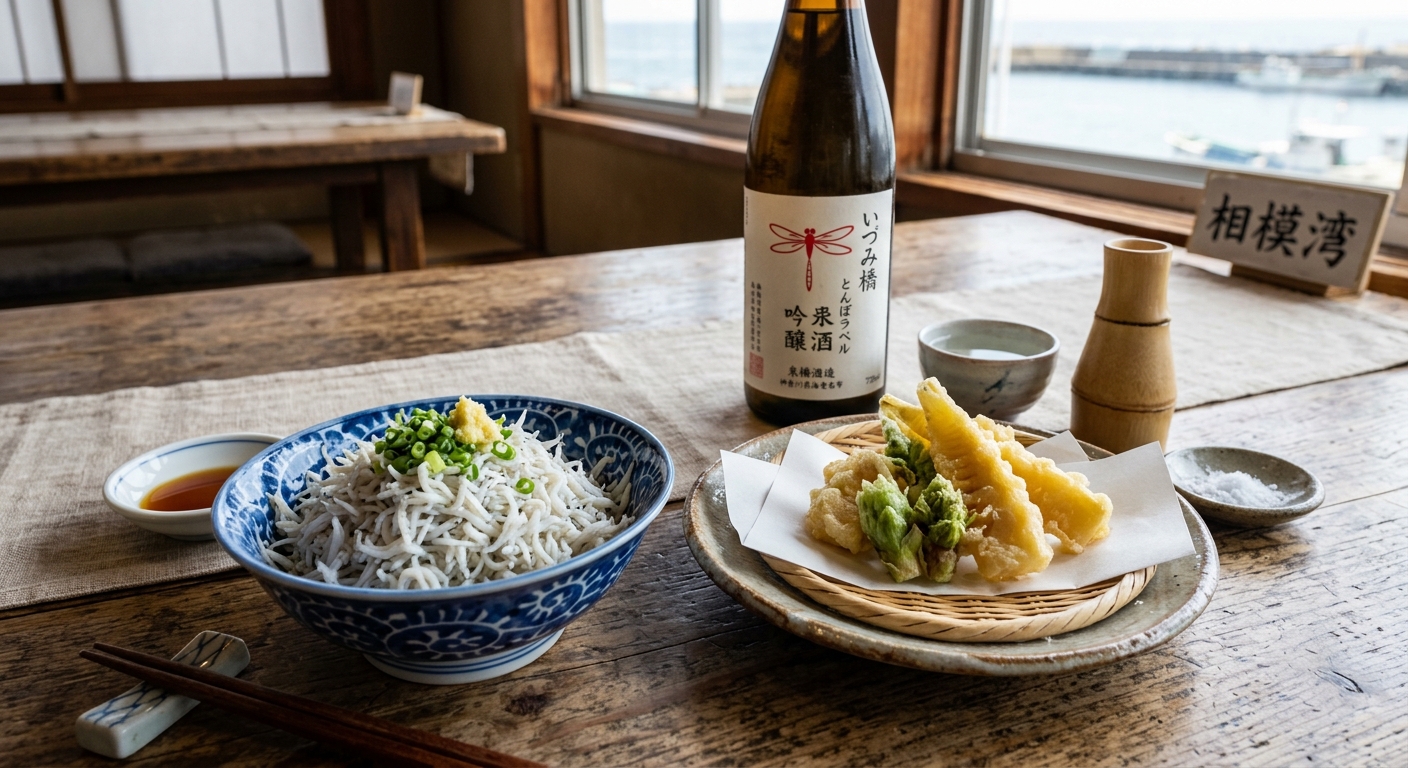
Kettle-boiled shirasu (baby sardines) from Sagami Bay
Shirasu is one of Kanagawa’s signature seafoods, and its gentle salinity and hint of the sea meet the Dragonfly Label’s showy ginjo aroma and rich sweetness with real lightness. It’s a way of pairing local water and local rice with a local catch from the sea.
Recipe (in Japanese): クラシル「釜あげしらす丼」
Tempura of spring vegetables (bamboo shoots, butterbur sprouts)
Mountain vegetables that push up through the last of the snow, along with spring vegetables from the Sagamino plain, fried in a light batter. Their gentle bitterness and the batter’s toasty aroma sit beautifully alongside the sake’s soft sweetness — it feels like a small, early taste of the very “spring in the northern country” the song describes.
Recipe (in Japanese): クラシル「ふきのとうの天ぷら」
A little science: the shirasu’s saltiness sets up a contrast effect that makes the sake’s sweetness pop, while the sake’s acidity cuts cleanly through the tempura’s oil — so even fried food never feels heavy alongside it.
Visiting the Brewery
Izumibashi Sake Brewery 5-5-1 Shimo-imaizumi, Ebina City, Kanagawa. About a 15-min walk from Ebina Station (JR / Odakyu / Sotetsu). A “cultivating brewery” that handles everything from growing the sake rice to milling and brewing.
Sights Nearby
Romancecar Museum / Ebina City (right by Ebina Station) | ~7 min, ~2 km by car from the brewery A railway museum showing successive generations of Odakyu Romancecar trains and a huge model diorama. 10:00-17:00, closed Tuesdays.
Sagami Kokubunji Temple Ruins / Ebina City | ~7 min, ~2.5 km by car from the brewery The site of the Nara-period provincial temple of Sagami (a nationally designated historic site). The foundation stones remain, and the grounds are open to walk freely.
Hot Springs Nearby
Ofuro no Osama, Ebina branch / Ebina City | ~15 min, ~6 km by car from the brewery A day-use bathhouse with 23 kinds of baths, including a free-flowing natural hot spring. 9:00-24:00, open year-round, ¥900 for adults.
Opening hours, closing days and day-use bathing availability can change. Please check each facility’s official information before visiting.
A Quick Glossary (Sake Terms)
Junmai Ginjo: Sake brewed purely from rice, water, and koji, polished down to 60% or less of the original grain — the most refined, aromatic tier of junmai sake.
Rice-polishing ratio (seimai buai): The percentage of the original brown rice grain that remains after polishing. The lower the number, the more the rice has been polished down.
Kimoto method: A traditional, labor-intensive way of cultivating the yeast starter, relying on naturally occurring lactic bacteria rather than added lactic acid.
コメントを残す