日本語で読む | This is the English version of a bilingual article.
Today’s Pairing
- Sake: Sasshu Masamune Junmai Ginjo — brewed with domestic rice, 15% alcohol / Satsuma Kinzan-gura Co., Ltd. (a subsidiary of Hamada Shuzo, 13665 Noshita, Ichikikushikino City, Kagoshima Prefecture)
Official site: https://www.hamadasyuzou.co.jp/kinzan/ - Kayoukyoku (classic Japanese popular song): “Seinen Ohara-bushi” (“Young Man’s Ohara Song”) by Saigo Teruhiko, 1965
YouTube: https://www.youtube.com/watch?v=dgbRNJDAf9I
▶ If the player above doesn’t play, open it on YouTube
The Story of the Brewery
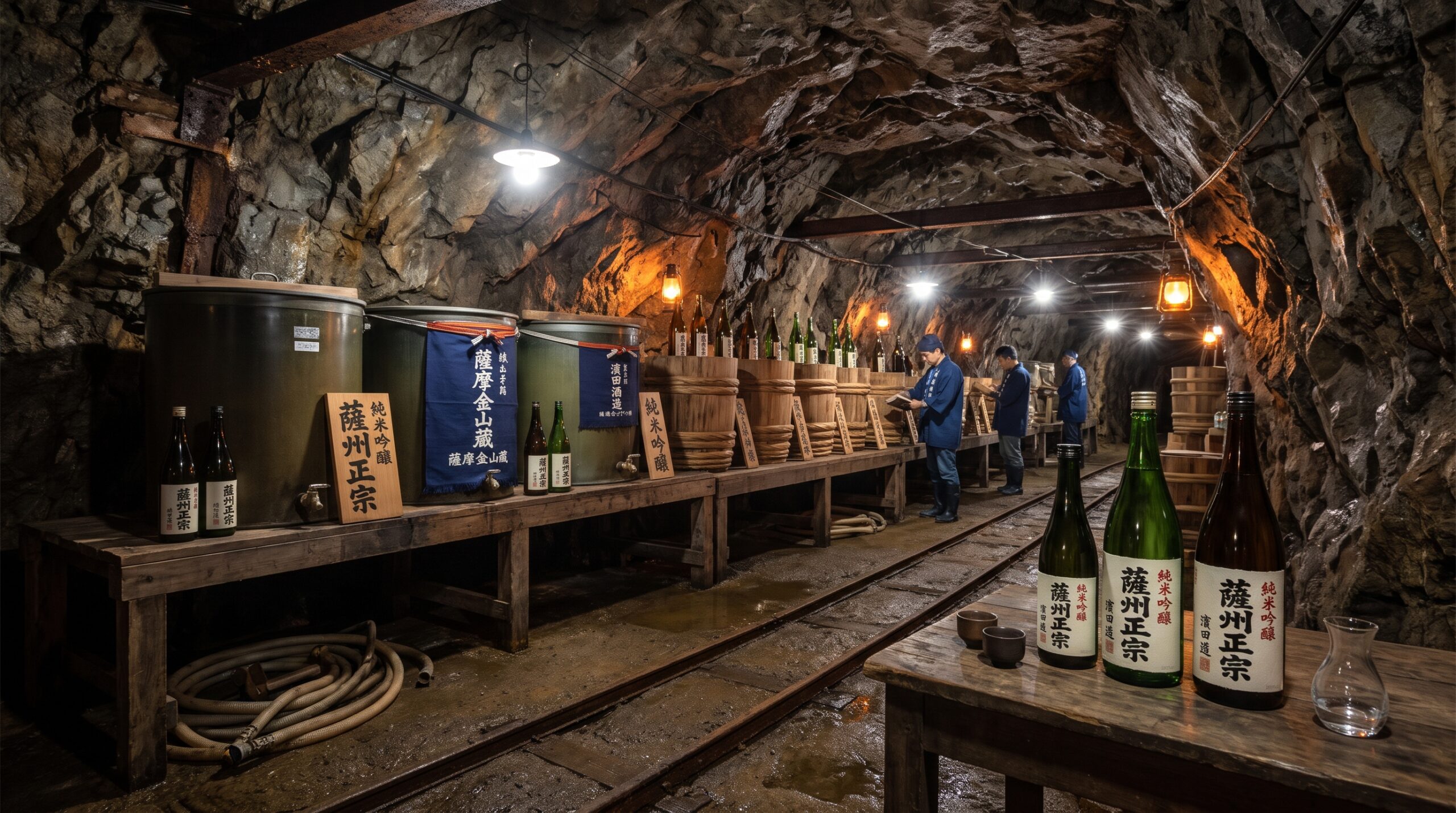
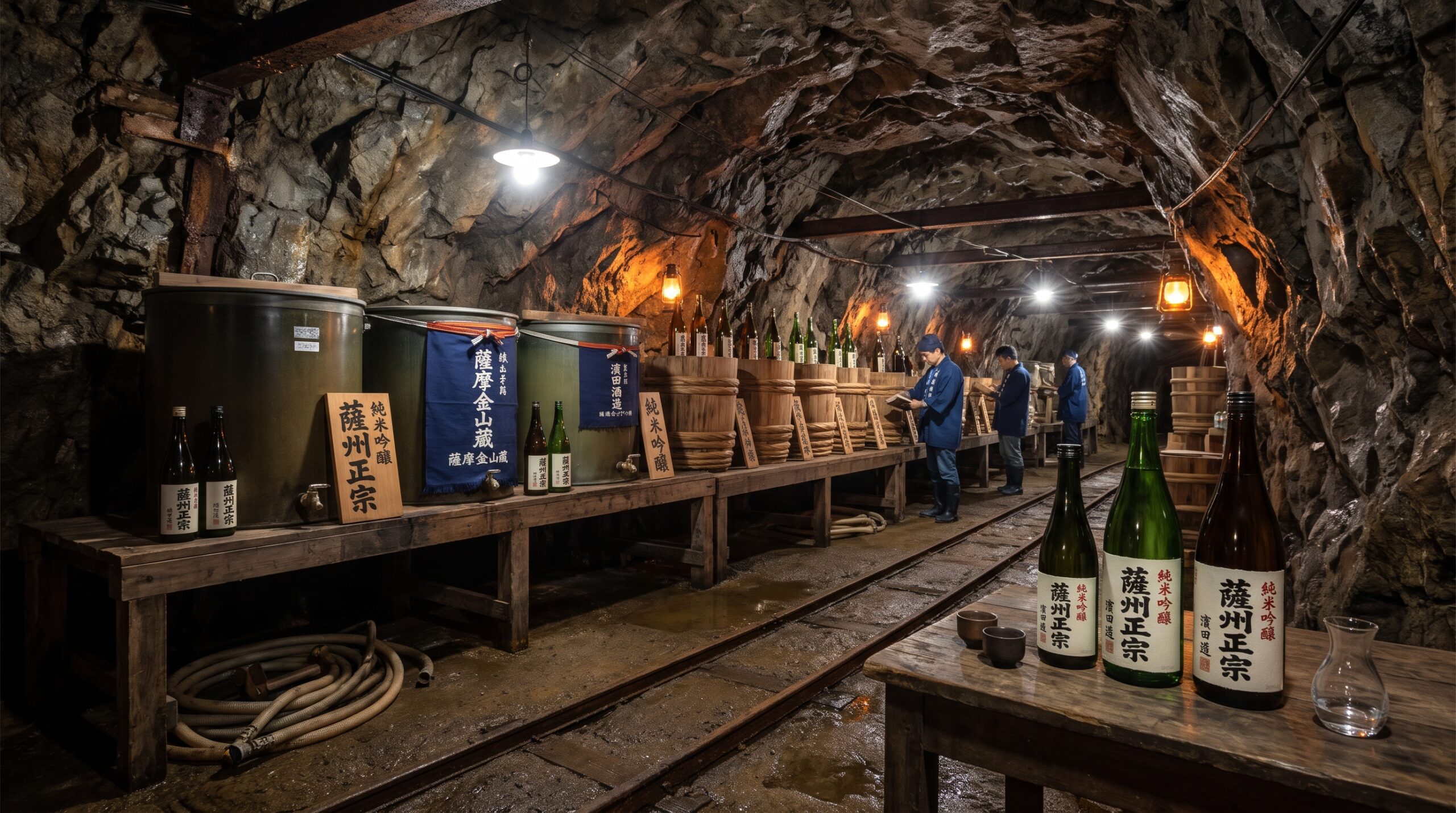
The Kushikino gold mine, in Ichikikushikino City, Kagoshima Prefecture, thrived as one of Japan’s leading gold mines from the late Edo period into the Showa era, and its tunnels — roughly 120 km in total length — still remain today. The mine site had operated as a tourist facility called “Gold Park Kushikino,” but closed in September 2003. At the city’s request, it reopened on April 23, 2005, as “Satsuma Kinzan-gura,” run by the shochu brewer Hamada Shuzo. The tunnels stay at a near-constant 19°C year-round — an environment well suited to the slow, low-temperature fermentation that ginjo-style brewing requires.
In 2012, sake brewing resumed inside those tunnels for the first time in 40 years — Kagoshima Prefecture had had no sake production since 1972. The result was Sasshu Masamune. The Junmai Ginjo — junmai meaning sake made only from rice, rice koji, and water, with no added brewing alcohol, and ginjo meaning it’s fermented slowly at low temperatures for a fragrant aroma — is brewed with domestic rice, its low-temperature fermentation drawing out a fragrant aroma and a clean sweetness. The brewing water is drawn from Mt. Kanmuri, the sacred mountain rising near the brewery. Hamada Shuzo, the company behind it, traces its founding to 1868 (incorporated in 1951), and is today led by Chairman Hamada Yuichiro and President Hamada Kotaro, who oversee this sake alongside the company’s core shochu business.
The Story of the Land
Ichikikushikino City sits on the northwestern side of the Satsuma Peninsula, facing the East China Sea. The Kushikino gold mine was one of the mines that helped support Japan’s modernization from the end of the Edo period into the Meiji era, and its tunnels carry the history of the people who once worked them. Mt. Kanmuri, rising near the brewery, is a mountain of mountain-worship tradition, said in legend to be where the Qin-dynasty alchemist Xu Fu once came ashore; at its foot stands the Chinese-style garden Kangaku-en. Tunnels that once yielded gold now quietly nurture something else — and Sasshu Masamune carries that memory of the land into the present.
The Story of the Song
“Seinen Ohara-bushi” is a song Saigo Teruhiko released in 1965, built around the local folk song “Kagoshima Ohara-bushi.” The lyrics are by Hoshino Tetsuro and the music by Yoneyama Masao.
Kagoshima Ohara-bushi is said to trace back to a song called “Akunode,” sung by samurai from Aku village in Hyuga Province (present-day Miyakonojo City, Miyazaki Prefecture) to rally spirits in camp during the early Edo period. Samurai from Harara, near Kagoshima, carried the song home and kept singing it, and it came to be called “Koharabushi,” after its place of origin. It spread nationwide after Shinbashi Kiyozo, a singer and geisha born in Nishinoomote City, Kagoshima, recorded it around 1933. Starting in 1949, Kagoshima City began holding the “Ohara Matsuri” festival, where large crowds of dancers have kept performing “Ohara-bushi” and “Kagoshima Hanya-bushi” every year since.
Saigo Teruhiko was born February 5, 1947, in Taniyama-cho, Kagoshima-gun, Kagoshima Prefecture (now part of Kagoshima City). He debuted on the Crown Records label with “Kimi Dake wo” in February 1964, and rose to fame alongside Hashi Yukio and Funaki Kazuo as one of the “Mitsuke” (Three Princes) of the era. His stage name was taken from the regional hero Saigo Takamori. “Seinen Ohara-bushi,” released the year after his debut, was a young singer born in Kagoshima singing, in his own voice, the folk song handed down in his hometown.
Why This Pairing
Satsuma Kinzan-gura gave a new purpose to tunnels that once yielded gold, quietly restarting sake brewing — silent for 40 years — deep within the same ground.
“Seinen Ohara-bushi,” too, breathed new life into “Ohara-bushi,” a local folk song handed down since the Edo period, through the voice of a young singer. A young man born in Kagoshima, carrying the name of Saigo Takamori as his stage name, singing his hometown’s own song — something old, carried forward rather than lost, taking on a new shape. Sake brewed inside a mountain tunnel, and a song that carries a folk tradition forward: both are stories of something this land has long protected, still living on in the hands of a new generation.
Where to Find This Bottle
The Rakuten Ichiba link below is an affiliate link.
- Brewery’s official site: https://www.hamadasyuzou.co.jp/kinzan/
- Buy on Rakuten Ichiba: View the product page (720ml, ¥1,650)
Note: the links above lead to Japan-based retailers. They’re most convenient for readers in Japan, or for those elsewhere who are able to arrange international shipping. Stock and availability change over time, so if you’re near a specialty sake shop, it’s well worth asking for this label by name.
Pairing Dishes Worth Trying
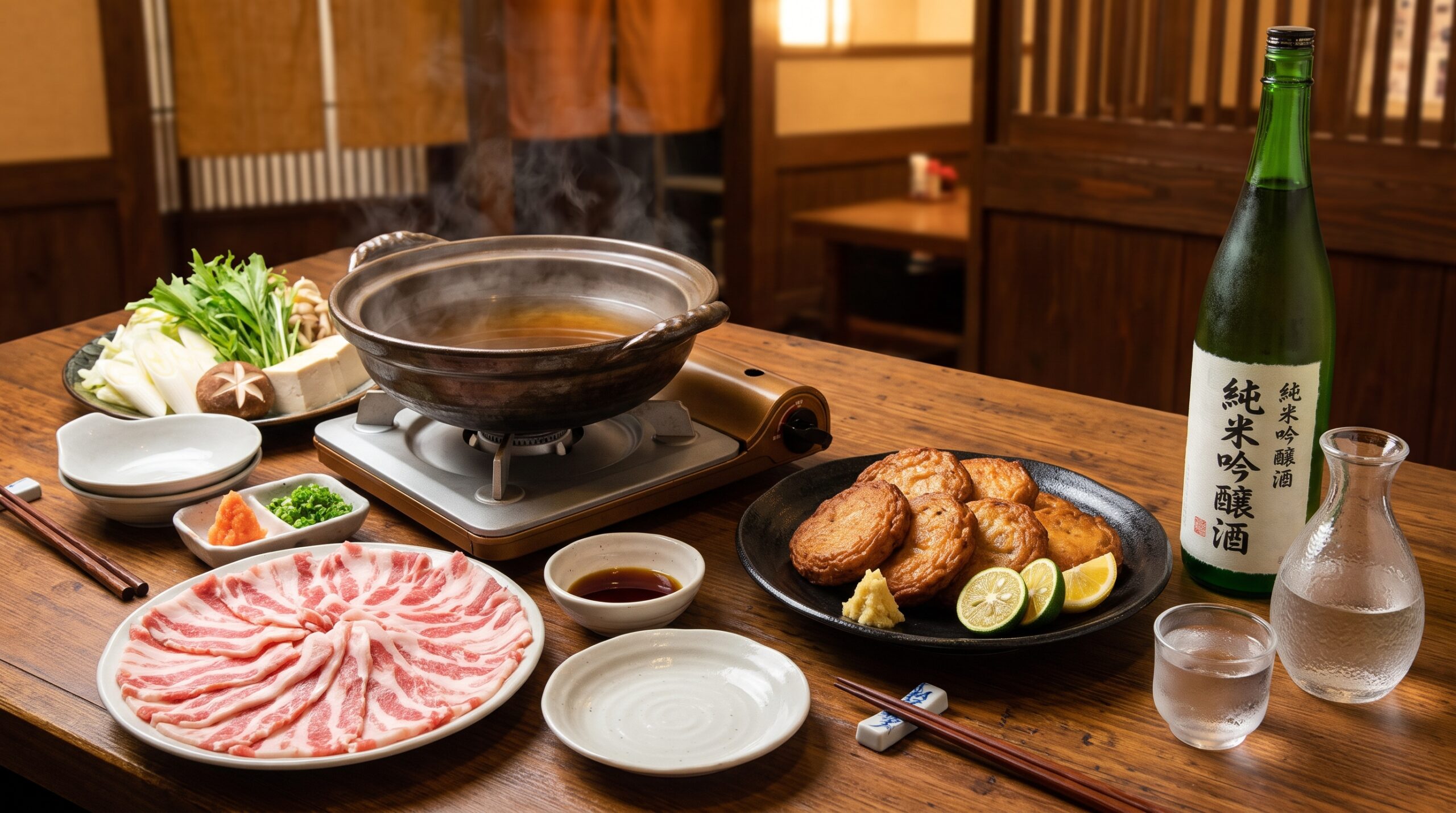
- Kuroton (Kagoshima black pork) shabu-shabu
Kagoshima black pork is the region’s signature brand of pork. The sweet fat and tender texture of thin slices briefly cooked in kombu dashi pair naturally with the clean sweetness of this junmai ginjo.
Recipe (in Japanese): Kurashiru, “Basic Pork Shabu-Shabu” (works the same way with Kagoshima black pork) - Satsuma-age (fried fish cake)
A local specialty made from ground fish paste. The umami of the fish paste and the toasted aroma of fresh frying echo the fragrant ginjo aroma of this junmai ginjo.
Recipe (in Japanese): Kurashiru, “Fluffy Homemade Satsuma-age with Mountain Yam”
A note on the science: the fat in pork is cut through by sake’s acidity and alcohol, keeping the aftertaste light. Umami compounds such as inosinic acid and glutamic acid in fish-paste dishes resonate with the fragrant aromatic compounds of a ginjo-style sake, extending the lingering impression of its aroma.
Visiting the Brewery
Satsuma Kinzan-gura (Hamada Shuzo)
13665 Noshita, Ichikikushikino City, Kagoshima Prefecture. About a 10-min drive from JR Kushikino Station; about 4 km / 6 min from Kushikino IC on the Minami-Kyushu Nishimawari Expressway via National Route 3.
The brewery offers a tour through the actual tunnels of the former Kushikino gold mine, including a small trolley ride through the mine shafts.
Sights Nearby
- Kangaku-en Garden / Ichikikushikino City (Kanmuridake area) | about 15 min / 6 km by car from the brewery
A Chinese-style garden at the foot of Mt. Kanmuri, the sacred mountain whose spring water is used to brew Sasshu Masamune. Free admission, open 9:00–17:00, closed Mondays and Dec. 29–31. Please confirm hours before visiting. - Denbee-gura (Hamada Shuzo’s main shochu brewery) / Ichikikushikino City (Minato-cho) | about 15 min / 7 km by car from the brewery
A shochu distillery run by the same company, Hamada Shuzo. Tours run twice daily (11:00 and 14:00), reservation required, ¥500 for adults. Shop open 9:00–17:00, closed Wednesdays. Advance phone booking is needed for the tour.
Hot Springs Nearby
- Ichiki Fureai Onsen Center / Ichikikushikino City (Minato-cho) | about 15 min / 7 km by car from the brewery
A city-run day-use hot spring facility. Open 7:00–22:00 (from 16:00 on the second Monday of the month), ¥350 for adults. No reservation needed for day bathing.
Opening hours, closing days and day-use bathing availability can change. Please check each facility’s official information before visiting.
A Quick Glossary of Sake Terms
- Junmai Ginjo: Junmai (sake made only from rice, rice koji, and water, with no added brewing alcohol) that has been polished to a seimai buai of 60% or less and fermented slowly at low temperatures, giving it a fragrant aroma.
- Seimai buai (rice-polishing ratio): The percentage of the original grain remaining after milling. The lower the number, the more the rice has been polished down.
Sources
- About Sasshu Masamune – Kinzan-gura (Hamada Shuzo official site)
- Sasshu Masamune Junmai Ginjo – Kinzan-gura (Hamada Shuzo official site)
- Company Profile – Hamada Shuzo Co., Ltd.
- Satsuma Kinzan-gura – Wikipedia (Japanese)
- Saigo Teruhiko – Wikipedia (Japanese)
- Kagoshima Ohara-bushi – Wikipedia (Japanese)
- Kangaku-en – Tabi-net Kagoshima (Kagoshima Prefecture tourism site)
- Ichiki Fureai Onsen Center – rurubu&more.
If you notice any errors in this article, please don’t hesitate to reach out at info@soundrecords.jp.
Keep reading in English
Sake and Kayokyoku
- Beyond the Glittering Tokyo, Three Hundred Years of Unchanging Water
- Two Brothers Relit a Brewery’s Dying Flame, Facing the Sea Wind
- Like a Flame That Never Goes Out, They Stayed True
Browse all articles in English
Read this article in Japanese: 黄金を掘った坑道が、こんどは酒を育てている