今日のペアリング
▶ 上のプレーヤーで再生できない場合は、YouTubeで開く
醸造所の話
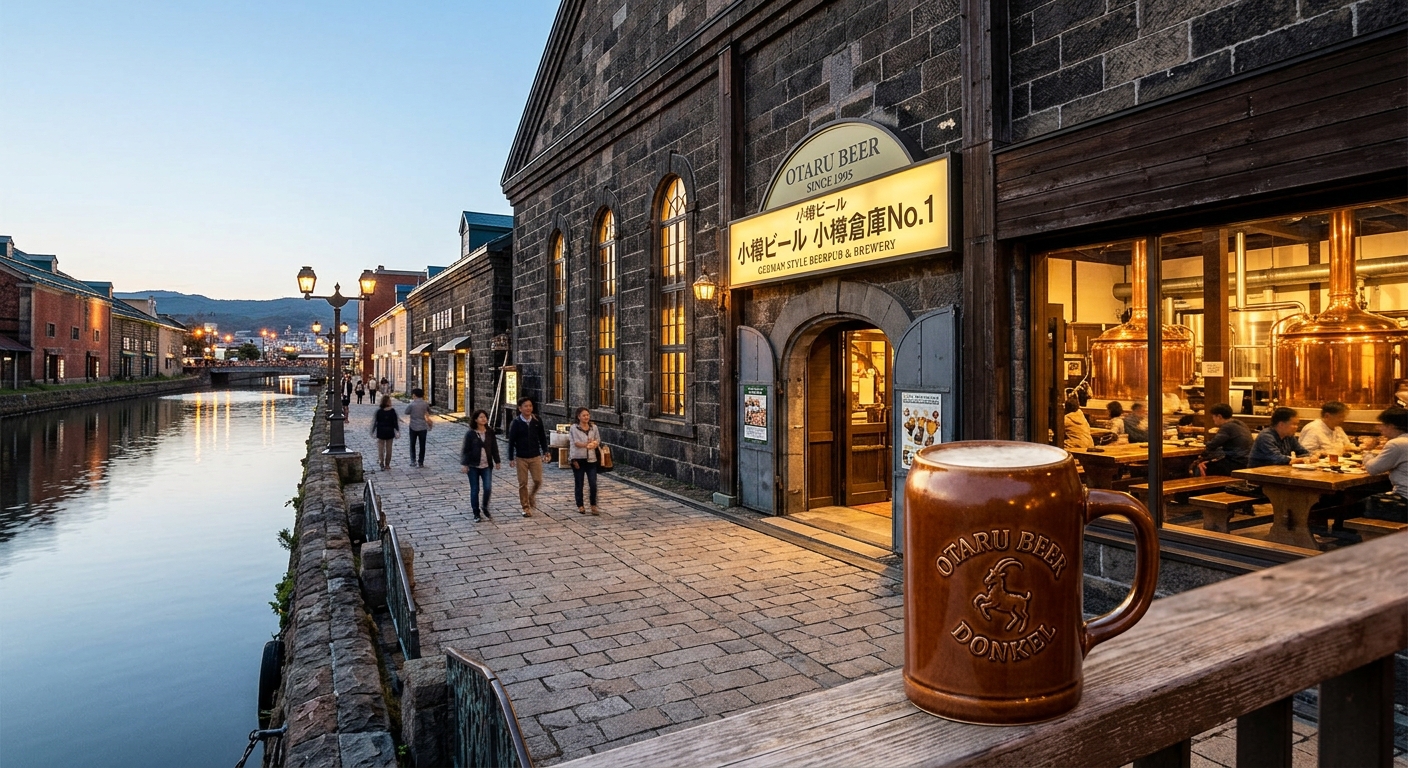
小樽ビールは1995年7月、小樽運河沿いに残る石造り倉庫の一つ「小樽倉庫No.1」を改装し、ドイツ風のビアパブとして始まりました。運営するのは札幌市に本社を置く株式会社アレフ。ハンバーグレストラン「びっくりドンキー」を全国に展開してきた企業で、創業者は庄司昭夫です。
製造を任されたのは、ドイツから招かれたヨハネス・ブラウン氏。ビール造りに1753年から携わってきた家系の出身で、ミュンヘンのビール醸造大学で5年間学んだのち、欧州各地の醸造所やスコットランドのウイスキー蒸留所でも経験を積みました。仕込みは1516年にドイツで定められたビール純粋令にならい、麦芽・ホップ・酵母・水の4つだけ。需要の拡大にあわせて1999年には銭函に第二の醸造拠点を新設し、場所選びから設備の設計までブラウン氏自身が手がけています。年間の生産能力は2,000キロリットル。ロシア(モスクワとサハリン)や台湾、香港、韓国、オーストラリアにも輸出されており、その量は生産量のおよそ8%です。
今回選んだ「ドンケル」は、カラメルモルトを主体に、麦汁の一部を煮出してから戻す「ダブルデコクション」というドイツ伝統の技法で仕込む、褐色のラガーです。ホップは主張を抑え、モルトの甘みと焙煎の香ばしさを前に出す造り。アルコール度数は5.2%です。
土地の話
小樽運河が完成したのは1923年(大正12年)。ところが1960年代のモータリゼーションで交通渋滞が深刻化すると、1966年には運河を埋め立てて道路を6車線に拡張する計画が持ち上がりました。周囲に立ち並ぶ倉庫群も、取り壊しの対象でした。これに対して1973年、市民が「小樽運河を守る会」を結成。1983年には約10万人の署名を集めた「小樽運河百人委員会」が発足し、北海道で最初の景観条例も生まれました。長い議論の末、当時の知事が示した折衷案は、運河の半分を埋め立てて道路にし、残り半分を散策路として残すというもの。1986年、ガス灯63基が並ぶ游歩道として整備が完了し、周囲の古い倉庫群は店舗や資料館、レストランへと生まれ変わりました。
小樽ビールが「小樽倉庫No.1」に店を構えたのは、それから約10年後の1995年。埋め立てられずに残った側の倉庫の一つで、いまもビールが仕込まれ続けています。
音楽の話
都はるみは1984年3月、人気の絶頂で「普通のおばさんになりたい」と歌手引退を宣言し、その年の紅白歌合戦出演を最後に一時活動を離れました。1987年に音楽プロデューサーとして活動を再開し、1989年の紅白歌合戦にゲスト出演したのち、1990年に歌手としての活動再開を発表します。その第一弾シングルが、1990年6月27日発売の「小樽運河」でした。作詞は吉岡治、作曲は弦哲也、編曲は桜庭伸幸、発売元は日本コロムビア。オリコン週間チャートには、自己最高位となる13位で初登場しています。
京都府京都市生まれの都はるみにとって、小樽は縁の深い土地というわけではありません。それでも、埋め立てを免れ、観光地としての顔を確立したばかりの運河の風景に、復帰第一作の題名を託しました。
なぜこの組み合わせなのか
どちらも、一度は失われかけたものが、形を変えて残った話です。小樽運河は道路に呑み込まれかけたところを、住民の声で半分だけ残されました。都はるみは「普通のおばさんになりたい」と一度は歌をやめ、6年の時を経てまた声を取り戻しました。すべてが元通りになったわけではありません。運河は半分になり、彼女の歌もかつてと同じ姿ではなくなりました。それでも、なくなりはしませんでした。
味の面でも通じるところがあります。ドンケルの焙煎香ばしさとカラメルの甘みは、取り壊しの淵に立った古い倉庫の、飴色に焼けた木材や煉瓦を思わせます。派手な主張はないけれど、じっくりと効いてくる味わいです。「小樽運河」の歌声もまた、若い頃の伸びやかさとは違う、重みを増した艶を帯びています。どちらも、時間を経てなお残ったものにしかない厚みを持っています。
この一杯を、探すなら
※楽天市場へのリンクは広告(アフィリエイト)です。醸造所がタップルームや直営店を持っている場合は、できたてを現地で味わうのが一番のおすすめです。
🌡️ おすすめの飲み方(温度とグラス):10〜12℃、一般的なラガーよりやや高めの温度で。冷やしすぎるとカラメルの香ばしさが閉じてしまいます。グラスは、褐色が映える厚手のマグや、香りを溜め込める丸みのあるタルグラスがおすすめです。
合わせたい「アテ」
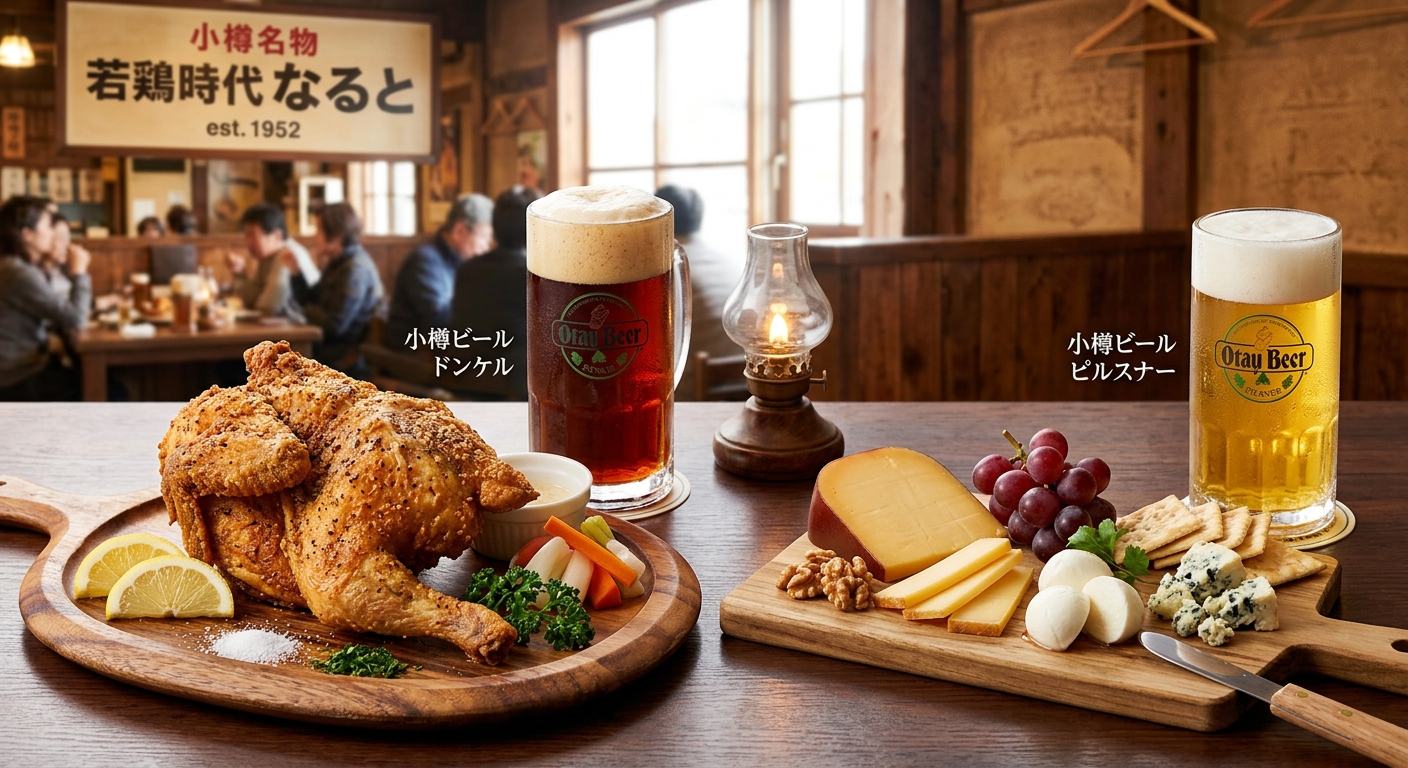
- 若鶏の半身揚げ
1952年創業の「若鶏時代なると」を発祥とする小樽の名物。にんにくと胡椒を効かせた衣の焦げ目が、ドンケルの焙煎香ばしさと同じ方向を向いています。
- 北海道産チーズ
セミハードタイプなど、乳脂肪と塩気のあるチーズと好相性。モルトの甘みと穏やかな苦みが、チーズのコクと絡み合います。
科学的にひとこと:半身揚げの衣に付く焼き色は、糖とアミノ酸が加熱で結びつく「メイラード反応」によるもので、麦芽を焙煎してドンケルに褐色と香ばしさを与えるのと同じ反応です。炭酸のガス圧は、揚げ物やチーズが口の中に残す脂の膜を洗い流し、次のひと口を軽くしてくれます。
この醸造所をたずねるなら
小樽ビール 小樽倉庫No.1(醸造所併設のビアパブ)
北海道小樽市港町5-5/JR「小樽駅」から徒歩約12分。
小樽運河沿いの石造倉庫で、店の中央の仕込み釜は現役。営業時間内は無料で自由見学できます(予約不要、約20分)。
近くの観光スポット
- 小樽運河/小樽市港町|醸造所の目の前
大正期の石造倉庫が並ぶ運河。散策路が整備され、夕方からはガス灯がともります。
- 堺町通り/小樽市堺町|醸造所から徒歩約10分
北一硝子や小樽オルゴール堂などが並ぶ、レトロな商店街。ガラス細工やスイーツの店が続きます。
近くの温泉
- 湯の花 手宮殿/小樽市手宮|醸造所から車で約7分・約2km
天然温泉の露天風呂やサウナがある日帰り温浴施設。小樽港を見下ろす高台にあります。
※営業時間・定休日・日帰り入浴の可否は変わることがあります。おでかけ前に各施設の公式情報をご確認ください。
ひとことメモ(ビールの用語)
- クラフトビール:小規模な醸造所が、造り手の個性を前面に出して仕込むビールの総称。大量生産の均一な味とは別の方向を目指しています。
- ラガー:低温で、酵母が下に沈みながら働く「下面発酵」で造るビール。すっきりと澄んだ切れ味になり、日本の大手ビールの多くがこの系統です。
- モルト:発芽させた大麦(麦芽)のこと。ビールの甘み・色・コクの土台になり、焙煎の深さで色と香ばしさが決まります。
- ホップ:ビールに苦みと香りを与えるつる性植物の毬花(まりばな)。品種によって、柑橘・トロピカルフルーツ・草原のように香りが変わります。
参考
内容に誤りがございましたら、お手数ですが info@soundrecords.jp までご連絡いただけますと幸いです。
Today’s Pairing
- Craft beer: Otaru Beer Dunkel — a dark lager built mainly on caramel malt, brewed with the traditional German double-decoction method, 5.2% ABV / Otaru Beer, operated by Alef Co., Ltd. (Minatomachi 5-4, Otaru, Hokkaido)
Official site: https://otarubeer.com/jp/
- Music: “Otaru Unga” (“Otaru Canal”) by Miyako Harumi (1990)
YouTube: https://www.youtube.com/watch?v=HjTnq9mKZ3k
▶ If the player above doesn’t play, open it on YouTube
The Story of the Brewery
Otaru Beer began in July 1995, when one of the stone warehouses still standing along the Otaru Canal — “Otaru Warehouse No. 1” — was converted into a German-style beer pub. It is run by Alef Co., Ltd., a Sapporo-based company known nationwide for its family-restaurant chain “Bikkuri Donkey.” Alef’s founder was Shoji Akio.
Brewing was entrusted to Johannes Braun, invited from Germany, whose family had been brewing beer since 1753. He studied for five years at a brewing university in Munich, then gained further experience at breweries across Europe and at a whisky distillery in Scotland. The beer is brewed according to Germany’s 1516 Reinheitsgebot (Beer Purity Law), using only malt, hops, yeast and water. As demand grew, a second brewing site opened in Zenibako in 1999 — Braun himself chose the location and designed the equipment. Annual production capacity there is 2,000 kiloliters. The beer is also exported to Russia (Moscow and Sakhalin), Taiwan, Hong Kong, South Korea and Australia, which together account for roughly 8% of production.
The Dunkel featured here is a dark lager built mainly on caramel malt and brewed using double decoction, a traditional German technique in which part of the wort is boiled separately and returned to the mash. The hops stay in the background, letting the malt’s sweetness and roasted character lead. ABV is 5.2%.
The Story of the Land
The Otaru Canal was completed in 1923. But as motorization brought serious traffic congestion in the 1960s, a 1966 plan proposed filling in the canal to widen the road to six lanes — which would have meant demolishing the warehouses around it too. In response, citizens formed the Otaru Canal Preservation Society in 1973, and by 1983 a “Committee of a Hundred” had gathered roughly 100,000 signatures; Hokkaido’s first landscape ordinance was born out of the debate. After years of argument, the prefectural governor’s compromise won out: half the canal would be filled for a road, and the other half preserved as a promenade. The work was completed in 1986, with 63 gas lamps lining the walkway, and the old warehouses around it were converted into shops, museums and restaurants.
Otaru Beer opened its doors at Warehouse No. 1 about a decade later, in 1995 — in one of the warehouses that had survived, on the side of the canal that was never filled in. Beer is still brewed there today.
The Story of the Song
In March 1984, at the height of her popularity, Miyako Harumi announced her retirement, saying she wanted to become “an ordinary woman,” and stepped away from performing after that year’s Kohaku Uta Gassen. She returned to work as a music producer in 1987, made a guest appearance at the 1989 Kohaku, and in 1990 announced she was resuming her career as a singer. Her first single back was “Otaru Unga,” released on June 27, 1990. It was written by Yoshioka Osamu, composed by Tsuru Tetsuya, arranged by Sakuraba Nobuyuki, and released on the Nippon Columbia label. It debuted on the Oricon weekly chart at No. 13 — reportedly her best-ever entry position.
Miyako Harumi was born in Kyoto, and Otaru is not a place she was deeply tied to. Even so, she gave her comeback single the name of a canal that had just narrowly escaped being filled in and had newly established itself as a tourist landmark.
Why This Pairing
Both are stories of something nearly lost that survived in a changed form. The Otaru Canal was almost swallowed by a road, and survived at half its original width because residents spoke up. Miyako Harumi once quit singing because she wanted to be “an ordinary woman,” and found her voice again six years later. Neither came back exactly as it was. The canal is half of what it used to be; her singing was no longer quite the same either. But neither one disappeared.
The flavors connect too. The roasted notes and caramel sweetness of the Dunkel recall the amber-toned wood and brick of old warehouses that once stood at the edge of demolition — nothing flashy, but something that works on you slowly. The voice on “Otaru Unga” carries a different kind of shine than her younger years, one with more weight to it. Both have a depth that only comes from having lasted this long.
Where to Find This Beer
The Rakuten Ichiba link below is an affiliate link.
These are Japanese storefronts. If you are visiting the brewery, drinking it fresh at their own taproom is by far the best option.
🌡️ How to serve it:10–12°C, a touch warmer than a typical lager — chill it too far and the caramel roastiness closes up. Pour into a heavy mug that shows off the dark color, or a rounded tulip-style glass that holds the aroma in.
Pairing Dishes Worth Trying
- Wakadori no hanshin-age (half-chicken fried in garlic and pepper)
An Otaru specialty said to have originated at “Wakadori Jidai Naruto,” open since 1952. The browned, garlic-pepper crust runs in the same direction as the Dunkel’s roasted character.
- Hokkaido cheese
Semi-hard cheeses in particular. The malt sweetness and gentle bitterness intertwine with the richness and salt of the cheese.
A note on the science: the browning on the fried chicken’s crust comes from the Maillard reaction, sugars and amino acids bonding under heat — the same reaction that gives roasted malt its color and toasty character in a Dunkel. Carbonation’s pressure then rinses away the film of fat that fried food or cheese leaves behind, keeping the next bite feeling just as light as the first.
Visiting the Brewery
Otaru Beer, Otaru Warehouse No.1 (brewpub with an on-site brewery)
5-5 Minatomachi, Otaru City, Hokkaido. About a 12-min walk from Otaru Station.
A stone warehouse on the Otaru Canal; the brew kettle in the middle of the hall is still in use. Free self-guided tours during opening hours (no reservation, about 20 min).
Sights Nearby
- Otaru Canal / Otaru City | right in front of the brewery
A canal lined with Taisho-era stone warehouses, with a walking path; gas lamps are lit from evening.
- Sakaimachi Street / Otaru City | ~10-min walk from the brewery
A retro shopping street with Kitaichi Glass, the Otaru Music Box Museum and a run of glasswork and sweet shops.
Hot Springs Nearby
- Yunohana Temiya-den / Otaru City | ~7 min, ~2 km by car from the brewery
A day-use bathhouse with open-air natural hot-spring baths and saunas, on a rise looking down over Otaru Harbour.
Opening hours, closing days and day-use bathing availability can change. Please check each facility’s official information before visiting.
A Quick Glossary of Beer Terms
- Craft beer: Beer made by small breweries that put the character of the maker front and centre, as opposed to the uniformity of mass production.
- Lager: Beer brewed by bottom fermentation, with the yeast working at low temperature and settling toward the bottom of the tank. It tends toward a clean, crisp finish, and most major Japanese beers belong to this family.
- Malt: Germinated barley. It forms the foundation of a beer’s sweetness, colour and body; how deeply it is roasted determines colour and toastiness.
- Hops: The cones of a climbing plant, which give beer its bitterness and aroma. Depending on the variety, that aroma can read as citrus, tropical fruit or open grassland.
Sources
If you notice any errors in this article, please don’t hesitate to reach out at info@soundrecords.jp.
コメントを残す