今日のペアリング
▶ 上のプレーヤーで再生できない場合は、YouTubeで開く
酒蔵の話
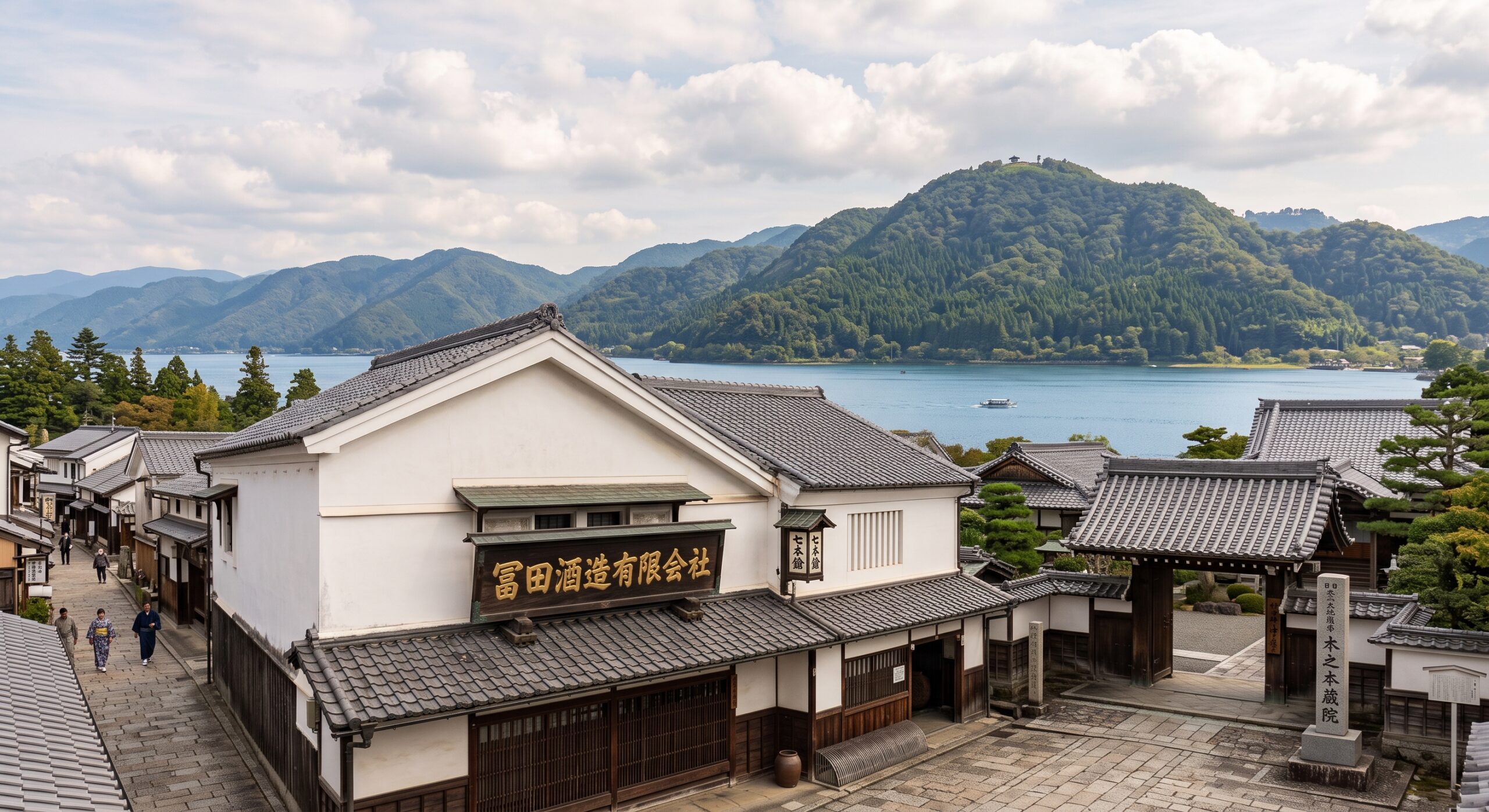
冨田酒造有限会社は、琵琶湖の最北端に近い旧北国街道の宿場町・木之本宿に蔵を構えます。創業は天文年間(1532〜1555年)の初め頃と伝わり、初代・高保が母方の縁を頼ってこの地に移り住み、武士の身分を離れて酒造りを始めたと伝えられています。銘柄「七本鎗」は、賤ヶ岳の戦い(1583年)で功をあげた七人の若武者「賤ヶ岳の七本槍」に由来し、大正期に蔵へ長く逗留した北大路魯山人が自ら彫った文字がラベルに使われています。
昭和後期、蔵は一時休業に近い窮地に陥りましたが、15代・冨田泰伸氏の母がこれを支え、平成に入って泰伸氏が後を継ぎました。2002年に蔵入りした泰伸氏は、それまで能登杜氏を招いて仕込んでいた体制を改め、蔵元自身が醸造も手がける体制へと転換します。蔵が掲げるのは「地の道をゆく、地の道をひらく」という理念。伝統を”残さなければならないもの”としてではなく”残したいと思えるもの”として、湖北の風土をそのまま酒に映すことを目指しています。
今回合わせる「七本鎗 低精白純米」は、その理念が最もはっきり表れた一本です。使用米は滋賀県産の酒造好適米「玉栄」。日本酒の多くは、雑味のもとになる糠(ぬか)の部分を大きく削り落として仕込まれますが、この酒はあえて玄米の80%までしか磨きません。精米歩合を上げすぎない代わりに、米という穀物が本来持つ骨太な旨みとコクを、そのまま酒に閉じ込めているのです。アルコール度数は15度。派手さより輪郭を重んじる、冨田酒造らしい一本です。
土地の話
木之本宿は、北陸と近江を結ぶ北国街道と、琵琶湖東岸を通る北国脇往還が合流する要衝として栄えた宿場町です。冨田酒造の蔵はこの旧街道沿いに今も残る白漆喰の町家群の一角にあり、蔵のすぐそばには「木之本地蔵院」(浄信寺)が建っています。日本三大地蔵の一つとされる地蔵菩薩を本尊とし、”目の仏様”として古くから旅人の信仰を集めてきました。街道を行き交う人々がこの地蔵に道中の無事を祈り、その足で酒を買い求めていった――そんな宿場町の記憶が、今も蔵の立地そのものに刻まれています。
蔵から車を少し走らせれば、琵琶湖の最北端に張り出す賤ヶ岳、そしてその北に広がる余呉湖にたどり着きます。琵琶湖と余呉湖という大小二つの湖に挟まれたこの土地は、古くから水運と街道の両方が交わる場所として、湖国・近江の物流と信仰を支えてきました。
音楽の話
「琵琶湖周航の歌」の始まりは、1917年(大正6年)6月28日にさかのぼります。旧制第三高等学校(現・京都大学)のボート部員たちが琵琶湖を漕ぎ巡る合宿の途上、部員のひとり・小口太郎が作った詞を、当時流行していた「ひつじぐさ」(吉田千秋作曲)のメロディに乗せて歌ったのが始まりとされています。現在歌われている6番までの歌詞は、翌1918年の夏までに完成したと伝わります。学生たちが仲間内で口ずさんでいたこの歌は、誰かが大きく手を加えることもないまま、以来60組以上の歌手にカバーされながら歌い継がれてきました。
中でも大きな転機となったのが、1971年、加藤登紀子が自身のアルバム『日本哀歌集』の中でこの歌を取り上げたことです。レコードは70万枚の大ヒットとなり、学生たちのボート部の歌だった一曲を、全国に知られる歌へと押し上げました。加藤登紀子は1943年、旧満州国ハルビン生まれ。東京大学在学中の1965年に日本アマチュアシャンソンコンクールで優勝し、翌1966年にレコードデビューした歌手で、「知床旅情」「百万本のバラ」などのヒット曲でも知られています。旧満州で生まれ育ち、これといった”ふるさと”を持たなかった加藤登紀子は、父が滋賀に縁があったことから、琵琶湖を歌ったこの曲を自らの”ふるさとの歌”と語っています。
なぜこの組み合わせなのか
「七本鎗 低精白純米」は、米を大きく削らず、玄米が本来持つ骨太な旨みをそのまま残す酒です。派手に磨き上げるのではなく、素材の姿をそのまま活かす――冨田酒造が掲げる「地の道をゆく」という理念そのものが、この一本には表れています。
「琵琶湖周航の歌」もまた、誰かが大きく手を加えることなく、100年以上前に学生たちが口にした歌の姿のまま歌い継がれてきた一曲です。加藤登紀子は、生まれた土地ではなく、父の縁を通じて出会ったこの琵琶湖の歌に、自らの”ふるさと”を見出しました。
削りすぎない酒と、磨き直されなかった歌。ともに、与えられたものの姿をそのまま受け入れることで、遠く離れた場所や時代にまで届いてきた物語です。木之本の蔵で生まれるこの一杯を傾けながら、琵琶湖を渡っていったこの歌に、耳を澄ませてみてください。
この一本を、探すなら
※楽天市場へのリンクは広告(アフィリエイト)です。在庫・取扱いは変動します。お近くの酒販店でも、ぜひ銘柄名を伝えて探してみてください。
🌡️ おすすめの飲み方:常温、またはぬる燗で。米の骨太な旨みと酸がふくらみ、低精白ならではの輪郭のある味わいが引き立ちます。
合わせたい「アテ」
- 鮒寿司
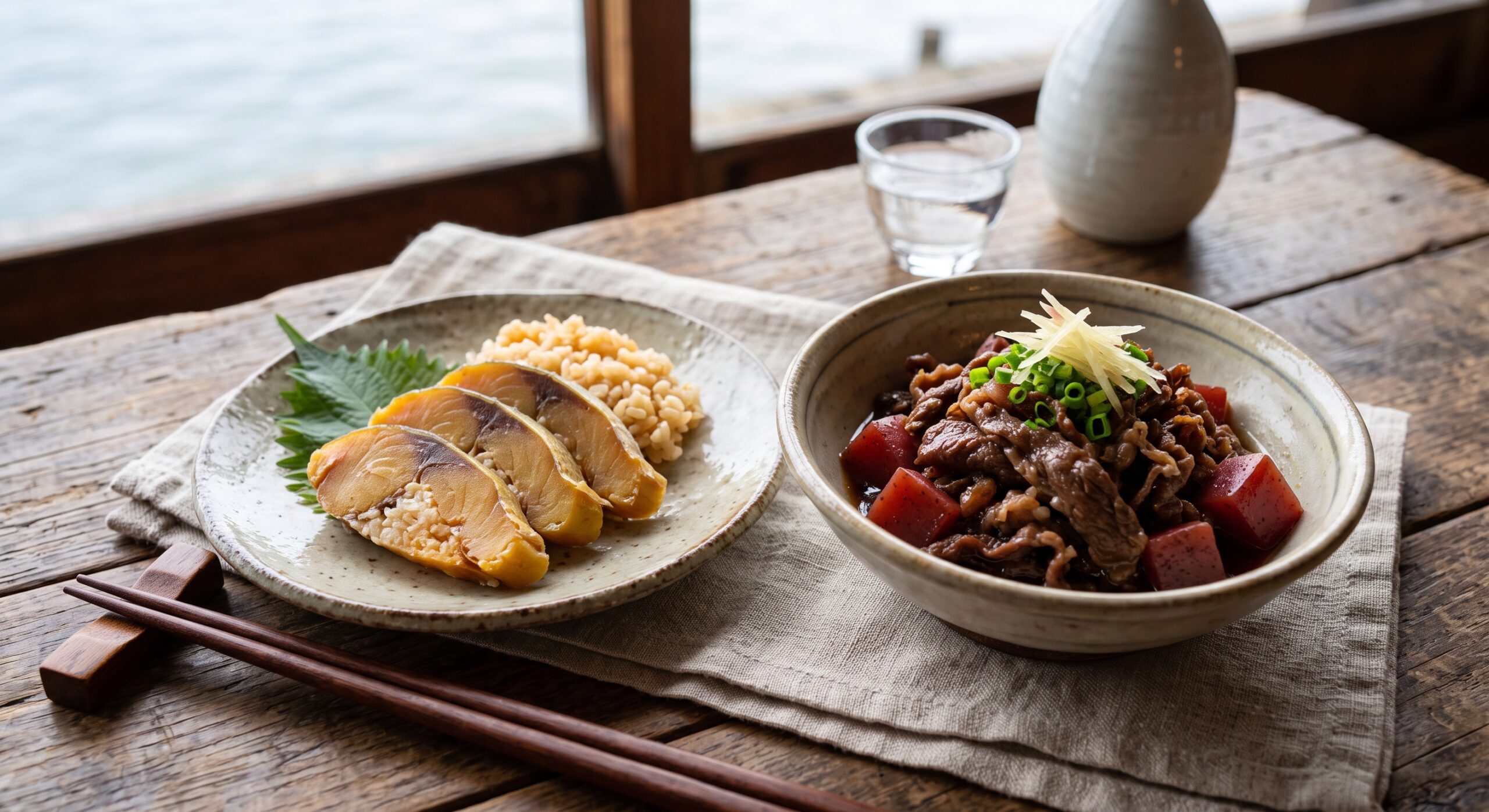
琵琶湖でとれるニゴロブナを塩と米で長期間発酵させた、滋賀を代表するなれずし。奈良時代の木簡にも記録が残り、現在のすし文化の源流の一つとされる発酵食品です。強い酸味と凝縮した旨味を持ち、骨太な酸を備えたこの酒とまっすぐに向き合います。
- 近江牛のしぐれ煮
近江牛と、同じく滋賀の名産である赤こんにゃくを甘辛く炊き合わせた、ご飯がすすむ一品。低精白純米の酸とキレが、牛肉の脂をすっきりと洗い流してくれます。
レシピはこちら:クックパッド「発見!食遺産」公式アカウント「近江牛しぐれ煮」
科学的にひとこと:鮒寿司の乳酸発酵によって生まれる強い酸味とうま味成分(グルタミン酸・イノシン酸)は、精米を抑えて仕込んだこの酒が持つ骨太な酸・旨味と、真正面から重なり合います。近江牛のしぐれ煮のように脂の多い料理には、低精白純米ならではの酸とキレが脂を洗い流し、後味を軽くしてくれます。
この蔵をたずねるなら
冨田酒造(滋賀県長浜市木之本町木之本1107)
JR木ノ本駅から徒歩約7分、北陸自動車道 木之本ICから車で約5分。旧北国街道沿いの宿場町・木之本宿にあり、蔵の見学は行っていません(外観と、すぐ隣の木之本地蔵院の参拝を楽しむ形になります)。
近くの観光スポット
- 木之本地蔵院(浄信寺)/長浜市木之本町|冨田酒造から徒歩約5分
日本三大地蔵の一つとされる地蔵菩薩を本尊とし、”目の仏様”として旅人の信仰を集めてきた古刹。境内は拝観無料(地蔵堂下の戒壇巡りのみ300円)。拝観時間は8:00〜17:00頃ですが、訪問前にご確認ください。
- 賤ヶ岳リフト・賤ヶ岳古戦場/長浜市木之本町|冨田酒造から車で約5分
リフトで山頂まで上がると、琵琶湖と余呉湖の両方を見渡せる、賤ヶ岳の戦いの古戦場跡。営業期間は例年4月中旬〜11月頃で、冬季は運休します。訪問前に営業状況をご確認ください。
- 余呉湖/長浜市余呉町|冨田酒造から車で約12分・約5.6km
羽衣伝説が伝わる、周囲約6kmの静かな湖。琵琶湖とはまた違う、山あいの湖ならではの景色が広がります。
※営業時間・定休日は変わることがあります。おでかけ前に各施設の公式情報をご確認ください。
ひとことメモ(日本酒の用語)
- 純米酒:米・米麹・水だけで造られ、醸造アルコールを添加していない日本酒。米の旨みをまっすぐ感じられるのが特徴です。
- 精米歩合:玄米を削り、残った部分の割合。数値が低いほど、米を多く磨いていることを示します。
参考
内容に誤りがございましたら、お手数ですが info@soundrecords.jp までご連絡いただけますと幸いです。
Today’s Pairing
- Sake: Shichihonyari Low-Polish Junmai — brewed with Shiga-grown Tamasakae sake rice, rice-polishing ratio (seimai buai) 80%, 15% alcohol / Tomita Shuzo Co., Ltd. (1107 Kinomoto, Kinomoto-cho, Nagahama City, Shiga Prefecture)
Official site: https://7yari.co.jp/
- Kayoukyoku (classic Japanese popular song): “Biwako Shuko no Uta” (“Song of Sailing Round Lake Biwa”) by Tokiko Kato, 1971
YouTube: https://www.youtube.com/watch?v=NmOJC7RfKPU
▶ If the player above doesn’t play, open it on YouTube
The Story of the Brewery
Tomita Shuzo Co., Ltd. is based in Kinomoto-juku, an old post town on the Hokkoku Kaido road near the northern tip of Lake Biwa. The brewery is said to have been founded in the early Tenmon era (1532–1555), when its first-generation founder, Takayasu, moved to Kinomoto relying on his mother’s family connections and left his samurai status behind to become a sake brewer. The brand name Shichihonyari (“Seven Spears”) comes from the “Seven Spears of Shizugatake,” seven young warriors who distinguished themselves at the Battle of Shizugatake (1583); the characters on the label were carved by the artist Rosanjin Kitaoji, who stayed at the brewery for an extended period in the Taisho era.
In the late Showa era the brewery came close to a hiatus, a crisis that was carried through by the mother of Tomita Yasunobu, the 15th-generation owner, until Yasunobu himself took over in the Heisei era. After joining the brewery in 2002, he moved away from the previous arrangement of hiring a Noto toji (a brewmaster from the Noto region) and shifted to a structure in which the owner himself also brews the sake. The brewery’s guiding idea is “walking the local path, opening the local path” — treating tradition not as something that “must be preserved,” but as something “one wants to keep,” so that the character of the Kohoku region comes through directly in the sake itself.
The bottle in this pairing, Shichihonyari Low-Polish Junmai, is where that philosophy shows most clearly. It’s brewed with Tamasakae, a sake-rice variety grown in Shiga. Most sake is made by polishing away a large portion of the rice grain’s outer layer, which is a source of off-flavors, but this sake is deliberately polished to only 80% of the original grain — a seimai buai of 80%. Rather than polishing the rice down further, the brewery keeps the grain’s inherent, full-bodied umami and depth intact in the finished sake. It comes in at 15% alcohol: a bottle that values a clear, solid backbone over showiness, very much in keeping with Tomita Shuzo’s approach.
The Story of the Land
Kinomoto-juku prospered as a post town where the Hokkoku Kaido, connecting the Hokuriku region to Omi (present-day Shiga), met the Hokkoku Wakiokan road running along the eastern shore of Lake Biwa. Tomita Shuzo’s brewery still stands today among the row of white-plastered old townhouses along that former highway, and just next door is Kinomoto Jizo-in (Joshin-ji Temple). Its principal image, a statue of the bodhisattva Jizo said to be one of Japan’s three great Jizo images, has long been revered by travelers as “the Jizo of the eyes.” Travelers passing along the highway would pray here for a safe journey and then go on to buy sake — a memory of the old post town that’s still written into the brewery’s very location.
A short drive from the brewery brings you to Mt. Shizugatake, which juts out toward the northern tip of Lake Biwa, and beyond it to Lake Yogo. Sitting between these two lakes, one large and one small, this area has long been a crossing point for both water transport and overland roads, supporting the trade and faith of the Omi region for centuries.
The Story of the Song
“Biwako Shuko no Uta” traces back to June 28, 1917. During a rowing trip around Lake Biwa, members of the boat club at the Third Higher School (now Kyoto University) are said to have first sung it, setting lyrics written by club member Oguchi Taro to the melody of a popular song of the day, “Hitsujigusa” (composed by Yoshida Chiaki). The full lyrics, running to six verses as sung today, are said to have been completed by the summer of 1918. This song, first hummed among a group of students, has been passed down and covered by more than 60 different singers since, without anyone significantly rewriting it.
The major turning point came in 1971, when Tokiko Kato included the song on her album “Nihon Aika-shu” (“Collection of Japanese Elegies”). The record became a major hit, selling 700,000 copies, and lifted a song that had belonged to a university boat club into one known across the whole country. Kato was born in 1943 in Harbin, in what was then Manchuria; while a student at the University of Tokyo, she won the Japan Amateur Chanson Competition in 1965 and made her record debut the following year, later becoming known for hits including “Shiretoko Ryojo” and “Hyakuman-bon no Bara” (“A Million Roses”). Having grown up in Manchuria with no single place she could call a hometown, Kato has said that this song about Lake Biwa — tied to her through her father’s connection to Shiga — became her own “hometown song.”
Why This Pairing
Shichihonyari Low-Polish Junmai is a sake that doesn’t polish away much of the rice at all, keeping the grain’s naturally full-bodied umami intact. Rather than polishing something up into something showier, it lets the material keep its own form — and that’s exactly the idea behind Tomita Shuzo’s guiding principle of “walking the local path.”
“Biwako Shuko no Uta,” too, has been carried down for more than a hundred years in essentially the same form the students first sang it in, without anyone significantly reworking it. Tokiko Kato found her own sense of “hometown” not in the place she was born, but in this song about Lake Biwa, which she came to know through her father’s ties to the region.
A sake that isn’t polished too far, and a song that was never polished up. Both are stories that reached distant places and later eras precisely by staying true to the form they were given. As you raise a glass of this sake, brewed in Kinomoto, take a moment to listen to the song that made its own way across Lake Biwa.
Where to Find This Bottle
The Rakuten Ichiba link below is an affiliate link.
Note: the links above lead to Japan-based retailers. They’re most convenient for readers in Japan, or for those elsewhere who are able to arrange international shipping. Stock and availability change over time, so if you’re near a specialty sake shop, it’s well worth asking for this label by name.
🌡️ Recommended way to drink it: At room temperature, or gently warmed (nurukan). Either brings out the rice’s full-bodied umami and acidity, and the clear backbone that comes from this sake’s low-polish brewing.
Pairing Dishes Worth Trying
- Funa-zushi
A fermented dish (narezushi) representative of Shiga, made by salting and fermenting nigorobuna, a crucian carp caught in Lake Biwa, with rice over a long period. Records of it appear on wooden tablets from the Nara period, and it’s considered one of the roots of Japan’s sushi culture. Its strong acidity and concentrated umami stand up directly to this sake’s own full-bodied acidity.
- Omi beef shigure-ni
Omi beef simmered sweet-and-savory together with red konnyaku, another Shiga specialty — a dish that goes straight through a bowl of rice. The acidity and clean finish (kire) of this low-polish junmai cut cleanly through the richness of the beef fat.
Recipe (in Japanese): Cookpad, “Discovery! Food Heritage” official account, “Omi Beef Shigure-ni”
A note on the science: the strong acidity and umami compounds (glutamic acid and inosinic acid) produced by funa-zushi’s lactic fermentation meet this sake’s own full-bodied acidity and umami head-on, since it too is brewed from rice that hasn’t been polished down very far. With a rich dish like Omi beef shigure-ni, the acidity and clean finish of a low-polish junmai wash through the fat and keep the aftertaste light.
Visiting the Brewery
Tomita Shuzo (1107 Kinomoto, Kinomoto-cho, Nagahama City, Shiga)
About a 7-min walk from JR Kinomoto Station; about 5 min by car from Kinomoto IC on the Hokuriku Expressway. The brewery sits along the old Hokkoku Kaido post road in the town of Kinomoto-juku. The brewery itself is not open for tours, but the townscape and the neighboring temple are worth a visit.
Sights Nearby
- Kinomoto Jizo-in (Joshin-ji Temple) / Nagahama City | about a 5-min walk from Tomita Shuzo
An old temple whose principal image, a statue of the bodhisattva Jizo, is said to be one of Japan’s three great Jizo images, long revered by travelers as “the Jizo of the eyes.” The grounds are free to enter (a separate 300-yen fee applies to walk the dark passage beneath the Jizo hall). Visiting hours are roughly 8:00–17:00; please check ahead of your visit.
- Shizugatake Lift and the Shizugatake battlefield / Nagahama City | about a 5-min drive from Tomita Shuzo
A chairlift carries visitors to the summit, with views over both Lake Biwa and Lake Yogo from the site of the Battle of Shizugatake. The lift usually operates from mid-April through around November and is closed in winter; please check current operating status before visiting.
- Lake Yogo / Nagahama City | about a 12-min drive (~5.6 km) from Tomita Shuzo
A quiet lake about 6 km around, tied to a local celestial-robe legend, offering mountain-lake scenery quite different from Lake Biwa itself.
Opening hours and closing days can change. Please check each facility’s official information before visiting.
A Quick Glossary of Sake Terms
- Junmai: Sake made only from rice, rice koji, and water, with no added brewing alcohol, allowing the umami of the rice to come through directly.
- Seimai buai (rice-polishing ratio): The percentage of the original grain remaining after milling. The lower the number, the more the rice has been polished down; this sake is deliberately polished only lightly, to 80%.
Sources
If you notice any errors in this article, please don’t hesitate to reach out at info@soundrecords.jp.
コメントを残す